 Add to Chrome
 Add to Firefox
 Add to Edge
High Dynamic Range Imaging Based on an Asymmetric Event-SVE Camera System
Feb 28, 2026
High dynamic range (HDR) imaging under extreme illumination remains challenging for conventional cameras due to overexposure. Event cameras provide microsecond temporal resolution and high dynamic range, while spatially varying exposure (SVE) sensors offer single-shot radiometric diversity.We present a hardware--algorithm co-designed HDR imaging system that tightly integrates an SVE micro-attenuation camera with an event sensor in an asymmetric dual-modality configuration. To handle non-coaxial geometry and heterogeneous optics, we develop a two-stage cross-modal alignment framework that combines feature-guided coarse homography estimation with a multi-scale refinement module based on spatial pooling and frequency-domain filtering. On top of aligned representations, we develop a cross-modal HDR reconstruction network with convolutional fusion, mutual-information regularization, and a learnable fusion loss that adaptively balances intensity cues and event-derived structural constraints. Comprehensive experiments on both synthetic benchmarks and real captures demonstrate that the proposed system consistently improves highlight recovery, edge fidelity, and robustness compared with frame-only or event-only HDR pipelines. The results indicate that jointly optimizing optical design, cross-modal alignment, and computational fusion provides an effective foundation for reliable HDR perception in highly dynamic and radiometrically challenging environments.

A DMD-Based Adaptive Modulation Method for High Dynamic Range Imaging in High-Glare Environments
Feb 13, 2026Background The accuracy of photomechanics measurements critically relies on image quality,particularly under extreme illumination conditions such as welding arc monitoring and polished metallic surface analysis. High dynamic range (HDR) imaging above 120 dB is essential in these contexts. Conventional CCD/CMOS sensors, with dynamic ranges typically below 70 dB, are highly susceptible to saturation under glare, resulting in irreversible loss of detail and significant errors in digital image correlation (DIC). Methods This paper presents an HDR imaging system that leverages the spatial modulation capability of a digital micromirror device (DMD). The system architecture enables autonomous regional segmentation and adaptive exposure control for high-dynamic-range scenes through an integrated framework comprising two synergistic subsystems: a DMD-based optical modulation unit and an adaptive computational imaging pipeline. Results The system achieves a measurable dynamic range of 127 dB, effectively eliminating satu ration artifacts under high glare. Experimental results demonstrate a 78% reduction in strain error and improved DIC positioning accuracy, confirming reliable performance across extreme intensity variations. Conclusion The DMD-based system provides high fidelity adaptive HDR imaging, overcoming key limitations of conventional sensors. It exhibits strong potential for optical metrology and stress analysis in high-glare environments where traditional methods are inadequate.
A Hardware-Algorithm Co-Designed Framework for HDR Imaging and Dehazing in Extreme Rocket Launch Environments
Jan 13, 2026Quantitative optical measurement of critical mechanical parameters -- such as plume flow fields, shock wave structures, and nozzle oscillations -- during rocket launch faces severe challenges due to extreme imaging conditions. Intense combustion creates dense particulate haze and luminance variations exceeding 120 dB, degrading image data and undermining subsequent photogrammetric and velocimetric analyses. To address these issues, we propose a hardware-algorithm co-design framework that combines a custom Spatially Varying Exposure (SVE) sensor with a physics-aware dehazing algorithm. The SVE sensor acquires multi-exposure data in a single shot, enabling robust haze assessment without relying on idealized atmospheric models. Our approach dynamically estimates haze density, performs region-adaptive illumination optimization, and applies multi-scale entropy-constrained fusion to effectively separate haze from scene radiance. Validated on real launch imagery and controlled experiments, the framework demonstrates superior performance in recovering physically accurate visual information of the plume and engine region. This offers a reliable image basis for extracting key mechanical parameters, including particle velocity, flow instability frequency, and structural vibration, thereby supporting precise quantitative analysis in extreme aerospace environments.
Event-based high temporal resolution measurement of shock wave motion field
Dec 27, 2025Accurate measurement of shock wave motion parameters with high spatiotemporal resolution is essential for applications such as power field testing and damage assessment. However, significant challenges are posed by the fast, uneven propagation of shock waves and unstable testing conditions. To address these challenges, a novel framework is proposed that utilizes multiple event cameras to estimate the asymmetry of shock waves, leveraging its high-speed and high-dynamic range capabilities. Initially, a polar coordinate system is established, which encodes events to reveal shock wave propagation patterns, with adaptive region-of-interest (ROI) extraction through event offset calculations. Subsequently, shock wave front events are extracted using iterative slope analysis, exploiting the continuity of velocity changes. Finally, the geometric model of events and shock wave motion parameters is derived according to event-based optical imaging model, along with the 3D reconstruction model. Through the above process, multi-angle shock wave measurement, motion field reconstruction, and explosive equivalence inversion are achieved. The results of the speed measurement are compared with those of the pressure sensors and the empirical formula, revealing a maximum error of 5.20% and a minimum error of 0.06%. The experimental results demonstrate that our method achieves high-precision measurement of the shock wave motion field with both high spatial and temporal resolution, representing significant progress.
Flexible Camera Calibration using a Collimator System
Dec 18, 2025Camera calibration is a crucial step in photogrammetry and 3D vision applications. This paper introduces a novel camera calibration method using a designed collimator system. Our collimator system provides a reliable and controllable calibration environment for the camera. Exploiting the unique optical geometry property of our collimator system, we introduce an angle invariance constraint and further prove that the relative motion between the calibration target and camera conforms to a spherical motion model. This constraint reduces the original 6DOF relative motion between target and camera to a 3DOF pure rotation motion. Using spherical motion constraint, a closed-form linear solver for multiple images and a minimal solver for two images are proposed for camera calibration. Furthermore, we propose a single collimator image calibration algorithm based on the angle invariance constraint. This algorithm eliminates the requirement for camera motion, providing a novel solution for flexible and fast calibration. The performance of our method is evaluated in both synthetic and real-world experiments, which verify the feasibility of calibration using the collimator system and demonstrate that our method is superior to existing baseline methods. Demo code is available at https://github.com/LiangSK98/CollimatorCalibration
Learning Affine Correspondences by Integrating Geometric Constraints
Apr 10, 2025
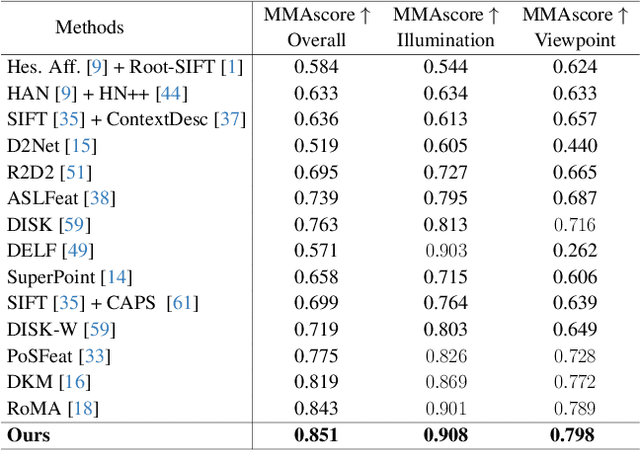
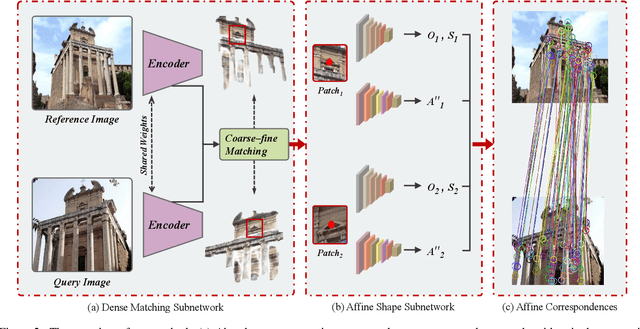

Affine correspondences have received significant attention due to their benefits in tasks like image matching and pose estimation. Existing methods for extracting affine correspondences still have many limitations in terms of performance; thus, exploring a new paradigm is crucial. In this paper, we present a new pipeline designed for extracting accurate affine correspondences by integrating dense matching and geometric constraints. Specifically, a novel extraction framework is introduced, with the aid of dense matching and a novel keypoint scale and orientation estimator. For this purpose, we propose loss functions based on geometric constraints, which can effectively improve accuracy by supervising neural networks to learn feature geometry. The experimental show that the accuracy and robustness of our method outperform the existing ones in image matching tasks. To further demonstrate the effectiveness of the proposed method, we applied it to relative pose estimation. Affine correspondences extracted by our method lead to more accurate poses than the baselines on a range of real-world datasets. The code is available at https://github.com/stilcrad/DenseAffine.
Stereo Event-based, 6-DOF Pose Tracking for Uncooperative Spacecraft
Mar 17, 2025Pose tracking of uncooperative spacecraft is an essential technology for space exploration and on-orbit servicing, which remains an open problem. Event cameras possess numerous advantages, such as high dynamic range, high temporal resolution, and low power consumption. These attributes hold the promise of overcoming challenges encountered by conventional cameras, including motion blur and extreme illumination, among others. To address the standard on-orbit observation missions, we propose a line-based pose tracking method for uncooperative spacecraft utilizing a stereo event camera. To begin with, we estimate the wireframe model of uncooperative spacecraft, leveraging the spatio-temporal consistency of stereo event streams for line-based reconstruction. Then, we develop an effective strategy to establish correspondences between events and projected lines of uncooperative spacecraft. Using these correspondences, we formulate the pose tracking as a continuous optimization process over 6-DOF motion parameters, achieved by minimizing event-line distances. Moreover, we construct a stereo event-based uncooperative spacecraft motion dataset, encompassing both simulated and real events. The proposed method is quantitatively evaluated through experiments conducted on our self-collected dataset, demonstrating an improvement in terms of effectiveness and accuracy over competing methods. The code will be open-sourced at https://github.com/Zibin6/SE6PT.
Camera Calibration using a Collimator System
Sep 30, 2024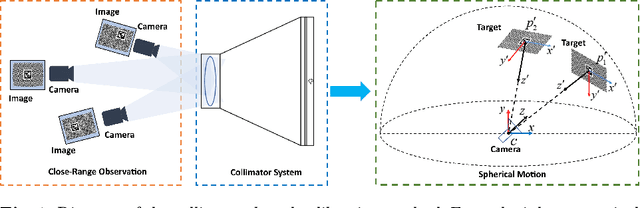
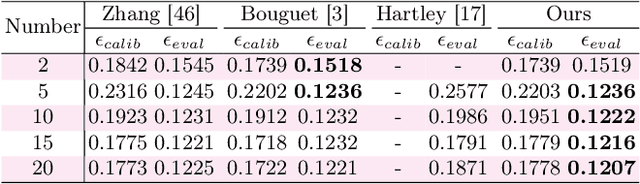
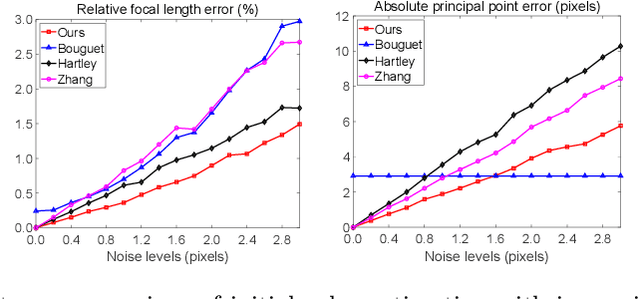
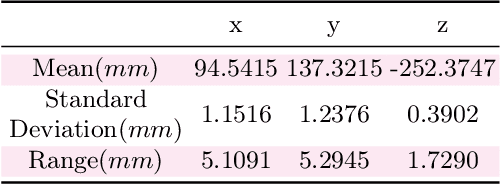
Camera calibration is a crucial step in photogrammetry and 3D vision applications. In practical scenarios with a long working distance to cover a wide area, target-based calibration methods become complicated and inflexible due to site limitations. This paper introduces a novel camera calibration method using a collimator system, which can provide a reliable and controllable calibration environment for cameras with varying working distances. Based on the optical geometry of the collimator system, we prove that the relative motion between the target and camera conforms to the spherical motion model, reducing the original 6DOF relative motion to 3DOF pure rotation motion. Furthermore, a closed-form solver for multiple views and a minimal solver for two views are proposed for camera calibration. The performance of our method is evaluated in both synthetic and real-world experiments, which verify the feasibility of calibration using the collimator system and demonstrate that our method is superior to the state-of-the-art methods. Demo code is available at https://github.com/LiangSK98/CollimatorCalibration.