 Add to Chrome
 Add to Firefox
 Add to Edge
The Llama 4 Herd: Architecture, Training, Evaluation, and Deployment Notes
Jan 15, 2026
This document consolidates publicly reported technical details about Metas Llama 4 model family. It summarizes (i) released variants (Scout and Maverick) and the broader herd context including the previewed Behemoth teacher model, (ii) architectural characteristics beyond a high-level MoE description covering routed/shared-expert structure, early-fusion multimodality, and long-context design elements reported for Scout (iRoPE and length generalization strategies), (iii) training disclosures spanning pre-training, mid-training for long-context extension, and post-training methodology (lightweight SFT, online RL, and lightweight DPO) as described in release materials, (iv) developer-reported benchmark results for both base and instruction-tuned checkpoints, and (v) practical deployment constraints observed across major serving environments, including provider-specific context limits and quantization packaging. The manuscript also summarizes licensing obligations relevant to redistribution and derivative naming, and reviews publicly described safeguards and evaluation practices. The goal is to provide a compact technical reference for researchers and practitioners who need precise, source-backed facts about Llama 4.

CRAG-MM: Multi-modal Multi-turn Comprehensive RAG Benchmark
Oct 30, 2025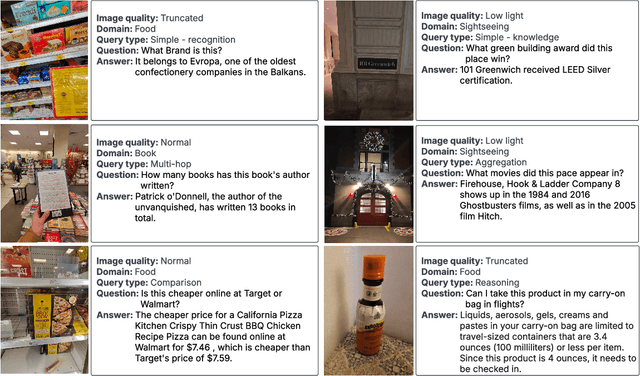
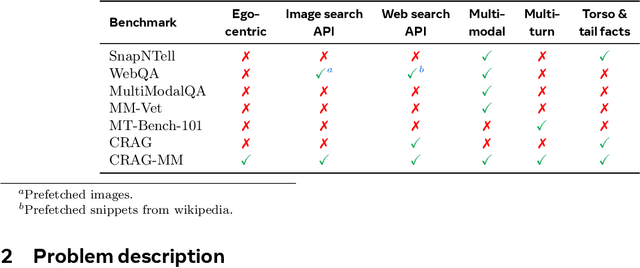
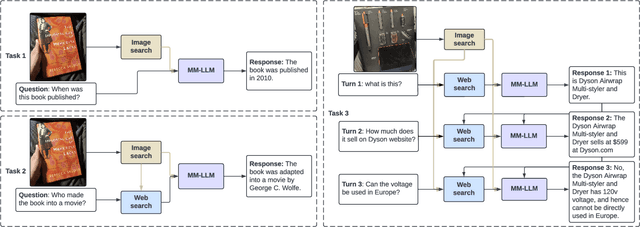
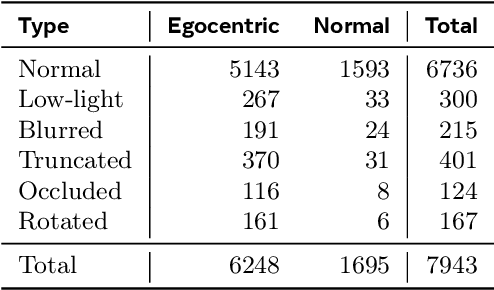
Wearable devices such as smart glasses are transforming the way people interact with their surroundings, enabling users to seek information regarding entities in their view. Multi-Modal Retrieval-Augmented Generation (MM-RAG) plays a key role in supporting such questions, yet there is still no comprehensive benchmark for this task, especially regarding wearables scenarios. To fill this gap, we present CRAG-MM -- a Comprehensive RAG benchmark for Multi-modal Multi-turn conversations. CRAG-MM contains a diverse set of 6.5K (image, question, answer) triplets and 2K visual-based multi-turn conversations across 13 domains, including 6.2K egocentric images designed to mimic captures from wearable devices. We carefully constructed the questions to reflect real-world scenarios and challenges, including five types of image-quality issues, six question types, varying entity popularity, differing information dynamism, and different conversation turns. We design three tasks: single-source augmentation, multi-source augmentation, and multi-turn conversations -- each paired with an associated retrieval corpus and APIs for both image-KG retrieval and webpage retrieval. Our evaluation shows that straightforward RAG approaches achieve only 32% and 43% truthfulness on CRAG-MM single- and multi-turn QA, respectively, whereas state-of-the-art industry solutions have similar quality (32%/45%), underscoring ample room for improvement. The benchmark has hosted KDD Cup 2025, attracting about 1K participants and 5K submissions, with winning solutions improving baseline performance by 28%, highlighting its early impact on advancing the field.
Adaptive Implicit-Based Deep Learning Channel Estimation for 6G Communications
May 23, 2025With the widespread deployment of fifth-generation (5G) wireless networks, research on sixth-generation (6G) technology is gaining momentum. Artificial Intelligence (AI) is anticipated to play a significant role in 6G, particularly through integration with the physical layer for tasks such as channel estimation. Considering resource limitations in real systems, the AI algorithm should be designed to have the ability to balance the accuracy and resource consumption according to the scenarios dynamically. However, conventional explicit multilayer-stacked Deep Learning (DL) models struggle to adapt due to their heavy reliance on the structure of deep neural networks. This article proposes an adaptive Implicit-layer DL Channel Estimation Network (ICENet) with a lightweight framework for vehicle-to-everything communications. This novel approach balances computational complexity and channel estimation accuracy by dynamically adjusting computational resources based on input data conditions, such as channel quality. Unlike explicit multilayer-stacked DL-based channel estimation models, ICENet offers a flexible framework, where specific requirements can be achieved by adaptively changing the number of iterations of the iterative layer. Meanwhile, ICENet requires less memory while maintaining high performance. The article concludes by highlighting open research challenges and promising future research directions.