 Add to Chrome
 Add to Firefox
 Add to Edge
Which Tool Response Should I Trust? Tool-Expertise-Aware Chest X-ray Agent with Multimodal Agentic Learning
Feb 25, 2026
AI agents with tool-use capabilities show promise for integrating the domain expertise of various tools. In the medical field, however, tools are usually AI models that are inherently error-prone and can produce contradictory responses. Existing research on medical agents lacks sufficient understanding of the tools' realistic reliability and thus cannot effectively resolve tool conflicts. To address this gap, this paper introduces a framework that enables an agent to interact with tools and empirically learn their practical trustworthiness across different types of multimodal queries via agentic learning. As a concrete instantiation, we focus on chest X-ray analysis and present a tool-expertise-aware chest X-ray agent (TEA-CXA). When tool outputs disagree, the agent experimentally accepts or rejects multimodal tool results, receives rewards, and learns which tool to trust for each query type. Importantly, TEA-CXA extends existing codebases for reinforcement learning with multi-turn tool-calling that focus on textual inputs, to support multimodal contexts effectively. In addition, we enhance the codebase for medical use scenarios by supporting multiple tool calls in one turn, parallel tool inference, and multi-image accommodation within a single user query. Our code framework is applicable to general medical research on multi-turn tool-calling reinforcement learning in multimodal settings. Experiments show that TEA-CXA outperforms the state-of-the-art methods and a comprehensive set of baselines. Code will be released.

Forgetting-Resistant and Lesion-Aware Source-Free Domain Adaptive Fundus Image Analysis with Vision-Language Model
Feb 23, 2026Source-free domain adaptation (SFDA) aims to adapt a model trained in the source domain to perform well in the target domain, with only unlabeled target domain data and the source model. Taking into account that conventional SFDA methods are inevitably error-prone under domain shift, recently greater attention has been directed to SFDA assisted with off-the-shelf foundation models, e.g., vision-language (ViL) models. However, existing works of leveraging ViL models for SFDA confront two issues: (i) Although mutual information is exploited to consider the joint distribution between the predictions of ViL model and the target model, we argue that the forgetting of some superior predictions of the target model still occurs, as indicated by the decline of the accuracies of certain classes during adaptation; (ii) Prior research disregards the rich, fine-grained knowledge embedded in the ViL model, which offers detailed grounding for fundus image diagnosis. In this paper, we introduce a novel forgetting-resistant and lesion-aware (FRLA) method for SFDA of fundus image diagnosis with ViL model. Specifically, a forgetting-resistant adaptation module explicitly preserves the confident predictions of the target model, and a lesion-aware adaptation module yields patch-wise predictions from ViL model and employs them to help the target model be aware of the lesion areas and leverage the ViL model's fine-grained knowledge. Extensive experiments show that our method not only significantly outperforms the vision-language model, but also achieves consistent improvements over the state-of-the-art methods. Our code will be released.
Leveraging Segment Anything Model for Source-Free Domain Adaptation via Dual Feature Guided Auto-Prompting
May 14, 2025Source-free domain adaptation (SFDA) for segmentation aims at adapting a model trained in the source domain to perform well in the target domain with only the source model and unlabeled target data.Inspired by the recent success of Segment Anything Model (SAM) which exhibits the generality of segmenting images of various modalities and in different domains given human-annotated prompts like bounding boxes or points, we for the first time explore the potentials of Segment Anything Model for SFDA via automatedly finding an accurate bounding box prompt. We find that the bounding boxes directly generated with existing SFDA approaches are defective due to the domain gap.To tackle this issue, we propose a novel Dual Feature Guided (DFG) auto-prompting approach to search for the box prompt. Specifically, the source model is first trained in a feature aggregation phase, which not only preliminarily adapts the source model to the target domain but also builds a feature distribution well-prepared for box prompt search. In the second phase, based on two feature distribution observations, we gradually expand the box prompt with the guidance of the target model feature and the SAM feature to handle the class-wise clustered target features and the class-wise dispersed target features, respectively. To remove the potentially enlarged false positive regions caused by the over-confident prediction of the target model, the refined pseudo-labels produced by SAM are further postprocessed based on connectivity analysis. Experiments on 3D and 2D datasets indicate that our approach yields superior performance compared to conventional methods. Code is available at https://github.com/xmed-lab/DFG.
Context-Aware Pseudo-Label Refinement for Source-Free Domain Adaptive Fundus Image Segmentation
Aug 15, 2023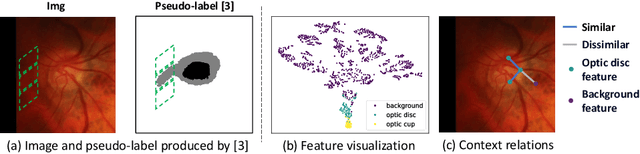
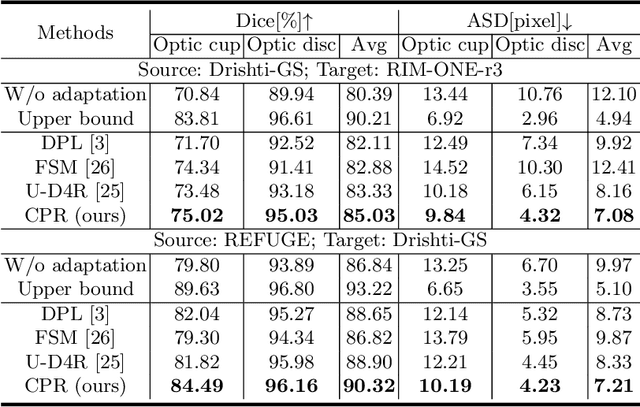
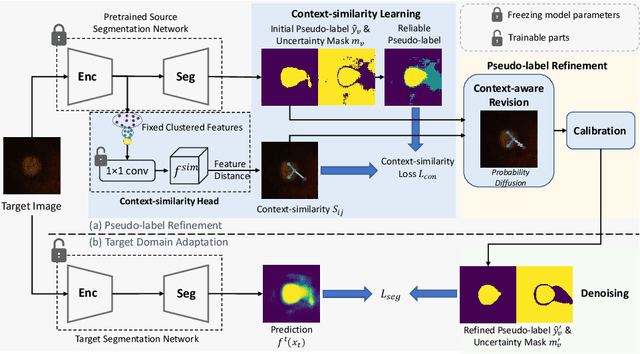
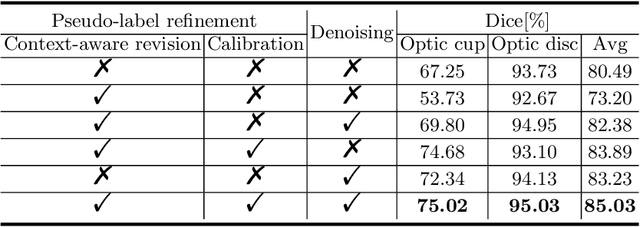
In the domain adaptation problem, source data may be unavailable to the target client side due to privacy or intellectual property issues. Source-free unsupervised domain adaptation (SF-UDA) aims at adapting a model trained on the source side to align the target distribution with only the source model and unlabeled target data. The source model usually produces noisy and context-inconsistent pseudo-labels on the target domain, i.e., neighbouring regions that have a similar visual appearance are annotated with different pseudo-labels. This observation motivates us to refine pseudo-labels with context relations. Another observation is that features of the same class tend to form a cluster despite the domain gap, which implies context relations can be readily calculated from feature distances. To this end, we propose a context-aware pseudo-label refinement method for SF-UDA. Specifically, a context-similarity learning module is developed to learn context relations. Next, pseudo-label revision is designed utilizing the learned context relations. Further, we propose calibrating the revised pseudo-labels to compensate for wrong revision caused by inaccurate context relations. Additionally, we adopt a pixel-level and class-level denoising scheme to select reliable pseudo-labels for domain adaptation. Experiments on cross-domain fundus images indicate that our approach yields the state-of-the-art results. Code is available at https://github.com/xmed-lab/CPR.