 Add to Chrome
 Add to Firefox
 Add to Edge
KV-Skill: Forging Expertise in the Model's Native Language
Aug 05, 2026
Task knowledge is commonly stored either as text in the prompt or as an update to model weights. Text is modular but must be interpreted on every use, while weight adaptation makes the resulting capability difficult to load, remove, or share independently. We introduce KV-Skill, a design space of external factorized operators that a frozen language model reads through a lightweight interface. KV-Skill supports two complementary paths. Registration converts an authored text skill into a text-derived operator and trains a shared per-backbone interface. Reward learning develops a compact latent operator directly from task outcomes, with or without an authored skill. Neither path adds positions to the prompt. Across ten benchmarks and four backbones from three model families, converting text to a KV-Skill consistently makes the same procedural knowledge more effective. On Qwen3.5-4B LiveMath, registration reaches 77.2 accuracy, compared with 23.4 for the source text skill, 52.0 for SkillOpt, and 64.5 for SoftSkill. Under matched reward training and parameter budgets, KV-Skill gives the best result in seven of eight matched settings against soft prefixes, prefix tuning, and LoRA. A post-hoc rank analysis further shows that text-derived operators retain nearly all of their benefit with one task-aligned direction per injection layer, while matched random directions fail. Finally, one shared interface retains three independently loadable KV-Skills without measurable forgetting. These results show that task knowledge can be acquired from text or experience, compressed into an external operator, and deployed separately from the backbone. Code is available at: https://github.com/shawnzhg/KV-Skill

Counterfactual Regret Minimization for Anti-jamming Game of Frequency Agile Radar
Feb 21, 2022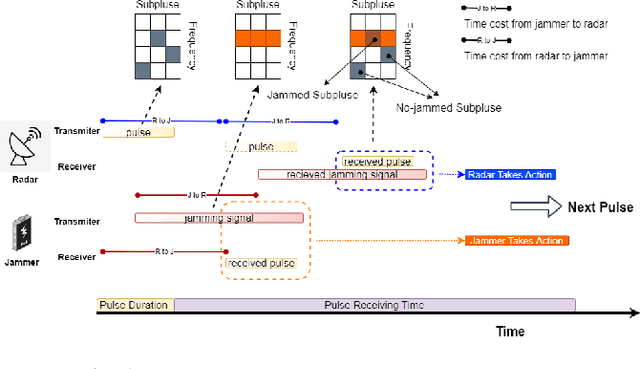
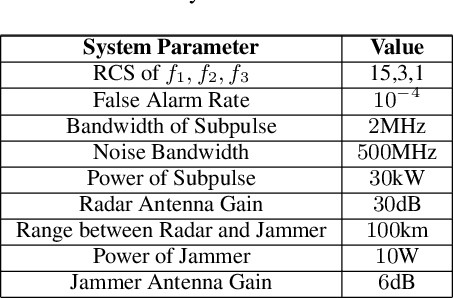
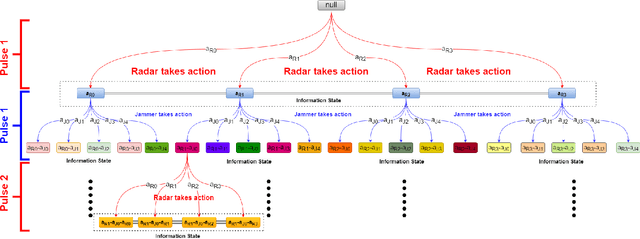
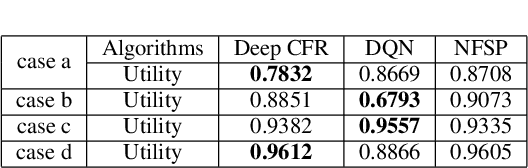
The competition between radar and jammer is one emerging issue in modern electronic warfare, which in principle can be viewed as a non-cooperative game with two players. In this work, the competition between a frequency agile (FA) radar and a noise-modulated jammer is considered. As modern FA radar adopts coherent processing with several pulses, the competition is hence in a multiple-round way where each pulse can be modeled as one round interaction between the radar and jammer. To capture such multiple-round property as well as imperfect information inside the game, i.e., radar and jammer are unable to know the upcoming signal, we propose an extensive-form game formulation for such competition. Since the number of game information states grows exponentially with respect to number of pulses, finding Nash Equilibrium (NE) strategies may be a computationally intractable task. To effectively solve the game, a learning-based algorithm called deep Counterfactual Regret Minimization (CFR) is utilized. Numerical simulations demonstrates the effectiveness of deep CFR algorithm for approximately finding NE and obtaining the best response strategy.