 Add to Chrome
 Add to Firefox
 Add to Edge
PIT-SUN: A Deployable Empirical Marginal Transform Framework with Expectation-Consistent Recovery for Regression in Recommender Systems
Jul 09, 2026
Estimating original-space conditional expectations is central to value-driven recommender systems, including dwell time, GMV, and LTV forecasting. Standard MSE is expectation-consistent in principle, but its gradients become unstable on heavy-tailed, zero-inflated, and multimodal targets, causing mean collapse and tail shrinkage. Target transformation alleviates this scale conflict, yet any useful nonlinear marginal transform loses expectation consistency under direct inversion. This is not an implementation oversight: a direct inverse-transform estimator is universally expectation-consistent only when the inverse transform is affine, which cannot simultaneously provide bounded tail compression. Existing conditionally linear recovery methods restore expectation consistency, but still leave open which coordinate, inverse lookup, recovery base, and deployment monitor should be selected for sparse complex marginals. We propose \textbf{P}robability-\textbf{I}ntegral-\textbf{TranS}formed \textbf{Un}biased recovery (\textbf{PIT-SUN}), a deployable empirical marginal recovery framework. PIT-SUN uses one empirical marginal table to define a bounded normal-score coordinate, its inverse-quantile lookup, a variance-controlled recovery base, and drift monitoring, then applies multiplicative SUN recovery to estimate the original-space expectation instead of directly inverting transformed predictions. Experiments on synthetic distributions, public benchmarks, large-scale industrial datasets, and online deployment show robust improvements in point accuracy, calibration, and ranking quality with lightweight deployment overhead.

Suppression of $^{14}\mathrm{C}$ photon hits in large liquid scintillator detectors via spatiotemporal deep learning
Mar 29, 2026Liquid scintillator detectors are widely used in neutrino experiments due to their low energy threshold and high energy resolution. Despite the tiny abundance of $^{14}$C in LS, the photons induced by the $β$ decay of the $^{14}$C isotope inevitably contaminate the signal, degrading the energy resolution. In this work, we propose three models to tag $^{14}$C photon hits in $e^+$ events with $^{14}$C pile-up, thereby suppressing its impact on the energy resolution at the hit level: a gated spatiotemporal graph neural network and two Transformer-based models with scalar and vector charge encoding. For a simulation dataset in which each event contains one $^{14}$C and one $e^+$ with kinetic energy below 5 MeV, the models achieve $^{14}$C recall rates of 25%-48% while maintaining $e^+$ to $^{14}$C misidentification below 1%, leading to a large improvement in the resolution of total charge for events where $e^+$ and $^{14}$C photon hits strongly overlap in space and time.
Bench4Merge: A Comprehensive Benchmark for Merging in Realistic Dense Traffic with Micro-Interactive Vehicles
Oct 21, 2024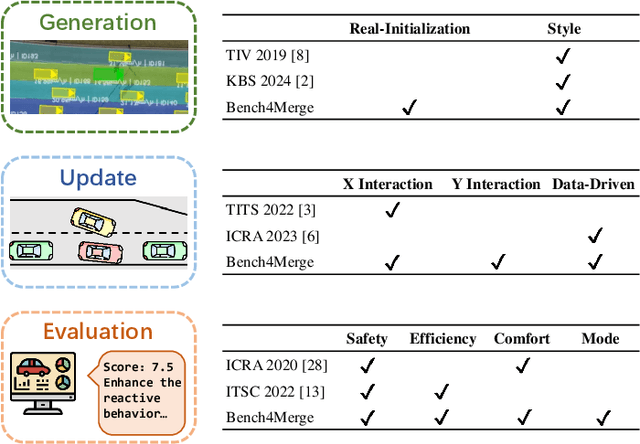

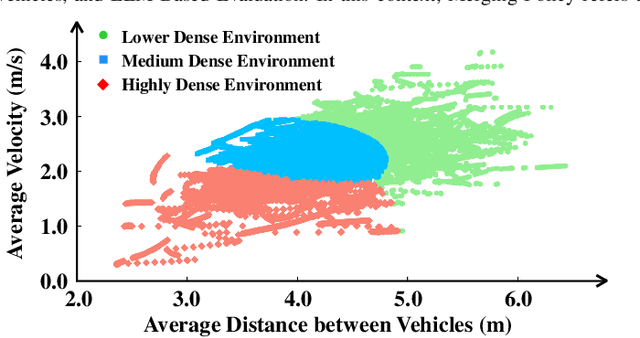
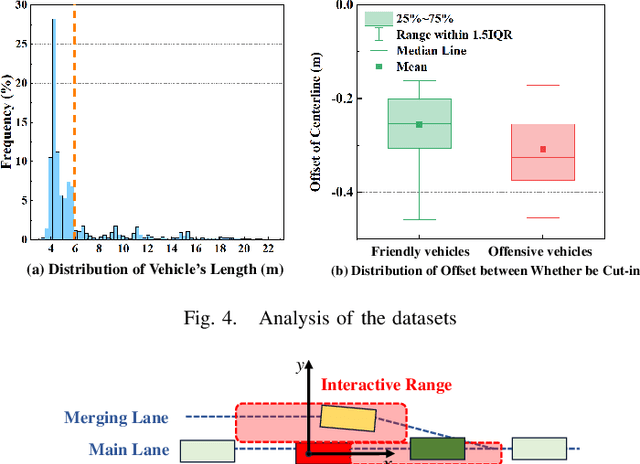
While the capabilities of autonomous driving have advanced rapidly, merging into dense traffic remains a significant challenge, many motion planning methods for this scenario have been proposed but it is hard to evaluate them. Most existing closed-loop simulators rely on rule-based controls for other vehicles, which results in a lack of diversity and randomness, thus failing to accurately assess the motion planning capabilities in highly interactive scenarios. Moreover, traditional evaluation metrics are insufficient for comprehensively evaluating the performance of merging in dense traffic. In response, we proposed a closed-loop evaluation benchmark for assessing motion planning capabilities in merging scenarios. Our approach involves other vehicles trained in large scale datasets with micro-behavioral characteristics that significantly enhance the complexity and diversity. Additionally, we have restructured the evaluation mechanism by leveraging large language models to assess each autonomous vehicle merging onto the main road. Extensive experiments have demonstrated the advanced nature of this evaluation benchmark. Through this benchmark, we have obtained an evaluation of existing methods and identified common issues. The environment and vehicle motion planning models we have designed can be accessed at https://anonymous.4open.science/r/Bench4Merge-EB5D