 Add to Chrome
 Add to Firefox
 Add to Edge
MARGIN: Margin-Aware Regularized Geometry for Imbalanced Vulnerability Detection
May 11, 2026
Software vulnerability detection is critical for ensuring software security and reliability. Despite recent advances in deep learning, real-world vulnerability datasets suffer from two severe challenges: frequency imbalance and difficulty imbalance. We reinterpret these challenges from an embedding geometry perspective, observing that such imbalances induce geometric distortions in hyperspherical representation space. To address this issue, we propose MARGIN, a metric-based framework that learns discriminative vulnerability representations through adaptive margin metric learning and hyperspherical prototype modeling. MARGIN dynamically adjusts geometric regularization according to the distribution structure estimated by the von Mises-Fisher concentration, aligning the probability mass of embedding distributions with their corresponding Voronoi cells, thereby reducing geometric distortion and yielding more stable decision boundaries. Extensive experiments on public vulnerability datasets show that MARGIN consistently outperforms strong baselines, achieving notable improvements in classification and detection, especially on challenging, imbalanced datasets. Further analysis demonstrates that MARGIN produces more structured embedding geometries, improving robustness, interpretability, and generalization.

Suppression of $^{14}\mathrm{C}$ photon hits in large liquid scintillator detectors via spatiotemporal deep learning
Mar 29, 2026Liquid scintillator detectors are widely used in neutrino experiments due to their low energy threshold and high energy resolution. Despite the tiny abundance of $^{14}$C in LS, the photons induced by the $β$ decay of the $^{14}$C isotope inevitably contaminate the signal, degrading the energy resolution. In this work, we propose three models to tag $^{14}$C photon hits in $e^+$ events with $^{14}$C pile-up, thereby suppressing its impact on the energy resolution at the hit level: a gated spatiotemporal graph neural network and two Transformer-based models with scalar and vector charge encoding. For a simulation dataset in which each event contains one $^{14}$C and one $e^+$ with kinetic energy below 5 MeV, the models achieve $^{14}$C recall rates of 25%-48% while maintaining $e^+$ to $^{14}$C misidentification below 1%, leading to a large improvement in the resolution of total charge for events where $e^+$ and $^{14}$C photon hits strongly overlap in space and time.
Automatic Semantic Content Removal by Learning to Neglect
Jul 20, 2018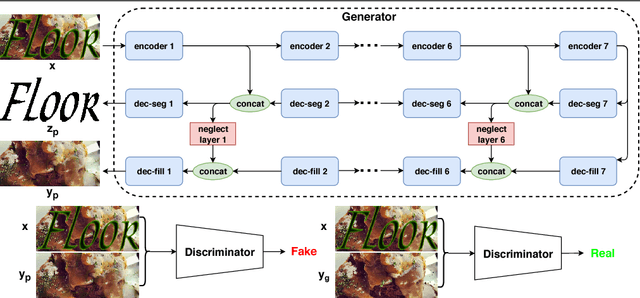
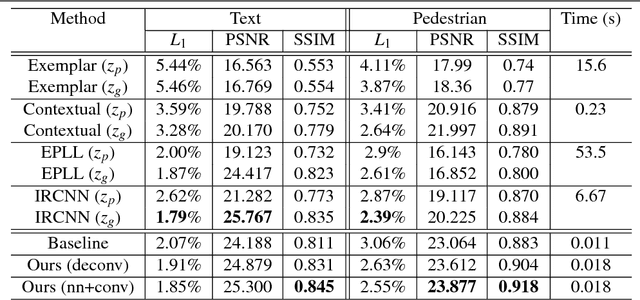
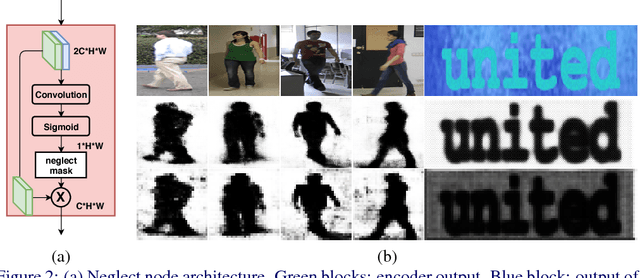
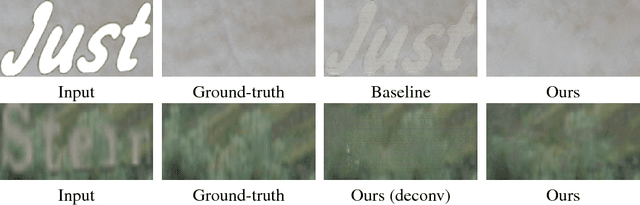
We introduce a new system for automatic image content removal and inpainting. Unlike traditional inpainting algorithms, which require advance knowledge of the region to be filled in, our system automatically detects the area to be removed and infilled. Region segmentation and inpainting are performed jointly in a single pass. In this way, potential segmentation errors are more naturally alleviated by the inpainting module. The system is implemented as an encoder-decoder architecture, with two decoder branches, one tasked with segmentation of the foreground region, the other with inpainting. The encoder and the two decoder branches are linked via neglect nodes, which guide the inpainting process in selecting which areas need reconstruction. The whole model is trained using a conditional GAN strategy. Comparative experiments show that our algorithm outperforms state-of-the-art inpainting techniques (which, unlike our system, do not segment the input image and thus must be aided by an external segmentation module.)