 Add to Chrome
 Add to Firefox
 Add to Edge
AutoPass: Evidence-Guided LLM Agents for Compiler Performance Tuning
Jun 18, 2026
Large Language Models (LLMs) show promise for code compilation tasks, but applying them to runtime performance tuning is difficult due to complex microarchitectural effects and noisy runtime measurements. We present AutoPass, a multi-agent framework for compiler performance tuning that uses compiler and runtime evidence to guide LLM-generated optimization decisions. Rather than treating the compiler as a black box like prior auto-tuning schemes, AutoPass opens up the compiler to the LLM, enabling it to query compiler-internal optimization states and analyze the intermediate representation to orchestrate compiler options. The search process iteratively refines optimization configurations using measured runtime feedback to diagnose regressions and guide latency-improving edits. AutoPass operates in an inference-only, training-free setting and requires no offline training or task-specific fine-tuning, making it readily applicable to new benchmarks and platforms. We implement AutoPass on the LLVM compiler and evaluate it on server-grade x86-64 and embedded ARM64 systems. AutoPass outperforms expert-tuned heuristics and classical autotuning methods, achieving geometric-mean speedups of 1.043x and 1.117x over LLVM -O3 on x86-64 and ARM64, respectively.

Stealthy Voice Eavesdropping with Acoustic Metamaterials: Unraveling a New Privacy Threat
Jan 25, 2025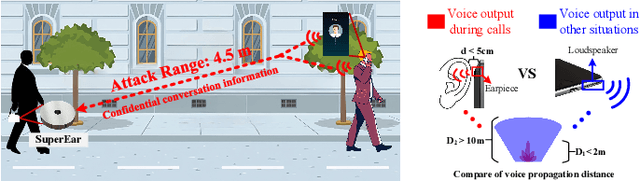
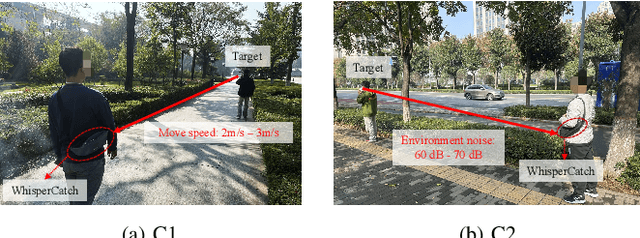
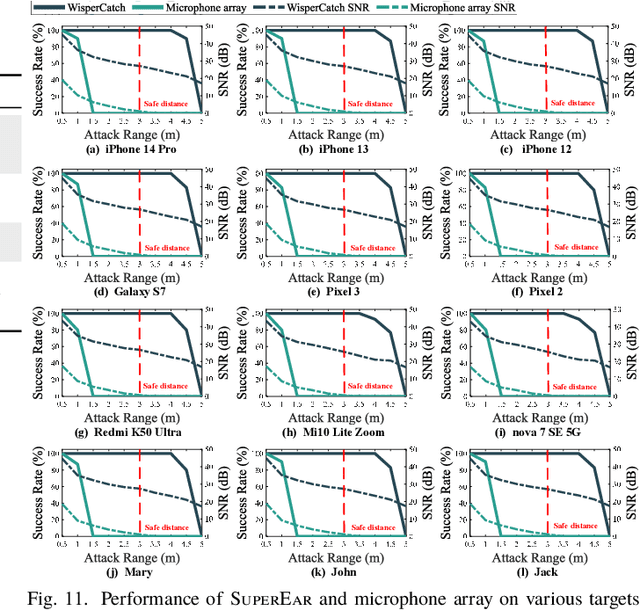
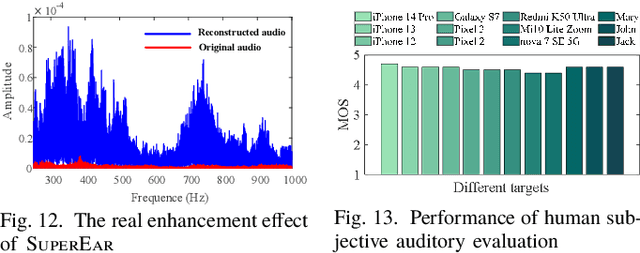
We present SuperEar, a novel privacy threat based on acoustic metamaterials. Unlike previous research, SuperEar can surreptitiously track and eavesdrop on the phone calls of a moving outdoor target from a safe distance. To design this attack, SuperEar overcomes the challenges faced by traditional acoustic metamaterials, including low low-frequency gain and audio distortion during reconstruction. It successfully magnifies the speech signal by approximately 20 times, allowing the sound to be captured from the earpiece of the target phone. In addition, SuperEar optimizes the trade-off between the number and size of acoustic metamaterials, improving the portability and concealability of the interceptor while ensuring effective interception performance. This makes it highly suitable for outdoor tracking and eavesdropping scenarios. Through extensive experimentation, we have evaluated SuperEar and our results show that it can achieve an eavesdropping accuracy of over 80% within a range of 4.5 meters in the aforementioned scenario, thus validating its great potential in real-world applications.