 Add to Chrome
 Add to Firefox
 Add to Edge
Leveraging Causal Reasoning Method for Explaining Medical Image Segmentation Models
Feb 24, 2026
Medical image segmentation plays a vital role in clinical decision-making, enabling precise localization of lesions and guiding interventions. Despite significant advances in segmentation accuracy, the black-box nature of most deep models has raised growing concerns about their trustworthiness in high-stakes medical scenarios. Current explanation techniques have primarily focused on classification tasks, leaving the segmentation domain relatively underexplored. We introduced an explanation model for segmentation task which employs the causal inference framework and backpropagates the average treatment effect (ATE) into a quantification metric to determine the influence of input regions, as well as network components, on target segmentation areas. Through comparison with recent segmentation explainability techniques on two representative medical imaging datasets, we demonstrated that our approach provides more faithful explanations than existing approaches. Furthermore, we carried out a systematic causal analysis of multiple foundational segmentation models using our method, which reveals significant heterogeneity in perceptual strategies across different models, and even between different inputs for the same model. Suggesting the potential of our method to provide notable insights for optimizing segmentation models. Our code can be found at https://github.com/lcmmai/PdCR.

Stealthy Voice Eavesdropping with Acoustic Metamaterials: Unraveling a New Privacy Threat
Jan 25, 2025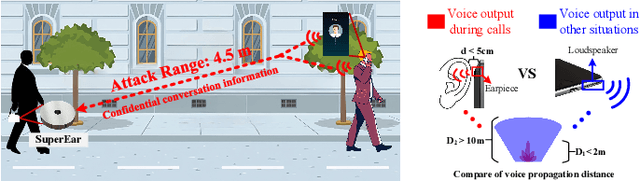
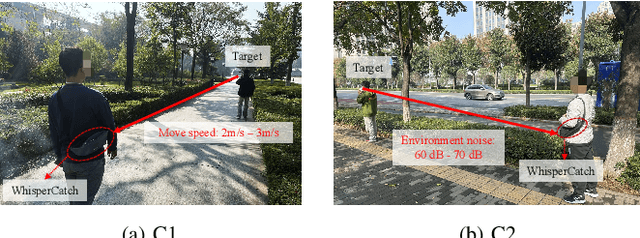
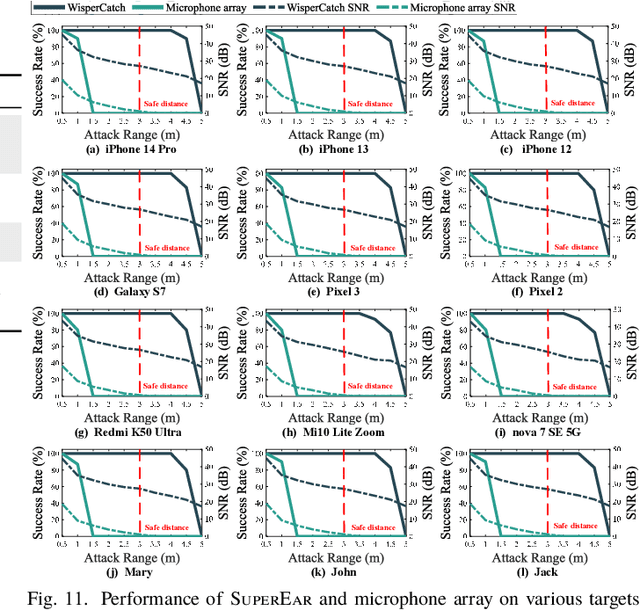
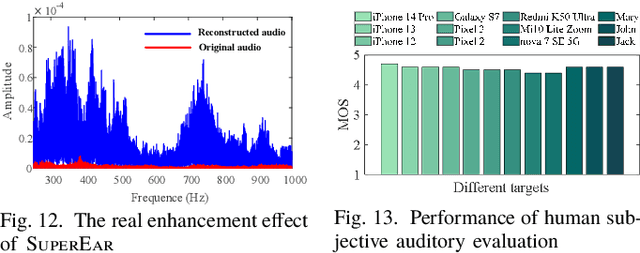
We present SuperEar, a novel privacy threat based on acoustic metamaterials. Unlike previous research, SuperEar can surreptitiously track and eavesdrop on the phone calls of a moving outdoor target from a safe distance. To design this attack, SuperEar overcomes the challenges faced by traditional acoustic metamaterials, including low low-frequency gain and audio distortion during reconstruction. It successfully magnifies the speech signal by approximately 20 times, allowing the sound to be captured from the earpiece of the target phone. In addition, SuperEar optimizes the trade-off between the number and size of acoustic metamaterials, improving the portability and concealability of the interceptor while ensuring effective interception performance. This makes it highly suitable for outdoor tracking and eavesdropping scenarios. Through extensive experimentation, we have evaluated SuperEar and our results show that it can achieve an eavesdropping accuracy of over 80% within a range of 4.5 meters in the aforementioned scenario, thus validating its great potential in real-world applications.
Deep Learning Method to Predict Wound Healing Progress Based on Collagen Fibers in Wound Tissue
May 08, 2024Wound healing is a complex process involving changes in collagen fibers. Accurate monitoring of these changes is crucial for assessing the progress of wound healing and has significant implications for guiding clinical treatment strategies and drug screening. However, traditional quantitative analysis methods focus on spatial characteristics such as collagen fiber alignment and variance, lacking threshold standards to differentiate between different stages of wound healing. To address this issue, we propose an innovative approach based on deep learning to predict the progression of wound healing by analyzing collagen fiber features in histological images of wound tissue. Leveraging the unique learning capabilities of deep learning models, our approach captures the feature variations of collagen fibers in histological images from different categories and classifies them into various stages of wound healing. To overcome the limited availability of histological image data, we employ a transfer learning strategy. Specifically, we fine-tune a VGG16 model pretrained on the ImageNet dataset to adapt it to the classification task of histological images of wounds. Through this process, our model achieves 82% accuracy in classifying six stages of wound healing. Furthermore, to enhance the interpretability of the model, we employ a class activation mapping technique called LayerCAM. LayerCAM reveals the image regions on which the model relies when making predictions, providing transparency to the model's decision-making process. This visualization not only helps us understand how the model identifies and evaluates collagen fiber features but also enhances trust in the model's prediction results. To the best of our knowledge, our proposed model is the first deep learning-based classification model used for predicting wound healing stages.