 Add to Chrome
 Add to Firefox
 Add to Edge
See Once, Then Act: Vision-Language-Action Model with Task Learning from One-Shot Video Demonstrations
Dec 08, 2025
Developing robust and general-purpose manipulation policies represents a fundamental objective in robotics research. While Vision-Language-Action (VLA) models have demonstrated promising capabilities for end-to-end robot control, existing approaches still exhibit limited generalization to tasks beyond their training distributions. In contrast, humans possess remarkable proficiency in acquiring novel skills by simply observing others performing them once. Inspired by this capability, we propose ViVLA, a generalist robotic manipulation policy that achieves efficient task learning from a single expert demonstration video at test time. Our approach jointly processes an expert demonstration video alongside the robot's visual observations to predict both the demonstrated action sequences and subsequent robot actions, effectively distilling fine-grained manipulation knowledge from expert behavior and transferring it seamlessly to the agent. To enhance the performance of ViVLA, we develop a scalable expert-agent pair data generation pipeline capable of synthesizing paired trajectories from easily accessible human videos, further augmented by curated pairs from publicly available datasets. This pipeline produces a total of 892,911 expert-agent samples for training ViVLA. Experimental results demonstrate that our ViVLA is able to acquire novel manipulation skills from only a single expert demonstration video at test time. Our approach achieves over 30% improvement on unseen LIBERO tasks and maintains above 35% gains with cross-embodiment videos. Real-world experiments demonstrate effective learning from human videos, yielding more than 38% improvement on unseen tasks.

Open-RGBT: Open-vocabulary RGB-T Zero-shot Semantic Segmentation in Open-world Environments
Oct 09, 2024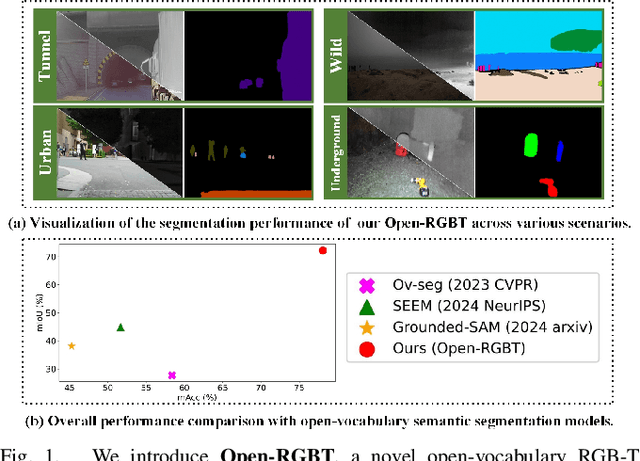
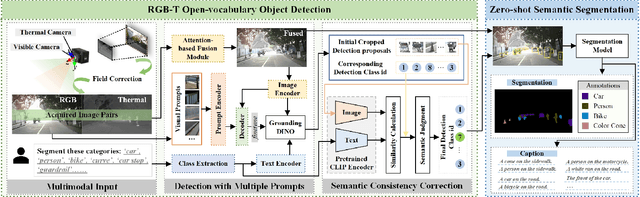
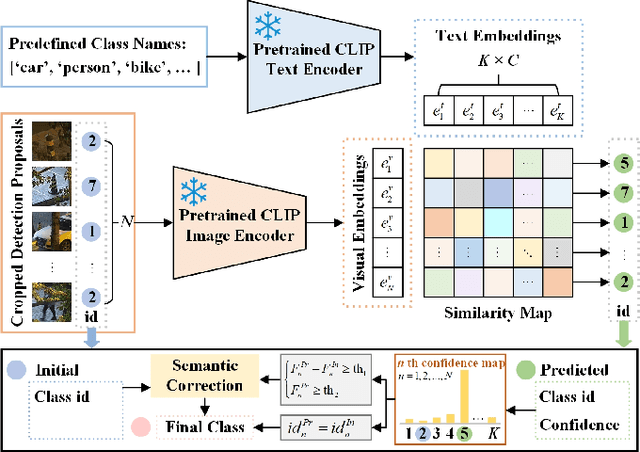
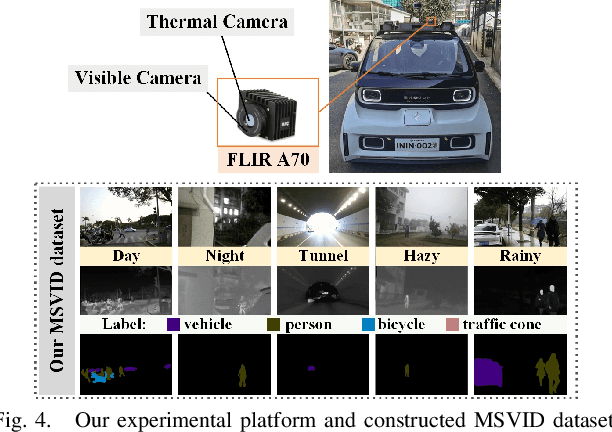
Semantic segmentation is a critical technique for effective scene understanding. Traditional RGB-T semantic segmentation models often struggle to generalize across diverse scenarios due to their reliance on pretrained models and predefined categories. Recent advancements in Visual Language Models (VLMs) have facilitated a shift from closed-set to open-vocabulary semantic segmentation methods. However, these models face challenges in dealing with intricate scenes, primarily due to the heterogeneity between RGB and thermal modalities. To address this gap, we present Open-RGBT, a novel open-vocabulary RGB-T semantic segmentation model. Specifically, we obtain instance-level detection proposals by incorporating visual prompts to enhance category understanding. Additionally, we employ the CLIP model to assess image-text similarity, which helps correct semantic consistency and mitigates ambiguities in category identification. Empirical evaluations demonstrate that Open-RGBT achieves superior performance in diverse and challenging real-world scenarios, even in the wild, significantly advancing the field of RGB-T semantic segmentation.
Joint Conditional Diffusion Model for Image Restoration with Mixed Degradations
Apr 11, 2024Image restoration is rather challenging in adverse weather conditions, especially when multiple degradations occur simultaneously. Blind image decomposition was proposed to tackle this issue, however, its effectiveness heavily relies on the accurate estimation of each component. Although diffusion-based models exhibit strong generative abilities in image restoration tasks, they may generate irrelevant contents when the degraded images are severely corrupted. To address these issues, we leverage physical constraints to guide the whole restoration process, where a mixed degradation model based on atmosphere scattering model is constructed. Then we formulate our Joint Conditional Diffusion Model (JCDM) by incorporating the degraded image and degradation mask to provide precise guidance. To achieve better color and detail recovery results, we further integrate a refinement network to reconstruct the restored image, where Uncertainty Estimation Block (UEB) is employed to enhance the features. Extensive experiments performed on both multi-weather and weather-specific datasets demonstrate the superiority of our method over state-of-the-art competing methods.