 Add to Chrome
 Add to Firefox
 Add to Edge
PETS: A Principled Framework Towards Optimal Trajectory Allocation for Efficient Test-Time Self-Consistency
Feb 18, 2026
Test-time scaling can improve model performance by aggregating stochastic reasoning trajectories. However, achieving sample-efficient test-time self-consistency under a limited budget remains an open challenge. We introduce PETS (Principled and Efficient Test-TimeSelf-Consistency), which initiates a principled study of trajectory allocation through an optimization framework. Central to our approach is the self-consistency rate, a new measure defined as agreement with the infinite-budget majority vote. This formulation makes sample-efficient test-time allocation theoretically grounded and amenable to rigorous analysis. We study both offline and online settings. In the offline regime, where all questions are known in advance, we connect trajectory allocation to crowdsourcing, a classic and well-developed area, by modeling reasoning traces as workers. This perspective allows us to leverage rich existing theory, yielding theoretical guarantees and an efficient majority-voting-based allocation algorithm. In the online streaming regime, where questions arrive sequentially and allocations must be made on the fly, we propose a novel method inspired by the offline framework. Our approach adapts budgets to question difficulty while preserving strong theoretical guarantees and computational efficiency. Experiments show that PETS consistently outperforms uniform allocation. On GPQA, PETS achieves perfect self-consistency in both settings while reducing the sampling budget by up to 75% (offline) and 55% (online) relative to uniform allocation. Code is available at https://github.com/ZDCSlab/PETS.

PHYBench: Holistic Evaluation of Physical Perception and Reasoning in Large Language Models
Apr 22, 2025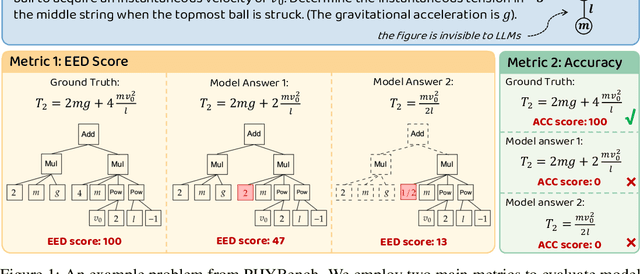

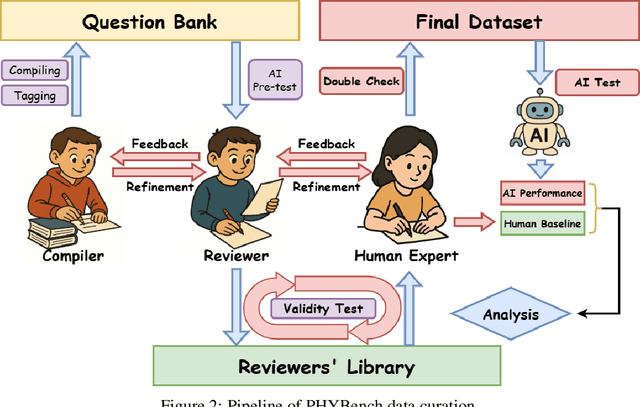
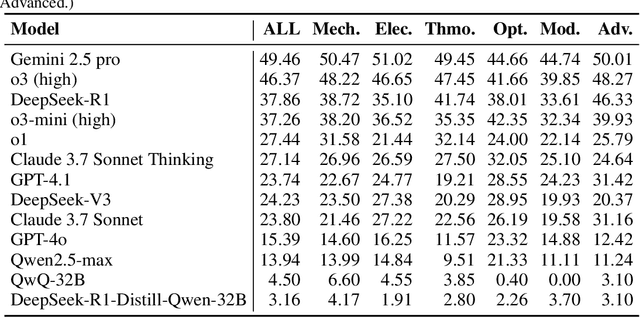
We introduce PHYBench, a novel, high-quality benchmark designed for evaluating reasoning capabilities of large language models (LLMs) in physical contexts. PHYBench consists of 500 meticulously curated physics problems based on real-world physical scenarios, designed to assess the ability of models to understand and reason about realistic physical processes. Covering mechanics, electromagnetism, thermodynamics, optics, modern physics, and advanced physics, the benchmark spans difficulty levels from high school exercises to undergraduate problems and Physics Olympiad challenges. Additionally, we propose the Expression Edit Distance (EED) Score, a novel evaluation metric based on the edit distance between mathematical expressions, which effectively captures differences in model reasoning processes and results beyond traditional binary scoring methods. We evaluate various LLMs on PHYBench and compare their performance with human experts. Our results reveal that even state-of-the-art reasoning models significantly lag behind human experts, highlighting their limitations and the need for improvement in complex physical reasoning scenarios. Our benchmark results and dataset are publicly available at https://phybench-official.github.io/phybench-demo/.