 Add to Chrome
 Add to Firefox
 Add to Edge
DataSpace: Benchmarking Data Agents for Verifiable Analytics over Heterogeneous Workspaces
Aug 04, 2026
Data agents enable natural-language analytics over organizational workspaces, where relevant evidence may be scattered across databases, structured files, long documents, and multimedia. Existing benchmarks largely isolate structured querying, retrieval, or open-ended analysis, leaving heterogeneous evidence discovery, complete tabular outputs, and deterministic evaluation insufficiently unified. We introduce DataSpace, a benchmark in which data agents produce verifiable tabular results from task-local heterogeneous workspaces. It contains 410 cross-language tasks and 7,439 artifacts totaling 15.01 GB across CSV, JSON, SQLite, Markdown, PDF, and video. DataSpace also served as the official evaluation benchmark for the KDD Cup 2026 Data Agents for Complex Data Analysis competition. Each agent receives only a question and workspace and returns the complete requested tabular result. We construct DataSpace with DataSpace-Builder, an execution-grounded framework comprising cross-language transformation, constraint-aware relational sampling, modality routing and artifact rendering, and human review and task repair by 11 domain experts. A deterministic evaluator performs header-invariant column alignment, type- and precision-aware normalization, and order-aware row comparison. Across six recently released frontier multimodal models and five widely used agent harnesses, the best accuracy reaches 66.34%, while harness choice creates a 15.36-point spread with the backbone fixed. Multimodal evidence integration and joins consistently reduce accuracy across all six backbones. These results show that DataSpace remains unsaturated and identify key challenges for improving data-agent reliability.

SQLConductor: Search-to-Policy Learning for Step-wise Text-to-SQL Orchestration
Jun 22, 2026Text-to-SQL enables users to access relational databases via natural language, but real-world settings remain challenging due to coordinated reasoning over complex database environments. Existing systems often use multi-stage pipelines or reasoning models specialized for individual stages. However, fixed pipelines rely on predefined stage orders, limiting their adaptivity to query demands and intermediate evidence. Recent orchestration-based methods provide flexibility by composing specialized modules for each query, but typical plan-then-execute approaches still commit to a complete workflow before execution and cannot adapt to intermediate artifacts and feedback. In this paper, we propose SQLConductor, a step-wise orchestration learning framework for Text-to-SQL. SQLConductor formulates Text-to-SQL subtasks as specialized actions for workflow composition and trains a policy model to select the next action based on intermediate artifacts and feedback. To learn this policy, SQLConductor introduces Search-to-Policy Learning, which uses Monte Carlo Tree Search to explore candidate workflows and stability estimation to identify robust supervision. The policy model is trained with Stability-weighted Supervised Fine-tuning to prioritize high-quality orchestration patterns and further enhanced through Curriculum Reinforcement Learning. This transforms offline workflow search into a deployable policy for step-wise orchestration at inference time. Experiments on BIRD-Dev and out-of-distribution datasets show that SQLConductor achieves superior execution accuracy and strong generalization, reaching 73.2% EX on BIRD-Dev with a compact orchestration policy coordinating frozen larger action models, outperforming prior methods that directly train comparable or larger Text-to-SQL backbones. Further analyses show that the learned policy adapts orchestration to diverse query demands.
OmniMoE: An Efficient MoE by Orchestrating Atomic Experts at Scale
Feb 05, 2026Mixture-of-Experts (MoE) architectures are evolving towards finer granularity to improve parameter efficiency. However, existing MoE designs face an inherent trade-off between the granularity of expert specialization and hardware execution efficiency. We propose OmniMoE, a system-algorithm co-designed framework that pushes expert granularity to its logical extreme. OmniMoE introduces vector-level Atomic Experts, enabling scalable routing and execution within a single MoE layer, while retaining a shared dense MLP branch for general-purpose processing. Although this atomic design maximizes capacity, it poses severe challenges for routing complexity and memory access. To address these, OmniMoE adopts a system-algorithm co-design: (i) a Cartesian Product Router that decomposes the massive index space to reduce routing complexity from O(N) to O(sqrt(N)); and (ii) Expert-Centric Scheduling that inverts the execution order to turn scattered, memory-bound lookups into efficient dense matrix operations. Validated on seven benchmarks, OmniMoE (with 1.7B active parameters) achieves 50.9% zero-shot accuracy across seven benchmarks, outperforming coarse-grained (e.g., DeepSeekMoE) and fine-grained (e.g., PEER) baselines. Crucially, OmniMoE reduces inference latency from 73ms to 6.7ms (a 10.9-fold speedup) compared to PEER, demonstrating that massive-scale fine-grained MoE can be fast and accurate. Our code is open-sourced at https://github.com/flash-algo/omni-moe.
Starling: An I/O-Efficient Disk-Resident Graph Index Framework for High-Dimensional Vector Similarity Search on Data Segment
Jan 16, 2024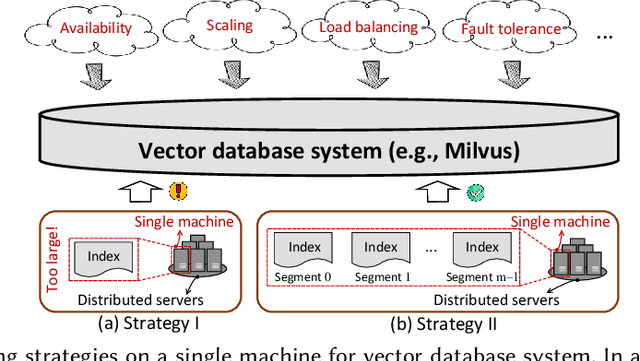

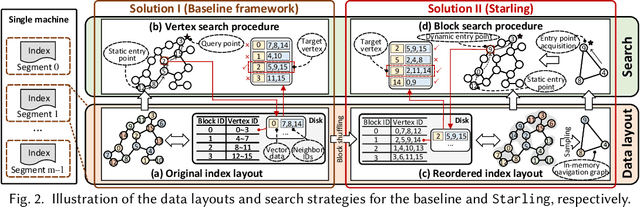
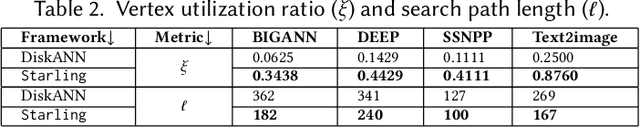
High-dimensional vector similarity search (HVSS) is gaining prominence as a powerful tool for various data science and AI applications. As vector data scales up, in-memory indexes pose a significant challenge due to the substantial increase in main memory requirements. A potential solution involves leveraging disk-based implementation, which stores and searches vector data on high-performance devices like NVMe SSDs. However, implementing HVSS for data segments proves to be intricate in vector databases where a single machine comprises multiple segments for system scalability. In this context, each segment operates with limited memory and disk space, necessitating a delicate balance between accuracy, efficiency, and space cost. Existing disk-based methods fall short as they do not holistically address all these requirements simultaneously. In this paper, we present Starling, an I/O-efficient disk-resident graph index framework that optimizes data layout and search strategy within the segment. It has two primary components: (1) a data layout incorporating an in-memory navigation graph and a reordered disk-based graph with enhanced locality, reducing the search path length and minimizing disk bandwidth wastage; and (2) a block search strategy designed to minimize costly disk I/O operations during vector query execution. Through extensive experiments, we validate the effectiveness, efficiency, and scalability of Starling. On a data segment with 2GB memory and 10GB disk capacity, Starling can accommodate up to 33 million vectors in 128 dimensions, offering HVSS with over 0.9 average precision and top-10 recall rate, and latency under 1 millisecond. The results showcase Starling's superior performance, exhibiting 43.9$\times$ higher throughput with 98% lower query latency compared to state-of-the-art methods while maintaining the same level of accuracy.