 Add to Chrome
 Add to Firefox
 Add to Edge
Long-Document QA with Chain-of-Structured-Thought and Fine-Tuned SLMs
Mar 31, 2026
Large language models (LLMs) are widely applied to data analytics over documents, yet direct reasoning over long, noisy documents remains brittle and error-prone. Hence, we study document question answering (QA) that consolidates dispersed evidence into a structured output (e.g., a table, graph, or chunks) to support reliable, verifiable QA. We propose a two-pillar framework, LiteCoST, to achieve both high accuracy and low latency with small language models (SLMs). Pillar 1: Chain-of-Structured-Thought (CoST). We introduce a CoST template, a schema-aware instruction that guides a strong LLM to produce both a step-wise CoST trace and the corresponding structured output. The process induces a minimal structure, normalizes entities/units, aligns records, serializes the output, and verifies/refines it, yielding auditable supervision. Pillar 2: SLM fine-tuning. The compact models are trained on LLM-generated CoST data in two stages: Supervised Fine-Tuning for structural alignment, followed by Group Relative Policy Optimization (GRPO) incorporating triple rewards for answer/format quality and process consistency. By distilling structure-first behavior into SLMs, this approach achieves LLM-comparable quality on multi-domain long-document QA using 3B/7B SLMs, while delivering 2-4x lower latency than GPT-4o and DeepSeek-R1 (671B). The code is available at https://github.com/HKUSTDial/LiteCoST.

DataMosaic: Explainable and Verifiable Multi-Modal Data Analytics through Extract-Reason-Verify
Apr 14, 2025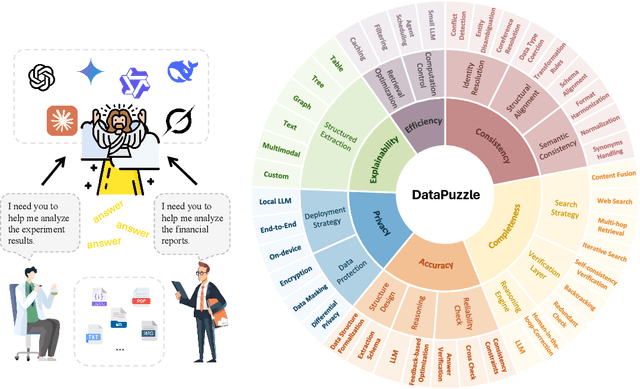
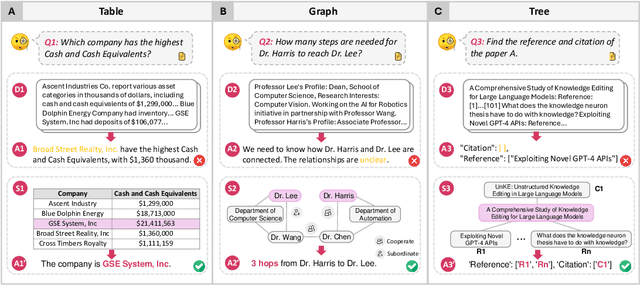
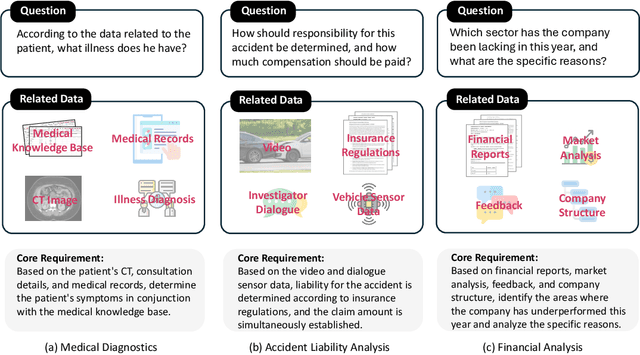
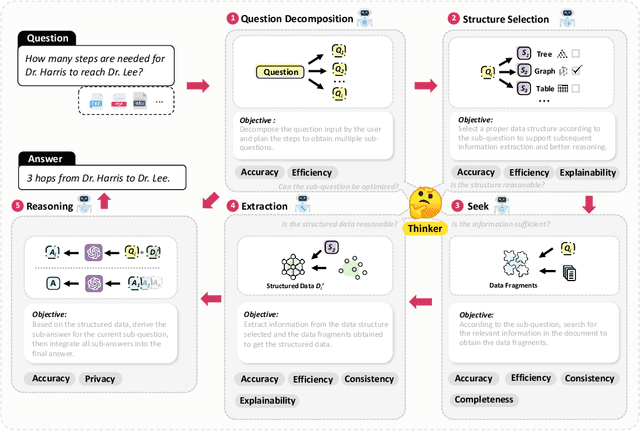
Large Language Models (LLMs) are transforming data analytics, but their widespread adoption is hindered by two critical limitations: they are not explainable (opaque reasoning processes) and not verifiable (prone to hallucinations and unchecked errors). While retrieval-augmented generation (RAG) improves accuracy by grounding LLMs in external data, it fails to address the core challenges of trustworthy analytics - especially when processing noisy, inconsistent, or multi-modal data (for example, text, tables, images). We propose DataMosaic, a framework designed to make LLM-powered analytics both explainable and verifiable. By dynamically extracting task-specific structures (for example, tables, graphs, trees) from raw data, DataMosaic provides transparent, step-by-step reasoning traces and enables validation of intermediate results. Built on a multi-agent framework, DataMosaic orchestrates self-adaptive agents that align with downstream task requirements, enhancing consistency, completeness, and privacy. Through this approach, DataMosaic not only tackles the limitations of current LLM-powered analytics systems but also lays the groundwork for a new paradigm of grounded, accurate, and explainable multi-modal data analytics.