 Add to Chrome
 Add to Firefox
 Add to Edge
I-SDPO: Instance-Level Adaptive Self-Distillation Policy Optimization
Aug 13, 2026
Group Relative Policy Optimization (GRPO) learns from reward differences within a rollout group, but receives no useful relative signal when every sampled response is incorrect. Privileged self-distillation can fill this gap with dense token supervision, yet applying it throughout training creates a different failure mode: the teacher is a biased, low-variance surrogate for the reward objective, so persistent imitation can oppose reward-improving updates after the policy becomes capable of producing successful trajectories. We introduce I-SDPO (Instance-Level Adaptive Self-Distillation Policy Optimization), which treats teacher reliance as capability-dependent. I-SDPO makes one routing decision per input instance and shares it across that instance's rollout group: all-incorrect groups use a privileged self-distillation objective, whereas any-success groups remain intact for GRPO. This design uses imitation only where group-relative rewards are uninformative. A local analysis characterizes when teacher and reward directions align and shows that a non-vanishing biased distillation weight induces an optimization bias floor. The routing rule automatically reduces the expected distillation rate as success probability rises, withdrawing teacher influence without a hand-designed schedule. On SciKnowEval, I-SDPO obtains the best result in all four scientific domains and improves average mean@16 accuracy from 56.67% with GRPO to 70.31%, with a maximum domain gain of 18.24 points.

ADHint: Adaptive Hints with Difficulty Priors for Reinforcement Learning
Dec 15, 2025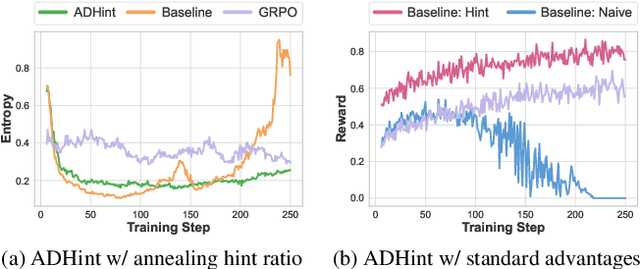
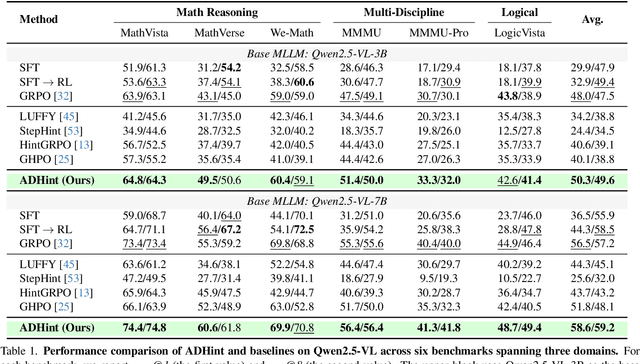
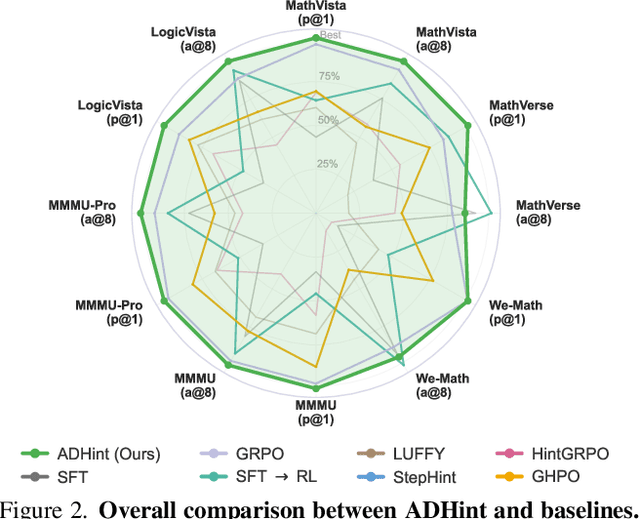
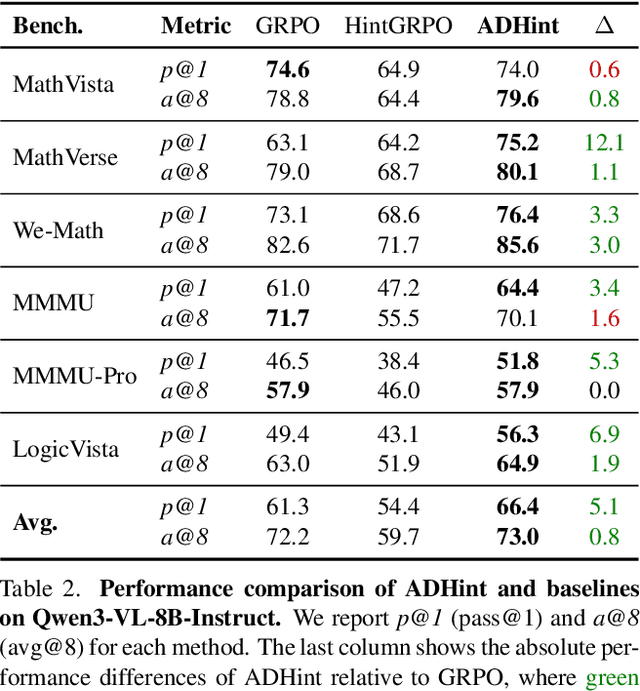
To combine the advantages of Supervised Fine-Tuning (SFT) and Reinforcement Learning (RL), recent methods have integrated ''hints'' into post-training, which are prefix segments of complete reasoning trajectories, aiming for powerful knowledge expansion and reasoning generalization. However, existing hint-based RL methods typically ignore difficulty when scheduling hint ratios and estimating relative advantages, leading to unstable learning and excessive imitation of off-policy hints. In this work, we propose ADHint, which treats difficulty as a key factor in both hint-ratio schedule and relative-advantage estimation to achieve a better trade-off between exploration and imitation. Specifically, we propose Adaptive Hint with Sample Difficulty Prior, which evaluates each sample's difficulty under the policy model and accordingly schedules an appropriate hint ratio to guide its rollouts. We also introduce Consistency-based Gradient Modulation and Selective Masking for Hint Preservation to modulate token-level gradients within hints, preventing biased and destructive updates. Additionally, we propose Advantage Estimation with Rollout Difficulty Posterior, which leverages the relative difficulty of rollouts with and without hints to estimate their respective advantages, thereby achieving more balanced updates. Extensive experiments across diverse modalities, model scales, and domains demonstrate that ADHint delivers superior reasoning ability and out-of-distribution generalization, consistently surpassing existing methods in both pass@1 and avg@8. Our code and dataset will be made publicly available upon paper acceptance.