 Add to Chrome
 Add to Firefox
 Add to Edge
I-SDPO: Instance-Level Adaptive Self-Distillation Policy Optimization
Aug 13, 2026
Group Relative Policy Optimization (GRPO) learns from reward differences within a rollout group, but receives no useful relative signal when every sampled response is incorrect. Privileged self-distillation can fill this gap with dense token supervision, yet applying it throughout training creates a different failure mode: the teacher is a biased, low-variance surrogate for the reward objective, so persistent imitation can oppose reward-improving updates after the policy becomes capable of producing successful trajectories. We introduce I-SDPO (Instance-Level Adaptive Self-Distillation Policy Optimization), which treats teacher reliance as capability-dependent. I-SDPO makes one routing decision per input instance and shares it across that instance's rollout group: all-incorrect groups use a privileged self-distillation objective, whereas any-success groups remain intact for GRPO. This design uses imitation only where group-relative rewards are uninformative. A local analysis characterizes when teacher and reward directions align and shows that a non-vanishing biased distillation weight induces an optimization bias floor. The routing rule automatically reduces the expected distillation rate as success probability rises, withdrawing teacher influence without a hand-designed schedule. On SciKnowEval, I-SDPO obtains the best result in all four scientific domains and improves average mean@16 accuracy from 56.67% with GRPO to 70.31%, with a maximum domain gain of 18.24 points.

RAVE: Re-Allocating Visual Attention in Large Multimodal Models
May 18, 2026Large multimodal models (LMMs) inherit the self-attention mechanism of pretrained language backbones, yet standard attention can exhibit suboptimal allocation, including cross-modal misallocation between textual and visual evidence and intra-visual imbalance among visual tokens. We propose RAVE (Re-Allocating Visual Attention), a lightweight pair-gating mechanism that adds a learned query--key bias to pre-softmax attention scores over visual keys, derived from pre-RoPE query and key features. RAVE requires no architectural modification to the backbone and can be trained end-to-end with the rest of the model. Across a suite of multimodal benchmarks, RAVE improves over standard attention by an average of 3 points, with the largest gains on perception-intensive tasks -- including multilingual OCR, chart understanding, document VQA, and scene text VQA -- where accurate visual grounding is critical.
Revisiting Reinforcement Learning with Verifiable Rewards from a Contrastive Perspective
May 13, 2026RLVR has become a widely adopted paradigm for improving LLMs' reasoning capabilities, and GRPO is one of its most representative algorithms. In this paper, we first show that GRPO admits an equivalent discriminative reformulation as a weighted positive-negative score difference. Under this view, GRPO increases sequence-level scores of verified positive rollouts and decreases those of negative rollouts, where the scores are averages of clipped token-level importance sampling ratios. This reformulation reveals two structural limitations of GRPO: likelihood-misaligned scoring, where clipped ratio-based surrogate scores are optimized instead of generation likelihoods, and score-insensitive credit assignment, where rollout-level credit is assigned without accounting for relative score gaps between positive and negative rollouts in the same group. To address these limitations, we propose ConSPO, a framework for Contrastive Sequence-level Policy Optimization in RLVR. ConSPO replaces GRPO's clipped ratio-based scores with length-normalized sequence log-probabilities, aligning the optimized rollout scores with the likelihoods used in autoregressive generation. It then optimizes a group-wise InfoNCE-style objective that contrasts each positive rollout against negative distractors from the same group, enabling credit assignment to depend on their relative scores. This contrastive formulation amplifies updates for poorly separated positives while concentrating suppressive updates on high-scoring negatives. Moreover, ConSPO introduces a curriculum-scheduled margin, guiding optimization from coarse positive-negative ordering in early training toward stronger separation in later stages. Extensive evaluations across diverse backbone models, parameter scales, and training datasets show that ConSPO consistently outperforms several strong RLVR baselines on challenging mathematical reasoning benchmarks.
ADHint: Adaptive Hints with Difficulty Priors for Reinforcement Learning
Dec 15, 2025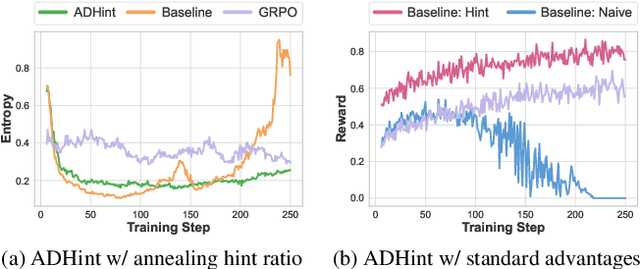
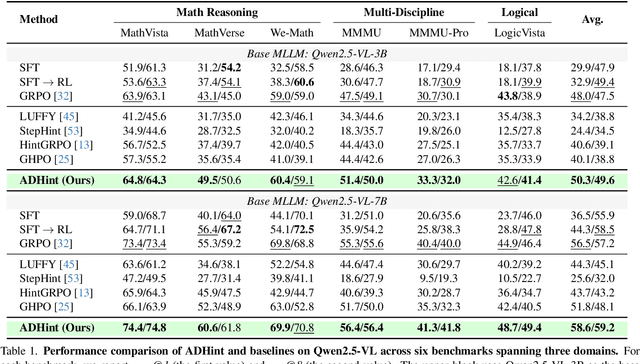
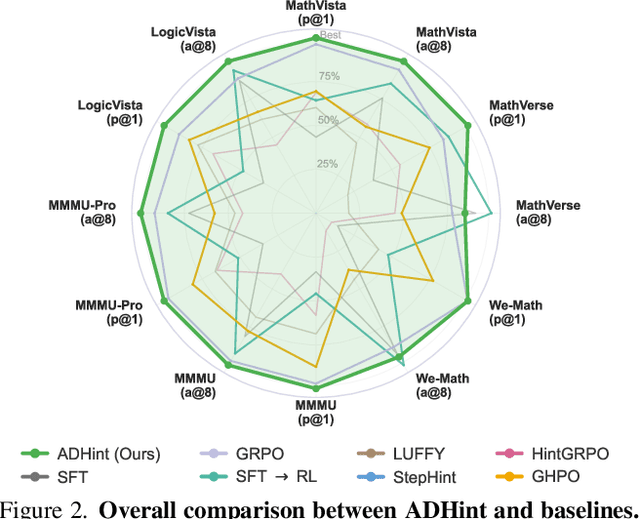
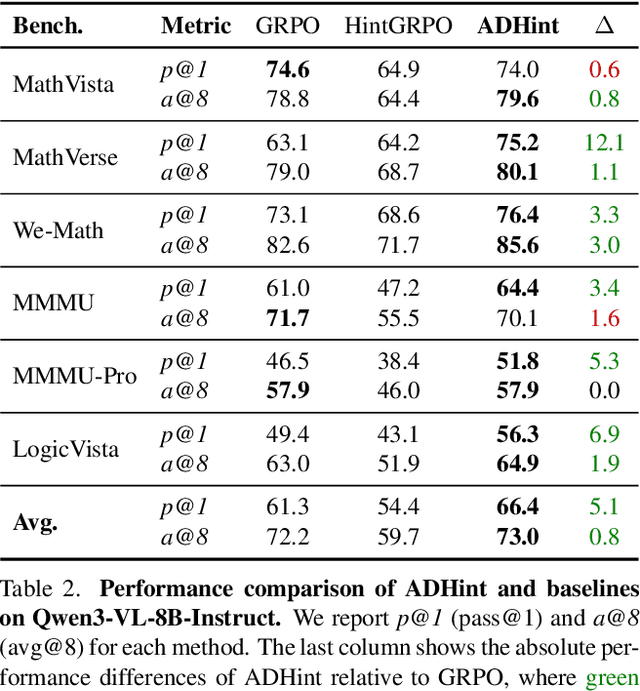
To combine the advantages of Supervised Fine-Tuning (SFT) and Reinforcement Learning (RL), recent methods have integrated ''hints'' into post-training, which are prefix segments of complete reasoning trajectories, aiming for powerful knowledge expansion and reasoning generalization. However, existing hint-based RL methods typically ignore difficulty when scheduling hint ratios and estimating relative advantages, leading to unstable learning and excessive imitation of off-policy hints. In this work, we propose ADHint, which treats difficulty as a key factor in both hint-ratio schedule and relative-advantage estimation to achieve a better trade-off between exploration and imitation. Specifically, we propose Adaptive Hint with Sample Difficulty Prior, which evaluates each sample's difficulty under the policy model and accordingly schedules an appropriate hint ratio to guide its rollouts. We also introduce Consistency-based Gradient Modulation and Selective Masking for Hint Preservation to modulate token-level gradients within hints, preventing biased and destructive updates. Additionally, we propose Advantage Estimation with Rollout Difficulty Posterior, which leverages the relative difficulty of rollouts with and without hints to estimate their respective advantages, thereby achieving more balanced updates. Extensive experiments across diverse modalities, model scales, and domains demonstrate that ADHint delivers superior reasoning ability and out-of-distribution generalization, consistently surpassing existing methods in both pass@1 and avg@8. Our code and dataset will be made publicly available upon paper acceptance.
Learning Transferable Conceptual Prototypes for Interpretable Unsupervised Domain Adaptation
Oct 12, 2023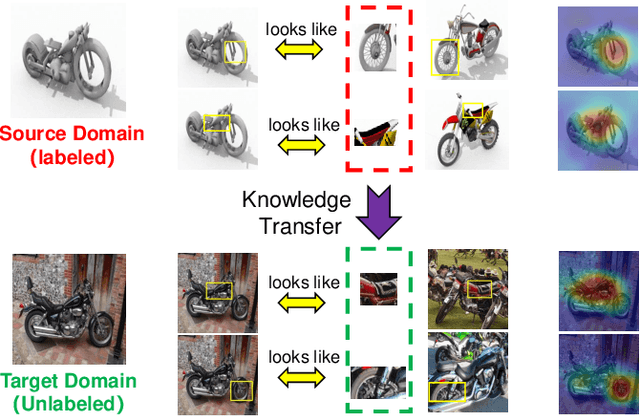
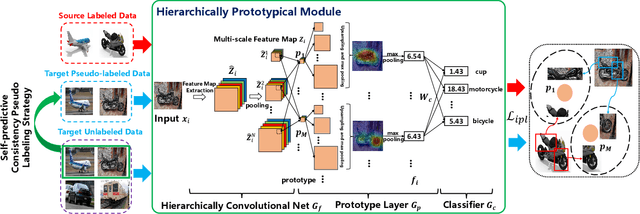
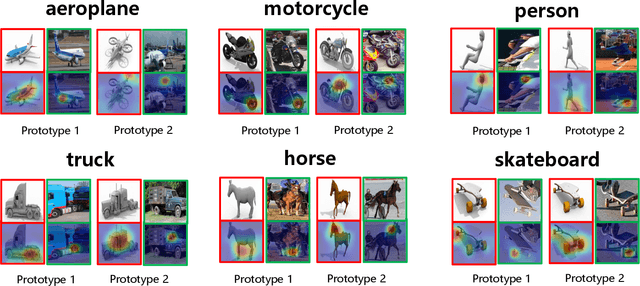
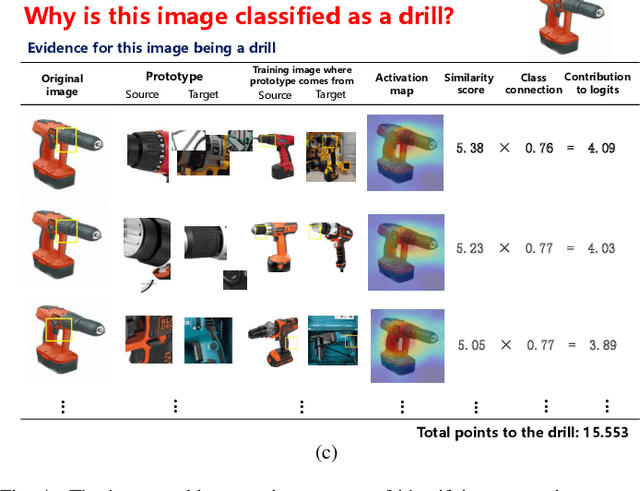
Despite the great progress of unsupervised domain adaptation (UDA) with the deep neural networks, current UDA models are opaque and cannot provide promising explanations, limiting their applications in the scenarios that require safe and controllable model decisions. At present, a surge of work focuses on designing deep interpretable methods with adequate data annotations and only a few methods consider the distributional shift problem. Most existing interpretable UDA methods are post-hoc ones, which cannot facilitate the model learning process for performance enhancement. In this paper, we propose an inherently interpretable method, named Transferable Conceptual Prototype Learning (TCPL), which could simultaneously interpret and improve the processes of knowledge transfer and decision-making in UDA. To achieve this goal, we design a hierarchically prototypical module that transfers categorical basic concepts from the source domain to the target domain and learns domain-shared prototypes for explaining the underlying reasoning process. With the learned transferable prototypes, a self-predictive consistent pseudo-label strategy that fuses confidence, predictions, and prototype information, is designed for selecting suitable target samples for pseudo annotations and gradually narrowing down the domain gap. Comprehensive experiments show that the proposed method can not only provide effective and intuitive explanations but also outperform previous state-of-the-arts.