 Add to Chrome
 Add to Firefox
 Add to Edge
Towards Effective and Efficient Graph Alignment without Supervision
Mar 09, 2026
Unsupervised graph alignment aims to find the node correspondence across different graphs without any anchor node pairs. Despite the recent efforts utilizing deep learning-based techniques, such as the embedding and optimal transport (OT)-based approaches, we observe their limitations in terms of model accuracy-efficiency tradeoff. By focusing on the exploitation of local and global graph information, we formalize them as the ``local representation, global alignment'' paradigm, and present a new ``global representation and alignment'' paradigm to resolve the mismatch between the two phases in the alignment process. We then propose \underline{Gl}obal representation and \underline{o}ptimal transport-\underline{b}ased \underline{Align}ment (\texttt{GlobAlign}), and its variant, \texttt{GlobAlign-E}, for better \underline{E}fficiency. Our methods are equipped with the global attention mechanism and a hierarchical cross-graph transport cost, able to capture long-range and implicit node dependencies beyond the local graph structure. Furthermore, \texttt{GlobAlign-E} successfully closes the time complexity gap between representative embedding and OT-based methods, reducing OT's cubic complexity to quadratic terms. Through extensive experiments, our methods demonstrate superior performance, with up to a 20\% accuracy improvement over the best competitor. Meanwhile, \texttt{GlobAlign-E} achieves the best efficiency, with an order of magnitude speedup against existing OT-based methods.

Combining Optimal Transport and Embedding-Based Approaches for More Expressiveness in Unsupervised Graph Alignment
Jun 19, 2024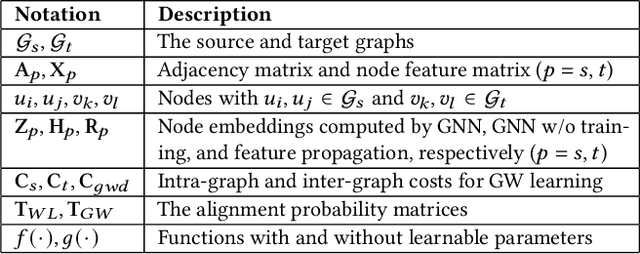


Unsupervised graph alignment finds the one-to-one node correspondence between a pair of attributed graphs by only exploiting graph structure and node features. One category of existing works first computes the node representation and then matches nodes with close embeddings, which is intuitive but lacks a clear objective tailored for graph alignment in the unsupervised setting. The other category reduces the problem to optimal transport (OT) via Gromov-Wasserstein (GW) learning with a well-defined objective but leaves a large room for exploring the design of transport cost. We propose a principled approach to combine their advantages motivated by theoretical analysis of model expressiveness. By noticing the limitation of discriminative power in separating matched and unmatched node pairs, we improve the cost design of GW learning with feature transformation, which enables feature interaction across dimensions. Besides, we propose a simple yet effective embedding-based heuristic inspired by the Weisfeiler-Lehman test and add its prior knowledge to OT for more expressiveness when handling non-Euclidean data. Moreover, we are the first to guarantee the one-to-one matching constraint by reducing the problem to maximum weight matching. The algorithm design effectively combines our OT and embedding-based predictions via stacking, an ensemble learning strategy. We propose a model framework named \texttt{CombAlign} integrating all the above modules to refine node alignment progressively. Through extensive experiments, we demonstrate significant improvements in alignment accuracy compared to state-of-the-art approaches and validate the effectiveness of the proposed modules.