 Add to Chrome
 Add to Firefox
 Add to Edge
Direct Translation between Sign Languages
May 20, 2026
The field of sign language translation has witnessed significant progress in the translation between sign and spoken languages, but the translation between sign languages remains largely unexplored and out of reach. The latter can help 1.5 billion deaf and hard-of-hearing (DHH) people worldwide communicate across language barriers without relying on hearing interpreters or written-language fluency. The cascade approach composing separate sign-to-text, text-to-text, and text-to-sign systems suffers from error propagation and extra latency as well as the loss of information unique in the visual modality. We aim to develop direct sign-to-sign translation. However, a large-scale open-domain parallel corpus has not been curated between sign languages. To enable direct translation between sign language utterances, we use back-translation to produce synthetic sign-sign pairs from unaligned individual language utterance-sign corpora. Using this data, we jointly train a single MBART-based model for both text->sign (T2S) and sign->sign (S2S). On synthetically generated paired sets between American Sign Language (ASL), Chinese Sign Language (CSL), and German Sign Language (DGS), our direct S2S method outperforms the cascaded baseline on geometric sign error metrics (20% lower DTW-aligned MPJPE) and language matching metrics after predicted sign utterances are translated back to sentences (50% high BLEU-4) while achieving a roughly 2.3* speedup. On a small set of pre-existing cross-lingual sign data, we find similar improvements for our proposed method.

MultiBench: Multiscale Benchmarks for Multimodal Representation Learning
Jul 15, 2021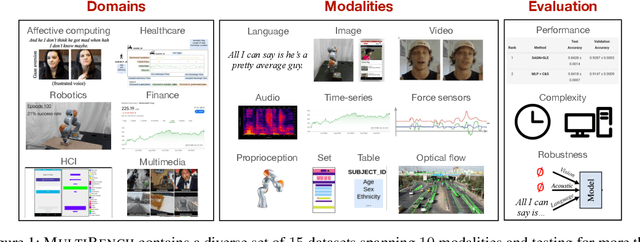
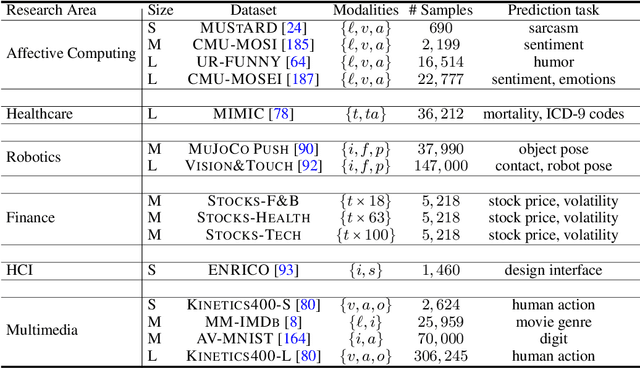
Learning multimodal representations involves integrating information from multiple heterogeneous sources of data. It is a challenging yet crucial area with numerous real-world applications in multimedia, affective computing, robotics, finance, human-computer interaction, and healthcare. Unfortunately, multimodal research has seen limited resources to study (1) generalization across domains and modalities, (2) complexity during training and inference, and (3) robustness to noisy and missing modalities. In order to accelerate progress towards understudied modalities and tasks while ensuring real-world robustness, we release MultiBench, a systematic and unified large-scale benchmark spanning 15 datasets, 10 modalities, 20 prediction tasks, and 6 research areas. MultiBench provides an automated end-to-end machine learning pipeline that simplifies and standardizes data loading, experimental setup, and model evaluation. To enable holistic evaluation, MultiBench offers a comprehensive methodology to assess (1) generalization, (2) time and space complexity, and (3) modality robustness. MultiBench introduces impactful challenges for future research, including scalability to large-scale multimodal datasets and robustness to realistic imperfections. To accompany this benchmark, we also provide a standardized implementation of 20 core approaches in multimodal learning. Simply applying methods proposed in different research areas can improve the state-of-the-art performance on 9/15 datasets. Therefore, MultiBench presents a milestone in unifying disjoint efforts in multimodal research and paves the way towards a better understanding of the capabilities and limitations of multimodal models, all the while ensuring ease of use, accessibility, and reproducibility. MultiBench, our standardized code, and leaderboards are publicly available, will be regularly updated, and welcomes inputs from the community.