 Add to Chrome
 Add to Firefox
 Add to Edge
Breaking the Tokenizer Barrier: On-Policy Distillation across Model Families
Jun 08, 2026
On-Policy Distillation (OPD) has become a core technique in the post-training of Large Language Models (LLMs) for transferring knowledge from domain experts to student models. However, existing OPD distillation methods require teacher and student models to share the same tokenizer, restricting the applicability of OPD within the model series. Current mainstream practice typically employs Supervised Fine-Tuning (SFT) on teacher-generated responses for cross-tokenizer distillation, which fails to capture the rich knowledge embedded in the teacher's probability distribution. In this work, we enable the standard on-policy distillation method to operate across model families, ensuring that high-fidelity token-level signals can propagate across different tokenizers with a precise token-mapping algorithm. Extensive experiments show that cross-tokenizer OPD is significantly more compute-efficient than baselines on various benchmarks. Our results unlock a broader range of teacher-student pairs for OPD, opening up new avenues for adapting and enhancing interactions between LLMs.

Training Agents with Weakly Supervised Feedback from Large Language Models
Nov 29, 2024


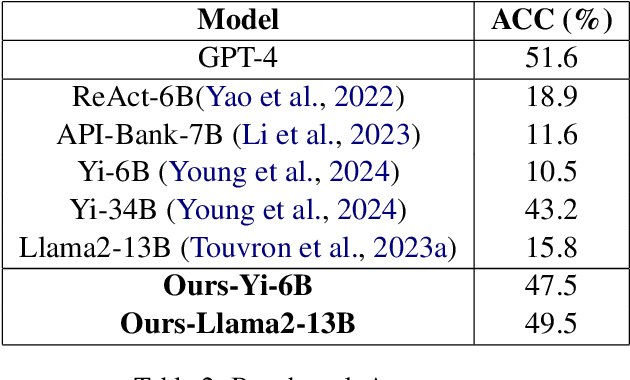
Large Language Models (LLMs) offer a promising basis for creating agents that can tackle complex tasks through iterative environmental interaction. Existing methods either require these agents to mimic expert-provided trajectories or rely on definitive environmental feedback for reinforcement learning which limits their application to specific scenarios like gaming or code generation. This paper introduces a novel training method for LLM-based agents using weakly supervised signals from a critic LLM, bypassing the need for expert trajectories or definitive feedback. Our agents are trained in iterative manner, where they initially generate trajectories through environmental interaction. Subsequently, a critic LLM selects a subset of good trajectories, which are then used to update the agents, enabling them to generate improved trajectories in the next iteration. Extensive tests on the API-bank dataset show consistent improvement in our agents' capabilities and comparable performance to GPT-4, despite using open-source models with much fewer parameters.
Deep CNN frameworks comparison for malaria diagnosis
Sep 06, 2019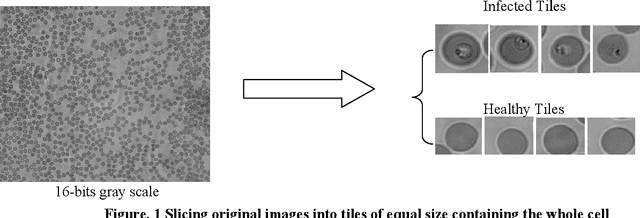

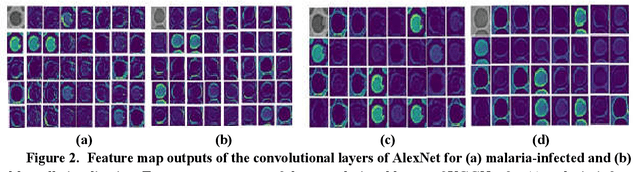
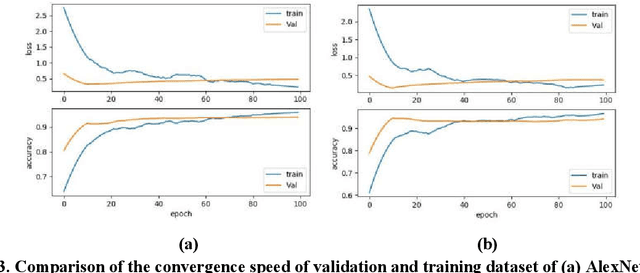
We compare Deep Convolutional Neural Networks (DCNN) frameworks, namely AlexNet and VGGNet, for the classification of healthy and malaria-infected cells in large, grayscale, low quality and low resolution microscopic images, in the case only a small training set is available. Experimental results deliver promising results on the path to quick, automatic and precise classification in unstained images.