 Add to Chrome
 Add to Firefox
 Add to Edge
LUNAR: Benchmarking Personalized Large Language Models on UNiversal User BehAvioR Logs
Aug 05, 2026
Existing personalized LLM benchmarks primarily rely on textual personas or isolated behavioral signals, providing limited evaluation of cross-domain behavioral personalization, where responses must be grounded in heterogeneous daily-life activities. To address this gap, we introduce LUNAR, the first benchmark for evaluating how LLMs personalize responses from longitudinal app interaction histories across universal daily-life domains, including clothing, food, housing, and mobility. To support scalable benchmark construction while mitigating data sparsity and privacy concerns, LUNAR uses a multi-stage coarse-to-fine synthesis pipeline grounded in real-world behavioral patterns. Fidelity analyses show closer alignment with real behavioral distributions than other synthetic benchmarks. Experiments on 19 mainstream LLMs show that access to behavioral logs is necessary but not sufficient for deep personalization: neither more context nor larger models guarantees better performance; effective personalization depends on selecting and integrating relevant evidence across domains. Direct retrieval of fine-grained behavioral records consistently outperforms compressed memory, while stronger personalization can come at the cost of privacy protection. These findings identify evidence selection, cross-domain integration, and privacy control as key challenges for personalized LLMs.

Vision Pretraining for Dense Spatial Perception
Jul 06, 2026Dense spatial perception is essential for physical intelligence, where visual systems are expected to recover structured, metric, and actionable representations from pixel observations. Modern visual foundation models tend to prioritize semantic invariance, often at the expense of detailed spatial understanding. In this work, we study vision pretraining through a boundary-centric lens, motivated by the premise that boundaries and shape discontinuities offer essential cues for perceiving geometric properties. Concretely, we propose masked boundary modeling, a self-supervised paradigm that dynamically learns sub-pixel boundary representations and subsequently leverages the discovered boundary-bearing tokens as masked targets to facilitate dense visual token learning. By scaling this framework, we develop LingBot-Vision and demonstrate its efficacy across a diverse set of downstream vision tasks with DINOv3 as a strong baseline. Remarkably, LingBot-Vision drives the progression from LingBot-Depth 1.0 to LingBot-Depth 2.0 for depth completion, and thereby yields enhanced depth estimation, a key pillar for embodied artificial intelligence. Our findings reveal that boundary modeling goes beyond simple line segments and instead serves as a scalable pretraining principle for learning spatially structured visual representations.
Masked Depth Modeling for Spatial Perception
Jan 25, 2026Spatial visual perception is a fundamental requirement in physical-world applications like autonomous driving and robotic manipulation, driven by the need to interact with 3D environments. Capturing pixel-aligned metric depth using RGB-D cameras would be the most viable way, yet it usually faces obstacles posed by hardware limitations and challenging imaging conditions, especially in the presence of specular or texture-less surfaces. In this work, we argue that the inaccuracies from depth sensors can be viewed as "masked" signals that inherently reflect underlying geometric ambiguities. Building on this motivation, we present LingBot-Depth, a depth completion model which leverages visual context to refine depth maps through masked depth modeling and incorporates an automated data curation pipeline for scalable training. It is encouraging to see that our model outperforms top-tier RGB-D cameras in terms of both depth precision and pixel coverage. Experimental results on a range of downstream tasks further suggest that LingBot-Depth offers an aligned latent representation across RGB and depth modalities. We release the code, checkpoint, and 3M RGB-depth pairs (including 2M real data and 1M simulated data) to the community of spatial perception.
The First MPDD Challenge: Multimodal Personality-aware Depression Detection
May 15, 2025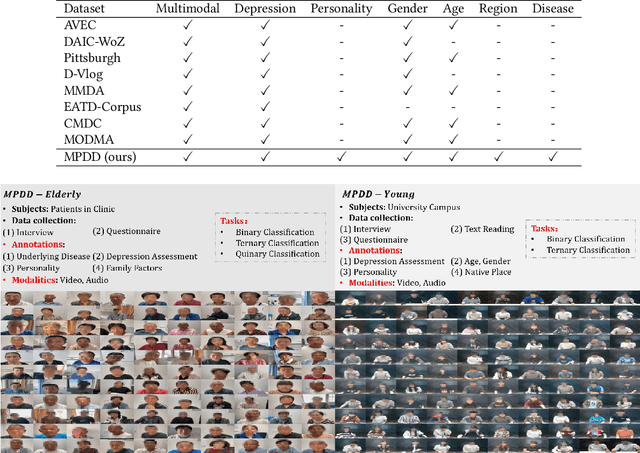
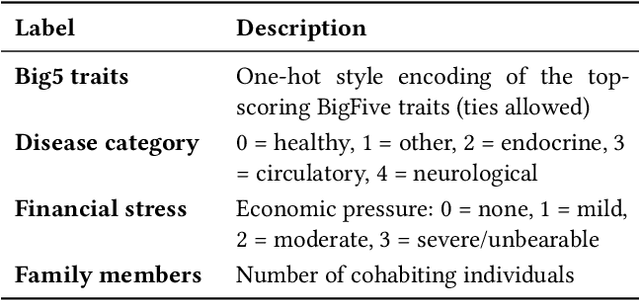
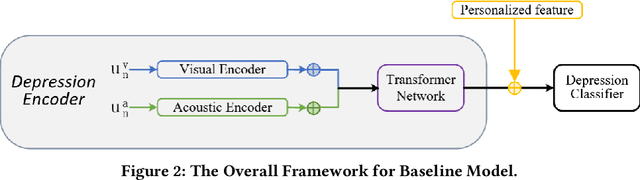
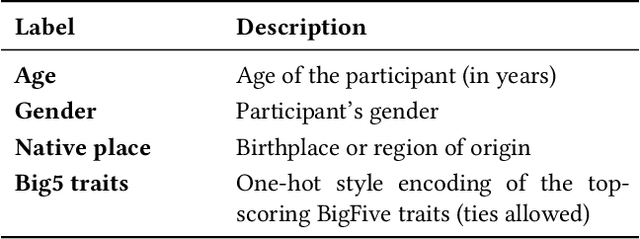
Depression is a widespread mental health issue affecting diverse age groups, with notable prevalence among college students and the elderly. However, existing datasets and detection methods primarily focus on young adults, neglecting the broader age spectrum and individual differences that influence depression manifestation. Current approaches often establish a direct mapping between multimodal data and depression indicators, failing to capture the complexity and diversity of depression across individuals. This challenge includes two tracks based on age-specific subsets: Track 1 uses the MPDD-Elderly dataset for detecting depression in older adults, and Track 2 uses the MPDD-Young dataset for detecting depression in younger participants. The Multimodal Personality-aware Depression Detection (MPDD) Challenge aims to address this gap by incorporating multimodal data alongside individual difference factors. We provide a baseline model that fuses audio and video modalities with individual difference information to detect depression manifestations in diverse populations. This challenge aims to promote the development of more personalized and accurate de pression detection methods, advancing mental health research and fostering inclusive detection systems. More details are available on the official challenge website: https://hacilab.github.io/MPDDChallenge.github.io.