 Add to Chrome
 Add to Firefox
 Add to Edge
MeMix: Writing Less, Remembering More for Streaming 3D Reconstruction
Mar 16, 2026
Reconstruction is a fundamental task in 3D vision and a fundamental capability for spatial intelligence. Particularly, streaming 3D reconstruction is central to real-time spatial perception, yet existing recurrent online models often suffer from progressive degradation on long sequences due to state drift and forgetting, motivating inference-time remedies. We present MeMix, a training-free, plug-and-play module that improves streaming reconstruction by recasting the recurrent state into a Memory Mixture. MeMix partitions the state into multiple independent memory patches and updates only the least-aligned memory patches while exactly preserving others. This selective update mitigates catastrophic forgetting while retaining $O(1)$ inference memory, and requires no fine-tuning or additional learnable parameters, making it directly applicable to existing recurrent reconstruction models. Across standard benchmarks (ScanNet, 7-Scenes, KITTI, etc.), under identical backbones and inference settings, MeMix reduces reconstruction completeness error by 15.3% on average (up to 40.0%) across 300--500 frame streams on 7-Scenes. The code is available at https://dongjiacheng06.github.io/MeMix/

RecurGS: Interactive Scene Modeling via Discrete-State Recurrent Gaussian Fusion
Dec 20, 2025Recent advances in 3D scene representations have enabled high-fidelity novel view synthesis, yet adapting to discrete scene changes and constructing interactive 3D environments remain open challenges in vision and robotics. Existing approaches focus solely on updating a single scene without supporting novel-state synthesis. Others rely on diffusion-based object-background decoupling that works on one state at a time and cannot fuse information across multiple observations. To address these limitations, we introduce RecurGS, a recurrent fusion framework that incrementally integrates discrete Gaussian scene states into a single evolving representation capable of interaction. RecurGS detects object-level changes across consecutive states, aligns their geometric motion using semantic correspondence and Lie-algebra based SE(3) refinement, and performs recurrent updates that preserve historical structures through replay supervision. A voxelized, visibility-aware fusion module selectively incorporates newly observed regions while keeping stable areas fixed, mitigating catastrophic forgetting and enabling efficient long-horizon updates. RecurGS supports object-level manipulation, synthesizes novel scene states without requiring additional scans, and maintains photorealistic fidelity across evolving environments. Extensive experiments across synthetic and real-world datasets demonstrate that our framework delivers high-quality reconstructions with substantially improved update efficiency, providing a scalable step toward continuously interactive Gaussian worlds.
The First MPDD Challenge: Multimodal Personality-aware Depression Detection
May 15, 2025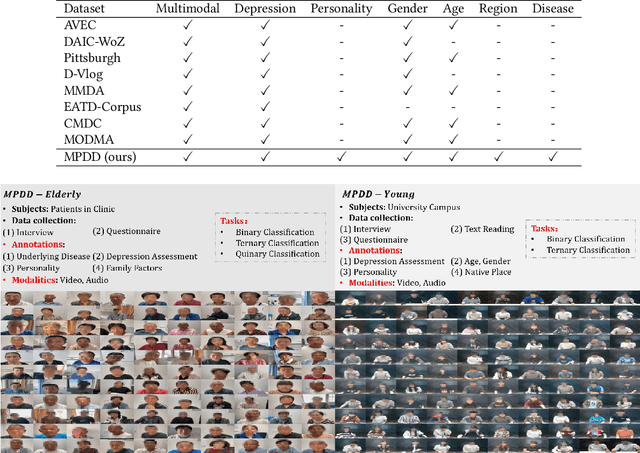
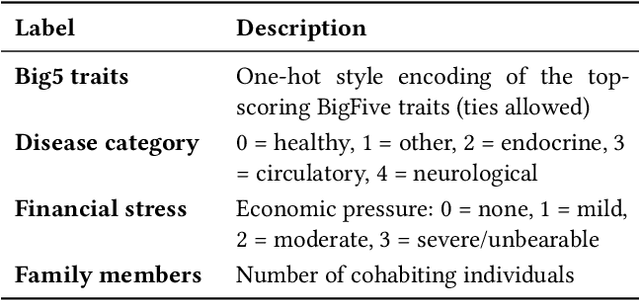
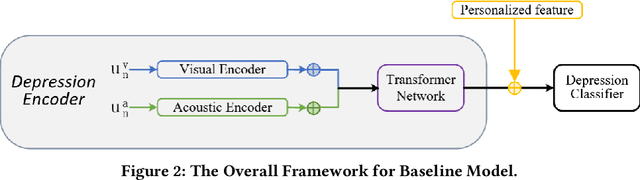
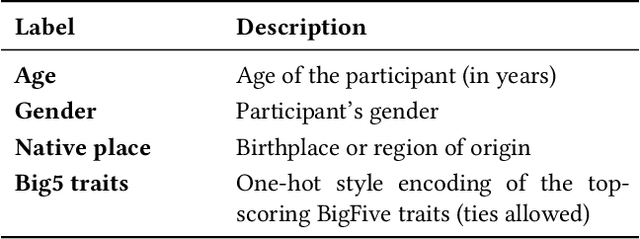
Depression is a widespread mental health issue affecting diverse age groups, with notable prevalence among college students and the elderly. However, existing datasets and detection methods primarily focus on young adults, neglecting the broader age spectrum and individual differences that influence depression manifestation. Current approaches often establish a direct mapping between multimodal data and depression indicators, failing to capture the complexity and diversity of depression across individuals. This challenge includes two tracks based on age-specific subsets: Track 1 uses the MPDD-Elderly dataset for detecting depression in older adults, and Track 2 uses the MPDD-Young dataset for detecting depression in younger participants. The Multimodal Personality-aware Depression Detection (MPDD) Challenge aims to address this gap by incorporating multimodal data alongside individual difference factors. We provide a baseline model that fuses audio and video modalities with individual difference information to detect depression manifestations in diverse populations. This challenge aims to promote the development of more personalized and accurate de pression detection methods, advancing mental health research and fostering inclusive detection systems. More details are available on the official challenge website: https://hacilab.github.io/MPDDChallenge.github.io.