 Add to Chrome
 Add to Firefox
 Add to Edge
3D-Fixer: Coarse-to-Fine In-place Completion for 3D Scenes from a Single Image
Apr 06, 2026
Compositional 3D scene generation from a single view requires the simultaneous recovery of scene layout and 3D assets. Existing approaches mainly fall into two categories: feed-forward generation methods and per-instance generation methods. The former directly predict 3D assets with explicit 6DoF poses through efficient network inference, but they generalize poorly to complex scenes. The latter improve generalization through a divide-and-conquer strategy, but suffer from time-consuming pose optimization. To bridge this gap, we introduce 3D-Fixer, a novel in-place completion paradigm. Specifically, 3D-Fixer extends 3D object generative priors to generate complete 3D assets conditioned on the partially visible point cloud at the original locations, which are cropped from the fragmented geometry obtained from the geometry estimation methods. Unlike prior works that require explicit pose alignment, 3D-Fixer uses fragmented geometry as a spatial anchor to preserve layout fidelity. At its core, we propose a coarse-to-fine generation scheme to resolve boundary ambiguity under occlusion, supported by a dual-branch conditioning network and an Occlusion-Robust Feature Alignment (ORFA) strategy for stable training. Furthermore, to address the data scarcity bottleneck, we present ARSG-110K, the largest scene-level dataset to date, comprising over 110K diverse scenes and 3M annotated images with high-fidelity 3D ground truth. Extensive experiments show that 3D-Fixer achieves state-of-the-art geometric accuracy, which significantly outperforms baselines such as MIDI and Gen3DSR, while maintaining the efficiency of the diffusion process. Code and data will be publicly available at https://zx-yin.github.io/3dfixer.

DreamLifting: A Plug-in Module Lifting MV Diffusion Models for 3D Asset Generation
Sep 09, 2025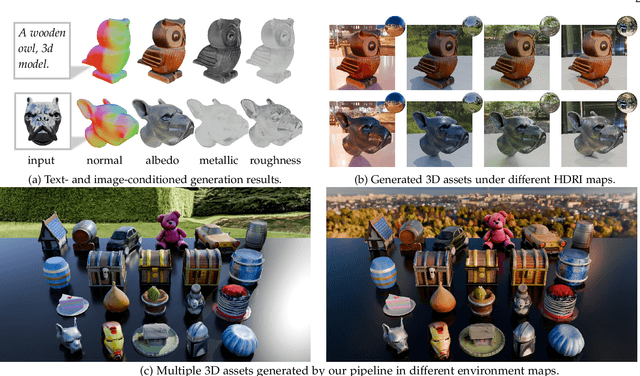

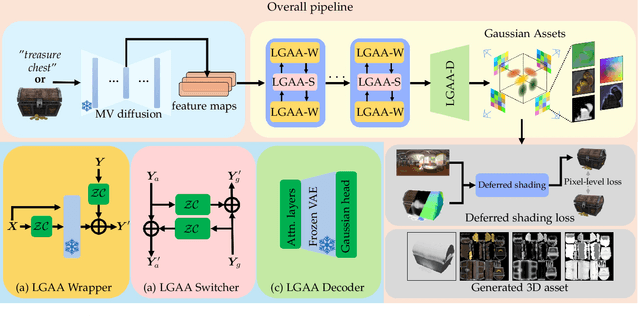

The labor- and experience-intensive creation of 3D assets with physically based rendering (PBR) materials demands an autonomous 3D asset creation pipeline. However, most existing 3D generation methods focus on geometry modeling, either baking textures into simple vertex colors or leaving texture synthesis to post-processing with image diffusion models. To achieve end-to-end PBR-ready 3D asset generation, we present Lightweight Gaussian Asset Adapter (LGAA), a novel framework that unifies the modeling of geometry and PBR materials by exploiting multi-view (MV) diffusion priors from a novel perspective. The LGAA features a modular design with three components. Specifically, the LGAA Wrapper reuses and adapts network layers from MV diffusion models, which encapsulate knowledge acquired from billions of images, enabling better convergence in a data-efficient manner. To incorporate multiple diffusion priors for geometry and PBR synthesis, the LGAA Switcher aligns multiple LGAA Wrapper layers encapsulating different knowledge. Then, a tamed variational autoencoder (VAE), termed LGAA Decoder, is designed to predict 2D Gaussian Splatting (2DGS) with PBR channels. Finally, we introduce a dedicated post-processing procedure to effectively extract high-quality, relightable mesh assets from the resulting 2DGS. Extensive quantitative and qualitative experiments demonstrate the superior performance of LGAA with both text-and image-conditioned MV diffusion models. Additionally, the modular design enables flexible incorporation of multiple diffusion priors, and the knowledge-preserving scheme leads to efficient convergence trained on merely 69k multi-view instances. Our code, pre-trained weights, and the dataset used will be publicly available via our project page: https://zx-yin.github.io/dreamlifting/.
Multi-Space Neural Radiance Fields
May 07, 2023Existing Neural Radiance Fields (NeRF) methods suffer from the existence of reflective objects, often resulting in blurry or distorted rendering. Instead of calculating a single radiance field, we propose a multi-space neural radiance field (MS-NeRF) that represents the scene using a group of feature fields in parallel sub-spaces, which leads to a better understanding of the neural network toward the existence of reflective and refractive objects. Our multi-space scheme works as an enhancement to existing NeRF methods, with only small computational overheads needed for training and inferring the extra-space outputs. We demonstrate the superiority and compatibility of our approach using three representative NeRF-based models, i.e., NeRF, Mip-NeRF, and Mip-NeRF 360. Comparisons are performed on a novelly constructed dataset consisting of 25 synthetic scenes and 7 real captured scenes with complex reflection and refraction, all having 360-degree viewpoints. Extensive experiments show that our approach significantly outperforms the existing single-space NeRF methods for rendering high-quality scenes concerned with complex light paths through mirror-like objects. Our code and dataset will be publicly available at https://zx-yin.github.io/msnerf.
Looking Through the Glass: Neural Surface Reconstruction Against High Specular Reflections
Apr 18, 2023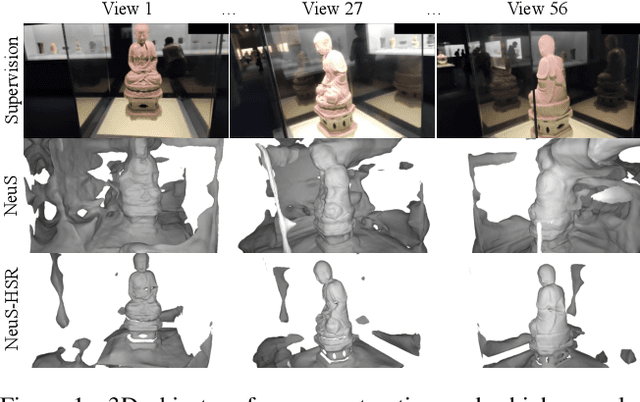
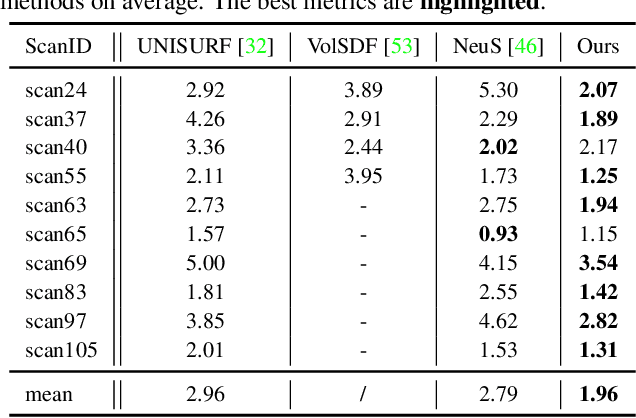
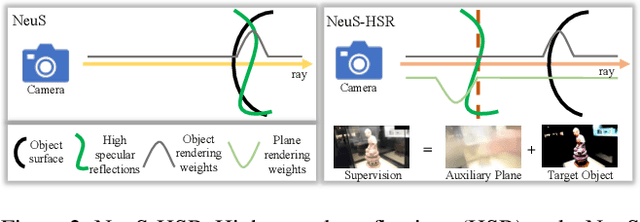

Neural implicit methods have achieved high-quality 3D object surfaces under slight specular highlights. However, high specular reflections (HSR) often appear in front of target objects when we capture them through glasses. The complex ambiguity in these scenes violates the multi-view consistency, then makes it challenging for recent methods to reconstruct target objects correctly. To remedy this issue, we present a novel surface reconstruction framework, NeuS-HSR, based on implicit neural rendering. In NeuS-HSR, the object surface is parameterized as an implicit signed distance function (SDF). To reduce the interference of HSR, we propose decomposing the rendered image into two appearances: the target object and the auxiliary plane. We design a novel auxiliary plane module by combining physical assumptions and neural networks to generate the auxiliary plane appearance. Extensive experiments on synthetic and real-world datasets demonstrate that NeuS-HSR outperforms state-of-the-art approaches for accurate and robust target surface reconstruction against HSR. Code is available at https://github.com/JiaxiongQ/NeuS-HSR.