 Add to Chrome
 Add to Firefox
 Add to Edge
AIChilles: Automatically Uncovering Hidden Weaknesses in AI-Evolved Systems
Jun 14, 2026
The computer systems community has recently seen growing interest in AI-driven system evolution, where AI agents iteratively rewrite systems. Frameworks such as AdaEvolve and Engram report 12-60% score improvements over human-designed algorithms. While these results are promising, there are practical concerns if these AI-evolved programs can perform worse on unseen workloads and exhibit scalability regressions. Given the speed and scale of AI-generated code, we need automated mechanisms to uncover such identify hidden weaknesses in AI-evolved systems programs. To this end, we develop AIChilles that takes as input a baseline program $P$ and an AI-evolved program $P'$, AIChilles searches for valid workloads where $P'$ regresses relative to $P$ in correctness, runtime, memory usage, or output quality. To tackle the diversity in system applications, weakness types and potential bugs, AIChilles combines deterministic workload-parameter extraction, agent-based constraint inference, differential oracles, and code-frequency coverage to discover diverse failures. Across five system applications and 30 AI-evolved programs, AIChilles finds 49 distinct hidden weaknesses. We also show that explicitly including AIChilles in the AI-driven development lifecycle can mitigate several of these weaknesses.

Don't Let a Few Network Failures Slow the Entire AllReduce
Jun 01, 2026Network failures are among the most frequent hardware faults in large-scale GPU clusters and a leading cause of training-job interruptions. Modern collective communication libraries such as NCCL mitigate network failures by rerouting traffic through surviving NICs on the same server, trading reduced inter-node bandwidth for uninterrupted training. However, the degraded server remains on the critical path of the standard ring algorithm, slowing the entire collective. We present the first information-theoretic lower bound on AllReduce completion time under asymmetric network bandwidth and show that when the straggler retains at least half of its original bandwidth, the unavoidable overhead relative to the fault-free optimum is only O(1/p) for p GPUs. We then design OptCC, a four-stage pipelined AllReduce algorithm that approaches this lower bound. Experiments on SimAI confirm that OptCC closes the gap left by existing fault-tolerant schemes: under practical network failures with up to 50% bandwidth loss, OptCC completes AllReduce within 2-6% of NCCL's fault-free ring performance, whereas the state-of-the-art incurs up to 57% overhead.
Reliable and Resilient Collective Communication Library for LLM Training and Serving
Dec 31, 2025Modern ML training and inference now span tens to tens of thousands of GPUs, where network faults can waste 10--15\% of GPU hours due to slow recovery. Common network errors and link fluctuations trigger timeouts that often terminate entire jobs, forcing expensive checkpoint rollback during training and request reprocessing during inference. We present R$^2$CCL, a fault-tolerant communication library that provides lossless, low-overhead failover by exploiting multi-NIC hardware. R$^2$CCL performs rapid connection migration, bandwidth-aware load redistribution, and resilient collective algorithms to maintain progress under failures. We evaluate R$^2$CCL on two 8-GPU H100 InfiniBand servers and via large-scale ML simulators modeling hundreds of GPUs with diverse failure patterns. Experiments show that R$^2$CCL is highly robust to NIC failures, incurring less than 1\% training and less than 3\% inference overheads. R$^2$CCL outperforms baselines AdapCC and DejaVu by 12.18$\times$ and 47$\times$, respectively.
GEAR: An Efficient KV Cache Compression Recipe for Near-Lossless Generative Inference of LLM
Mar 11, 2024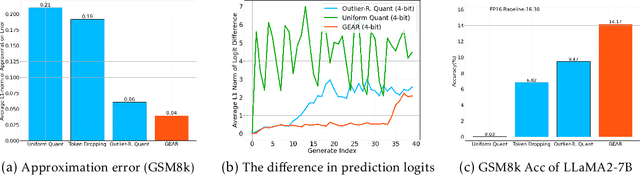
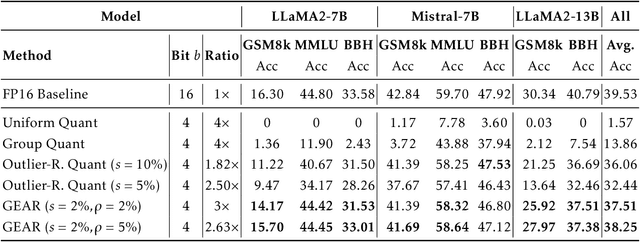
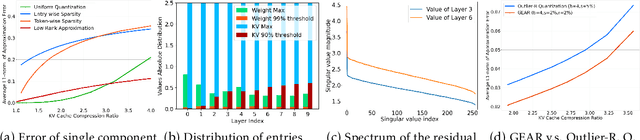
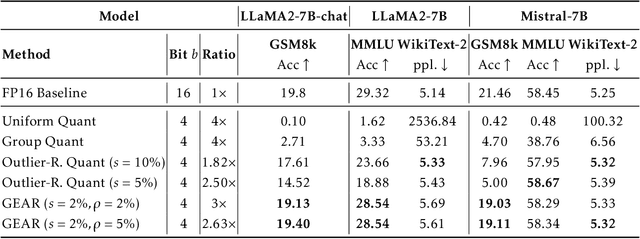
Key-value (KV) caching has become the de-facto to accelerate generation speed for large language models (LLMs) inference. However, the growing cache demand with increasing sequence length has transformed LLM inference to be a memory bound problem, significantly constraining the system throughput. Existing methods rely on dropping unimportant tokens or quantizing all entries uniformly. Such methods, however, often incur high approximation errors to represent the compressed matrices. The autoregressive decoding process further compounds the error of each step, resulting in critical deviation in model generation and deterioration of performance. To tackle this challenge, we propose GEAR, an efficient KV cache compression framework that achieves near-lossless high-ratio compression. GEAR first applies quantization to majority of entries of similar magnitudes to ultra-low precision. It then employs a low rank matrix to approximate the quantization error, and a sparse matrix to remedy individual errors from outlier entries. By adeptly integrating three techniques, GEAR is able to fully exploit their synergistic potentials. Our experiments demonstrate that compared to alternatives, GEAR achieves near-lossless 4-bit KV cache compression with up to 2.38x throughput improvement, while reducing peak-memory size up to 2.29x. Our code is publicly available at https://github.com/HaoKang-Timmy/GEAR.
Privacy for Free: Communication-Efficient Learning with Differential Privacy Using Sketches
Dec 06, 2019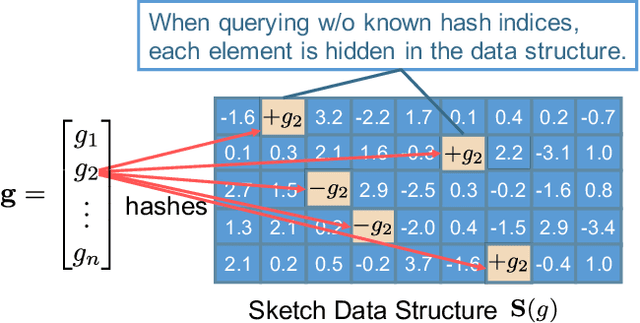
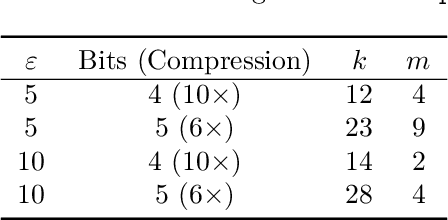
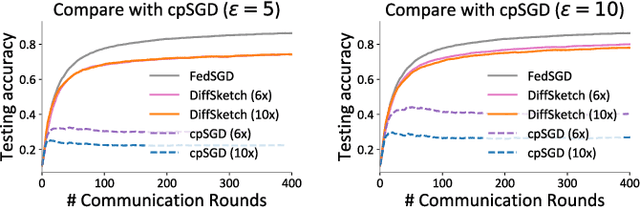
Communication and privacy are two critical concerns in distributed learning. Many existing works treat these concerns separately. In this work, we argue that a natural connection exists between methods for communication reduction and privacy preservation in the context of distributed machine learning. In particular, we prove that Count Sketch, a simple method for data stream summarization, has inherent differential privacy properties. Using these derived privacy guarantees, we propose a novel sketch-based framework (DiffSketch) for distributed learning, where we compress the transmitted messages via sketches to simultaneously achieve communication efficiency and provable privacy benefits. Our evaluation demonstrates that DiffSketch can provide strong differential privacy guarantees (e.g., $\varepsilon$= 1) and reduce communication by 20-50x with only marginal decreases in accuracy. Compared to baselines that treat privacy and communication separately, DiffSketch improves absolute test accuracy by 5%-50% while offering the same privacy guarantees and communication compression.
Enhancing the Privacy of Federated Learning with Sketching
Nov 05, 2019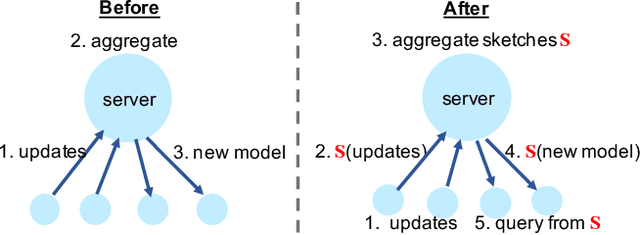
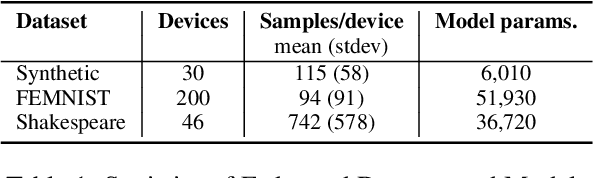
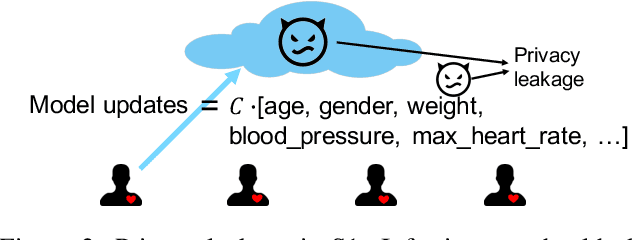
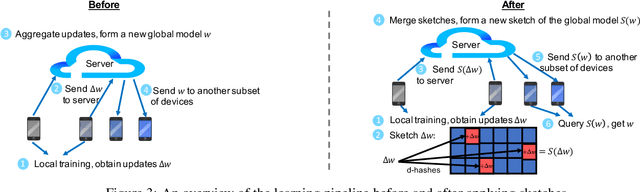
In response to growing concerns about user privacy, federated learning has emerged as a promising tool to train statistical models over networks of devices while keeping data localized. Federated learning methods run training tasks directly on user devices and do not share the raw user data with third parties. However, current methods still share model updates, which may contain private information (e.g., one's weight and height), during the training process. Existing efforts that aim to improve the privacy of federated learning make compromises in one or more of the following key areas: performance (particularly communication cost), accuracy, or privacy. To better optimize these trade-offs, we propose that \textit{sketching algorithms} have a unique advantage in that they can provide both privacy and performance benefits while maintaining accuracy. We evaluate the feasibility of sketching-based federated learning with a prototype on three representative learning models. Our initial findings show that it is possible to provide strong privacy guarantees for federated learning without sacrificing performance or accuracy. Our work highlights that there exists a fundamental connection between privacy and communication in distributed settings, and suggests important open problems surrounding the theoretical understanding, methodology, and system design of practical, private federated learning.