 Add to Chrome
 Add to Firefox
 Add to Edge
Probe Before You Edit: Probing-Guided Molecular Optimization for LLM Agents in Structure-Based Drug Design
May 30, 2026
Structure-based drug design increasingly employs LLM agents to iteratively refine ligands against a target pocket, yet a viable ligand must satisfy two often-conflicting objectives -- binding affinity and druggability -- which single optimization steps rarely improve together. To quantify this difficulty, we introduce two diagnostic metrics: the first measures how often a single edit improves both objectives, and the second measures how often a gain on one objective comes with a loss on the other. Applying these diagnostics to current LLM-agent pipelines exposes a consistent failure mode: the agent performs molecular editing without knowing how the pocket-ligand complex responds to local modifications, thus rarely achieving joint improvement. Inspired by medicinal chemists, who probe the pocket-ligand complex with controlled analog edits before choosing an optimization direction, we propose \textbf{PROBE}, an optimization framework built around edit-response probing. PROBE first decomposes the ligand into editable sites and builds a pocket-specific \textbf{site map} that flags where joint gains are plausible, where the two objectives are likely in tension, and where liability substructures should be changed; it then performs controlled probe edits whose responses are distilled into an \textbf{EditManual}. Guided by the site map and EditManual, PROBE runs an iterative multi-agent loop in which an affinity agent, a druggability agent, and a co-optimization agent jointly produce edits. On the CrossDocked2020 benchmark, PROBE achieves state-of-the-art performance and substantially mitigates the failure modes exposed by our diagnostics metrics.

Enhancing Protein-Protein Interaction Prediction with Hierarchical Motif-based Multimodal Protein Embedding
May 30, 2026Protein-protein interactions (PPIs) are essential for many biological processes. However, existing PPI prediction approaches suffer from two major limitations: they overlook the hierarchical organization of proteins, particularly meso-scale motifs that critically regulate PPIs, and fail to effectively integrate sequence, structure, and function modalities. To address these limitations, we propose MMM-PPI, a Hierarchical Motif-based Multi-Modal protein Encoder for PPI Prediction that constructs PPI embeddings in a bottom-up multi-modal manner across three scales. At the micro-scale, we encode three modal residue features; at the meso-scale, a novel multimodal motif encoder aggregates residues into spatially-informed motif embeddings; at the macro-scale, a multimodal protein encoder integrates motifs into protein embeddings by jointly modeling motif importance and inter-modal correlations. The pre-trained encoder can be used off-the-shelf for large-scale PPI prediction. Extensive experiments on multiple PPI datasets show that MMM-PPI outperforms state-of-the-art multi-label PPI prediction models, particularly under challenging data partitions and limited data scenarios. Codes are in https://github.com/yzf-code/MMM-PPI.
HERM: Benchmarking and Enhancing Multimodal LLMs for Human-Centric Understanding
Oct 09, 2024The significant advancements in visual understanding and instruction following from Multimodal Large Language Models (MLLMs) have opened up more possibilities for broader applications in diverse and universal human-centric scenarios. However, existing image-text data may not support the precise modality alignment and integration of multi-grained information, which is crucial for human-centric visual understanding. In this paper, we introduce HERM-Bench, a benchmark for evaluating the human-centric understanding capabilities of MLLMs. Our work reveals the limitations of existing MLLMs in understanding complex human-centric scenarios. To address these challenges, we present HERM-100K, a comprehensive dataset with multi-level human-centric annotations, aimed at enhancing MLLMs' training. Furthermore, we develop HERM-7B, a MLLM that leverages enhanced training data from HERM-100K. Evaluations on HERM-Bench demonstrate that HERM-7B significantly outperforms existing MLLMs across various human-centric dimensions, reflecting the current inadequacy of data annotations used in MLLM training for human-centric visual understanding. This research emphasizes the importance of specialized datasets and benchmarks in advancing the MLLMs' capabilities for human-centric understanding.
Accurate and interpretable drug-drug interaction prediction enabled by knowledge subgraph learning
Nov 25, 2023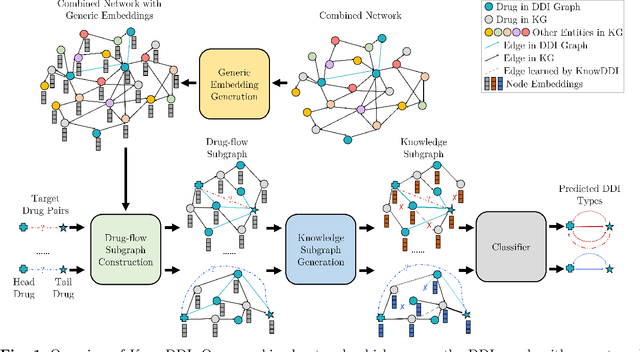
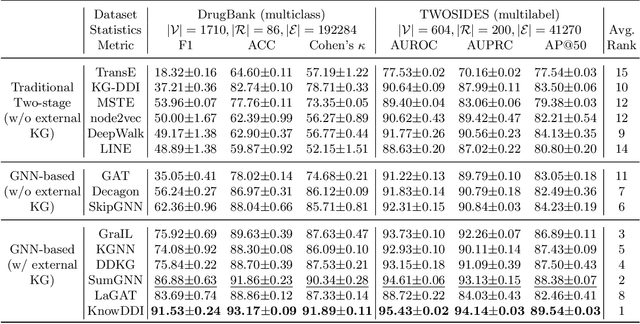
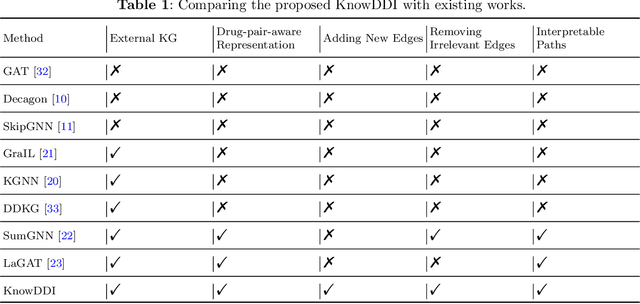
Background: Discovering potential drug-drug interactions (DDIs) is a long-standing challenge in clinical treatments and drug developments. Recently, deep learning techniques have been developed for DDI prediction. However, they generally require a huge number of samples, while known DDIs are rare. Methods: In this work, we present KnowDDI, a graph neural network-based method that addresses the above challenge. KnowDDI enhances drug representations by adaptively leveraging rich neighborhood information from large biomedical knowledge graphs. Then, it learns a knowledge subgraph for each drug-pair to interpret the predicted DDI, where each of the edges is associated with a connection strength indicating the importance of a known DDI or resembling strength between a drug-pair whose connection is unknown. Thus, the lack of DDIs is implicitly compensated by the enriched drug representations and propagated drug similarities. Results: We evaluate KnowDDI on two benchmark DDI datasets. Results show that KnowDDI obtains the state-of-the-art prediction performance with better interpretability. We also find that KnowDDI suffers less than existing works given a sparser knowledge graph. This indicates that the propagated drug similarities play a more important role in compensating for the lack of DDIs when the drug representations are less enriched. Conclusions: KnowDDI nicely combines the efficiency of deep learning techniques and the rich prior knowledge in biomedical knowledge graphs. As an original open-source tool, KnowDDI can help detect possible interactions in a broad range of relevant interaction prediction tasks, such as protein-protein interactions, drug-target interactions and disease-gene interactions, eventually promoting the development of biomedicine and healthcare.