 Add to Chrome
 Add to Firefox
 Add to Edge
PEEL: Parallel Extraction for Long-Horizon Disassembly Planning via Scale-Invariant Sampling
Aug 09, 2026
Long-horizon multi-part object disassembly requires robots to compute feasible sequences of collision-free removal motions, even in the presence of tight, narrow escape corridors. To efficiently solve such disassembly problems, we propose Parallel Extraction for Long-Horizon Disassembly (PEEL), an algorithm which efficiently computes disassembly motions for object assemblies and feeds them to a robot manipulator for execution. PEEL uses sampling-based motion planning to compute single-object motions through the use of a scale-invariant sampling scheme, where the object scale is estimated in a burn-in phase and a subsequent directional sampler exploits the scale. This sampling scheme is integrated into a multi-arm bandit rapidly-exploring random tree (MAB-RRT) planner, which switches between different samplers depending on the reward signal received. Using MAB-RRT, the PEEL algorithm runs a batch of planners in parallel to obtain an ordered graph specifying the sequence in which object parts have to be removed. We show that MAB-RRT can efficiently solve single-part disassemblies with 100 percent success rate on 76 assemblies, and that it is robust to its parameters. By integrating MAB-RRT into PEEL, we solve four long-horizon disassembly problems using the Fetch manipulator robot involving 10 to 17 individual object parts.

Fast Asymptotically Optimal Kinodynamic Planning via Vectorization
Jul 04, 2026Sampling-based motion planners have been shown to be effective for systems with complex kinodynamic constraints and high dimensionality. However, these algorithms struggle to achieve real-time performance, leading to recent efforts to parallelize planning. While GPU-accelerated planners have achieved significant speedups, existing approaches require specialized CUDA programming that limits accessibility and portability. We present Parallel Asymptotically Optimal Kinodynamic RRT (PAKR), a massively parallel kinodynamic planner leveraging JAX and the XLA compiler to achieve GPU acceleration through standard Python tooling. By combining our parallel planner with the AO-x meta-algorithm, we achieve asymptotic optimality through fast iterative replanning. We provide a theoretical analysis of probabilistic completeness, analyze the effects of batch size and branching factor on convergence, and demonstrate scalability to complex dynamics using the MuJoCo-XLA simulator. Experiments show competitive runtimes with state-of-the-art GPU planners and superior solution quality.
NeHMO: Neural Hamilton-Jacobi Reachability Learning for Decentralized Safe Multi-Arm Motion Planning
Jul 01, 2026Safe multi-arm motion planning is a challenging problem in robotics due to its high dimensionality, coupled configuration space, and complex collision constraints. Centralized planners are capable of coordinating all arms but often face scalability limitations, restricting applicability in real-time settings. On the other hand, decentralized methods are scalable and recent deep learning-based approaches have shown promising results. However, these depend on accurate behavior prediction or coordination protocols and may fail when other arms act unpredictably. To address these challenges, we introduce a neural Hamilton-Jacobi Reachability (HJR) learning-based approach to approximate a safety value function that captures worst-case inter-arm safety constraints. We further develop a decentralized trajectory optimization framework that uses the learned HJR representation for real-time planning. The proposed method is scalable and data-efficient, generalizes across multi-manipulator systems, and outperforms state-of-the-art baselines on challenging multi-arm motion planning tasks.
Think Fast and Far: Long-Horizon Online POMDP Planning via Rapid State Sampling
Jun 03, 2026Partially Observable Markov Decision Processes (POMDPs) are a general and principled framework for motion planning under uncertainty. Despite tremendous improvement in the scalability of POMDP solvers, long-horizon POMDPs remain difficult to solve. To alleviate the difficulty, this paper proposes a new approximate online POMDP solver, called Reference-Based Online POMDP Planning via Rapid State Space Sampling (ROP-RAS3). ROP-RAS3 uses novel extremely fast sampling-based motion planning techniques to sample the state space and generate a diverse set of macro actions online, which are then used to bias belief-space sampling and infer high-quality policies without requiring exhaustive enumeration of the action space -- a fundamental constraint for modern online POMDP solvers. ROP-RAS3 converges to a near-optimal reference-based solution at a rate that depends on the number of sampled actions, rather than the size of the action space. ROP-RAS3 is evaluated on various long-horizon POMDPs with up to 3000 lookahead steps and 35-dimensional state spaces, where the state, action and observation spaces can be continuous, discrete, or a hybrid of discrete and continuous. Although the reference-based optimal solution may not be the same as the optimal POMDP solution, empirical results indicate that in all of these problems, in terms of success rate, ROP-RAS3 outperforms other state-of-the-art methods by up to multiple folds. We also demonstrate the capability of our approach on a physical robot demonstration. This work extends the theory and empirical results of our ISRR24 paper. Code can be found at \texttt{https://github.com/RDLLab/ROPRAS3}.
Vectorizing Projection in Manifold-Constrained Motion Planning for Real-Time Whole-Body Control
Apr 14, 2026Many robot planning tasks require satisfaction of one or more constraints throughout the entire trajectory. For geometric constraints, manifold-constrained motion planning algorithms are capable of planning collision-free path between start and goal configurations on the constraint submanifolds specified by task. Current state-of-the-art methods can take tens of seconds to solve these tasks for complex systems such as humanoid robots, making real-world use impractical, especially in dynamic settings. Inspired by recent advances in hardware accelerated motion planning, we present a CPU SIMD-accelerated manifold-constrained motion planner that revisits projection-based constraint satisfaction through the lens of parallelization. By transforming relevant components into parallelizable structures, we use SIMD parallelism to plan constraint satisfying solutions. Our approach achieves up to 100-1000x speed-ups over the state-of-the-art, making real-time constrained motion planning feasible for the first time. We demonstrate our planner on a real humanoid robot and show real-time whole-body quasi-static plan generation. Our work is available at https://commalab.org/papers/mcvamp/.
Ultrafast Sampling-based Kinodynamic Planning via Differential Flatness
Mar 17, 2026Motion planning under dynamics constraints, i.e., kinodynamic planning, enables safe robot operation by generating dynamically feasible trajectories that the robot can accurately track. For high-\dof robots such as manipulators, sampling-based motion planners are commonly used, especially for complex tasks in cluttered environments. However, enforcing constraints on robot dynamics in such planners requires solving either challenging two-point boundary value problems (BVPs) or propagating robot dynamics over time, both of which are computational bottlenecks that drastically increase planning times. Meanwhile, recent efforts have shown that sampling-based motion planners can generate plans in microseconds using parallelization, but are limited to geometric paths. This paper develops AkinoPDF, a fast parallelized sampling-based kinodynamic motion planning technique for a broad class of differentially flat robot systems, including manipulators, ground and aerial vehicles, and more. Differential flatness allows us to transform the motion planning problem from the original state space to a flat output space, where an analytical time-parameterized solution of the BVP and dynamics integration can be obtained. A trajectory in the flat output space is then converted back to a closed-form dynamically feasible trajectory in the original state space, enabling fast validation via ``single instruction, multiple data" parallelism. Our method is fast, exact, and compatible with any sampling-based motion planner. We extensively verify the effectiveness of our approach in both simulated benchmarks and real experiments with cluttered and dynamic environments, requiring mere microseconds to milliseconds of planning time.
AgenticLab: A Real-World Robot Agent Platform that Can See, Think, and Act
Feb 02, 2026Recent advances in large vision-language models (VLMs) have demonstrated generalizable open-vocabulary perception and reasoning, yet their real-robot manipulation capability remains unclear for long-horizon, closed-loop execution in unstructured, in-the-wild environments. Prior VLM-based manipulation pipelines are difficult to compare across different research groups' setups, and many evaluations rely on simulation, privileged state, or specially designed setups. We present AgenticLab, a model-agnostic robot agent platform and benchmark for open-world manipulation. AgenticLab provides a closed-loop agent pipeline for perception, task decomposition, online verification, and replanning. Using AgenticLab, we benchmark state-of-the-art VLM-based agents on real-robot tasks in unstructured environments. Our benchmark reveals several failure modes that offline vision-language tests (e.g., VQA and static image understanding) fail to capture, including breakdowns in multi-step grounding consistency, object grounding under occlusion and scene changes, and insufficient spatial reasoning for reliable manipulation. We will release the full hardware and software stack to support reproducible evaluation and accelerate research on general-purpose robot agents.
Differentiable Particle Optimization for Fast Sequential Manipulation
Oct 09, 2025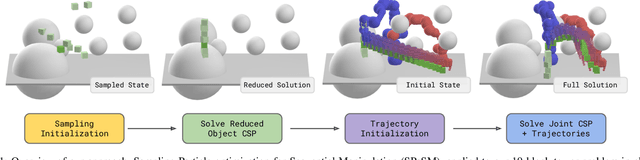
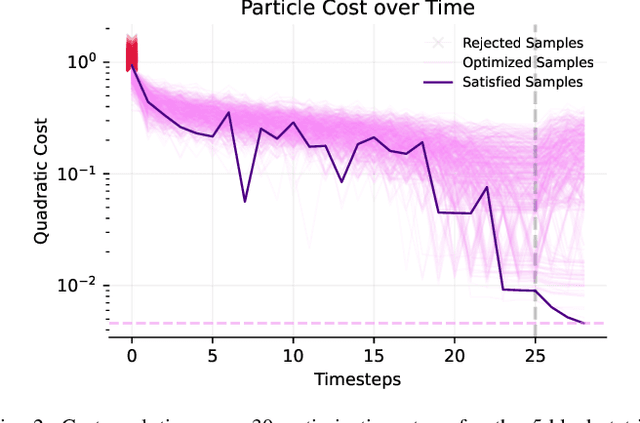
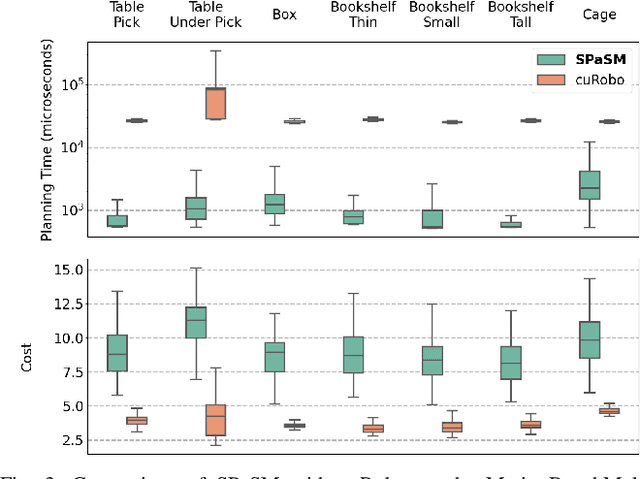
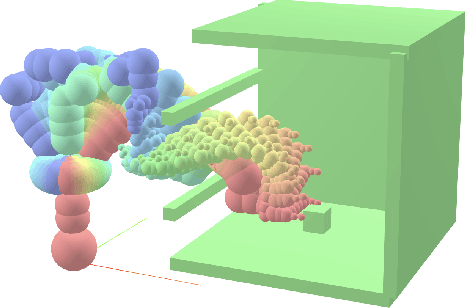
Sequential robot manipulation tasks require finding collision-free trajectories that satisfy geometric constraints across multiple object interactions in potentially high-dimensional configuration spaces. Solving these problems in real-time and at large scales has remained out of reach due to computational requirements. Recently, GPU-based acceleration has shown promising results, but prior methods achieve limited performance due to CPU-GPU data transfer overhead and complex logic that prevents full hardware utilization. To this end, we present SPaSM (Sampling Particle optimization for Sequential Manipulation), a fully GPU-parallelized framework that compiles constraint evaluation, sampling, and gradient-based optimization into optimized CUDA kernels for end-to-end trajectory optimization without CPU coordination. The method consists of a two-stage particle optimization strategy: first solving placement constraints through massively parallel sampling, then lifting solutions to full trajectory optimization in joint space. Unlike hierarchical approaches, SPaSM jointly optimizes object placements and robot trajectories to handle scenarios where motion feasibility constrains placement options. Experimental evaluation on challenging benchmarks demonstrates solution times in the realm of $\textbf{milliseconds}$ with a 100% success rate; a $4000\times$ speedup compared to existing approaches.
Parallel Simulation of Contact and Actuation for Soft Growing Robots
Sep 18, 2025Soft growing robots, commonly referred to as vine robots, have demonstrated remarkable ability to interact safely and robustly with unstructured and dynamic environments. It is therefore natural to exploit contact with the environment for planning and design optimization tasks. Previous research has focused on planning under contact for passively deforming robots with pre-formed bends. However, adding active steering to these soft growing robots is necessary for successful navigation in more complex environments. To this end, we develop a unified modeling framework that integrates vine robot growth, bending, actuation, and obstacle contact. We extend the beam moment model to include the effects of actuation on kinematics under growth and then use these models to develop a fast parallel simulation framework. We validate our model and simulator with real robot experiments. To showcase the capabilities of our framework, we apply our model in a design optimization task to find designs for vine robots navigating through cluttered environments, identifying designs that minimize the number of required actuators by exploiting environmental contacts. We show the robustness of the designs to environmental and manufacturing uncertainties. Finally, we fabricate an optimized design and successfully deploy it in an obstacle-rich environment.
Variational Shape Inference for Grasp Diffusion on SE(3)
Aug 24, 2025Grasp synthesis is a fundamental task in robotic manipulation which usually has multiple feasible solutions. Multimodal grasp synthesis seeks to generate diverse sets of stable grasps conditioned on object geometry, making the robust learning of geometric features crucial for success. To address this challenge, we propose a framework for learning multimodal grasp distributions that leverages variational shape inference to enhance robustness against shape noise and measurement sparsity. Our approach first trains a variational autoencoder for shape inference using implicit neural representations, and then uses these learned geometric features to guide a diffusion model for grasp synthesis on the SE(3) manifold. Additionally, we introduce a test-time grasp optimization technique that can be integrated as a plugin to further enhance grasping performance. Experimental results demonstrate that our shape inference for grasp synthesis formulation outperforms state-of-the-art multimodal grasp synthesis methods on the ACRONYM dataset by 6.3%, while demonstrating robustness to deterioration in point cloud density compared to other approaches. Furthermore, our trained model achieves zero-shot transfer to real-world manipulation of household objects, generating 34% more successful grasps than baselines despite measurement noise and point cloud calibration errors.