 Add to Chrome
 Add to Firefox
 Add to Edge
Enabling Ultra-Fast Cardiovascular Imaging Across Heterogeneous Clinical Environments with a Generalist Foundation Model and Multimodal Database
Dec 25, 2025
Multimodal cardiovascular magnetic resonance (CMR) imaging provides comprehensive and non-invasive insights into cardiovascular disease (CVD) diagnosis and underlying mechanisms. Despite decades of advancements, its widespread clinical adoption remains constrained by prolonged scan times and heterogeneity across medical environments. This underscores the urgent need for a generalist reconstruction foundation model for ultra-fast CMR imaging, one capable of adapting across diverse imaging scenarios and serving as the essential substrate for all downstream analyses. To enable this goal, we curate MMCMR-427K, the largest and most comprehensive multimodal CMR k-space database to date, comprising 427,465 multi-coil k-space data paired with structured metadata across 13 international centers, 12 CMR modalities, 15 scanners, and 17 CVD categories in populations across three continents. Building on this unprecedented resource, we introduce CardioMM, a generalist reconstruction foundation model capable of dynamically adapting to heterogeneous fast CMR imaging scenarios. CardioMM unifies semantic contextual understanding with physics-informed data consistency to deliver robust reconstructions across varied scanners, protocols, and patient presentations. Comprehensive evaluations demonstrate that CardioMM achieves state-of-the-art performance in the internal centers and exhibits strong zero-shot generalization to unseen external settings. Even at imaging acceleration up to 24x, CardioMM reliably preserves key cardiac phenotypes, quantitative myocardial biomarkers, and diagnostic image quality, enabling a substantial increase in CMR examination throughput without compromising clinical integrity. Together, our open-access MMCMR-427K database and CardioMM framework establish a scalable pathway toward high-throughput, high-quality, and clinically accessible cardiovascular imaging.

Compressed Sensing MRI via a Multi-scale Dilated Residual Convolution Network
Jun 11, 2019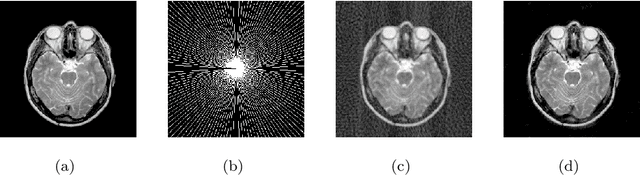
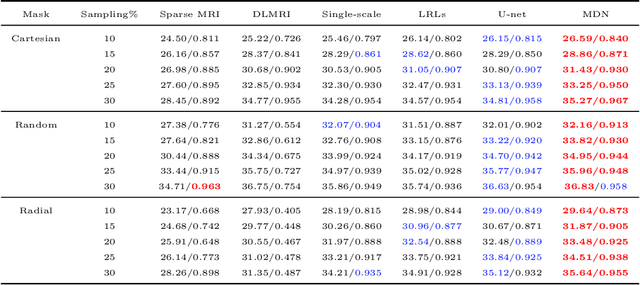
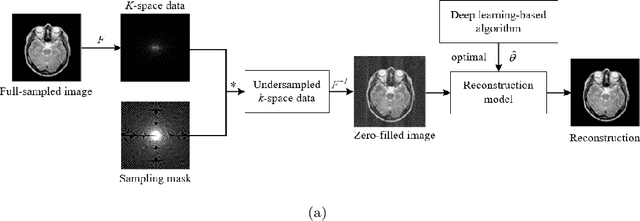
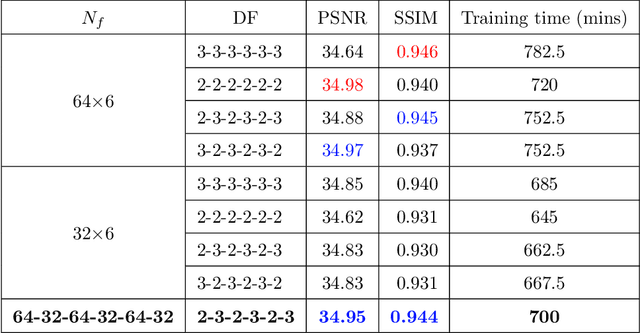
Magnetic resonance imaging (MRI) reconstruction is an active inverse problem which can be addressed by conventional compressed sensing (CS) MRI algorithms that exploit the sparse nature of MRI in an iterative optimization-based manner. However, two main drawbacks of iterative optimization-based CSMRI methods are time-consuming and are limited in model capacity. Meanwhile, one main challenge for recent deep learning-based CSMRI is the trade-off between model performance and network size. To address the above issues, we develop a new multi-scale dilated network for MRI reconstruction with high speed and outstanding performance. Comparing to convolutional kernels with same receptive fields, dilated convolutions reduce network parameters with smaller kernels and expand receptive fields of kernels to obtain almost same information. To maintain the abundance of features, we present global and local residual learnings to extract more image edges and details. Then we utilize concatenation layers to fuse multi-scale features and residual learnings for better reconstruction. Compared with several non-deep and deep learning CSMRI algorithms, the proposed method yields better reconstruction accuracy and noticeable visual improvements. In addition, we perform the noisy setting to verify the model stability, and then extend the proposed model on a MRI super-resolution task.