 Add to Chrome
 Add to Firefox
 Add to Edge
UniM: A Unified Any-to-Any Interleaved Multimodal Benchmark
Mar 05, 2026
In real-world multimodal applications, systems usually need to comprehend arbitrarily combined and interleaved multimodal inputs from users, while also generating outputs in any interleaved multimedia form. This capability defines the goal of any-to-any interleaved multimodal learning under a unified paradigm of understanding and generation, posing new challenges and opportunities for advancing Multimodal Large Language Models (MLLMs). To foster and benchmark this capability, this paper introduces the UniM benchmark, the first Unified Any-to-Any Interleaved Multimodal dataset. UniM contains 31K high-quality instances across 30 domains and 7 representative modalities: text, image, audio, video, document, code, and 3D, each requiring multiple intertwined reasoning and generation capabilities. We further introduce the UniM Evaluation Suite, which assesses models along three dimensions: Semantic Correctness & Generation Quality, Response Structure Integrity, and Interleaved Coherence. In addition, we propose UniMA, an agentic baseline model equipped with traceable reasoning for structured interleaved generation. Comprehensive experiments demonstrate the difficulty of UniM and highlight key challenges and directions for advancing unified any-to-any multimodal intelligence. The project page is https://any2any-mllm.github.io/unim.

TraGraph-GS: Trajectory Graph-based Gaussian Splatting for Arbitrary Large-Scale Scene Rendering
Jun 10, 2025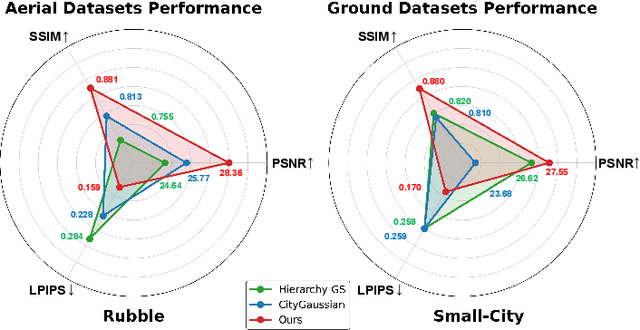
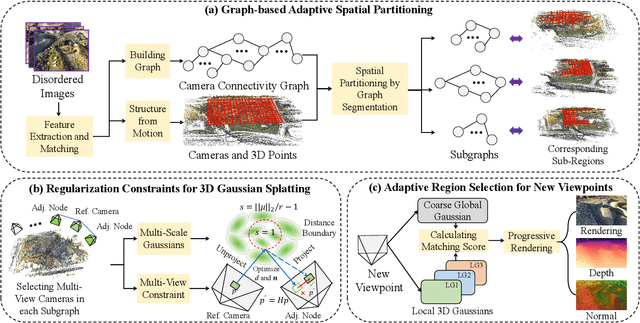
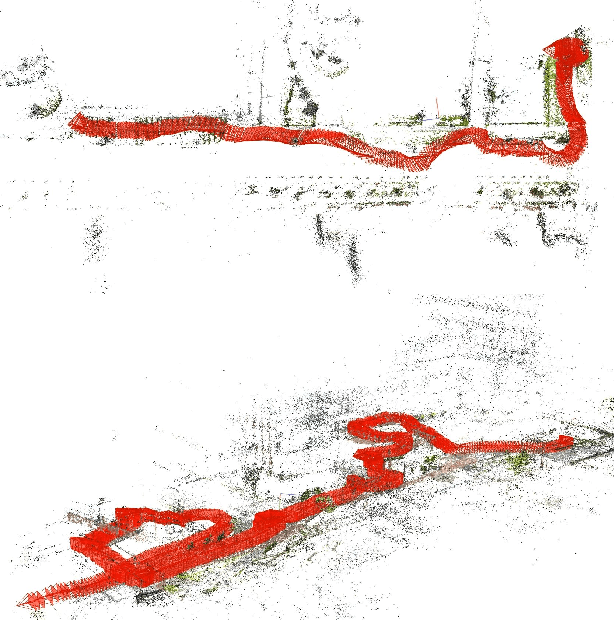
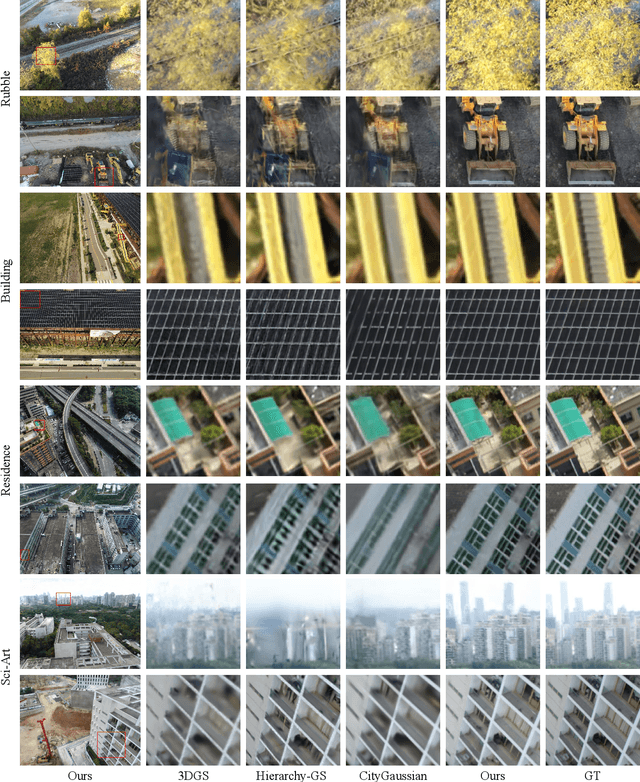
High-quality novel view synthesis for large-scale scenes presents a challenging dilemma in 3D computer vision. Existing methods typically partition large scenes into multiple regions, reconstruct a 3D representation using Gaussian splatting for each region, and eventually merge them for novel view rendering. They can accurately render specific scenes, yet they do not generalize effectively for two reasons: (1) rigid spatial partition techniques struggle with arbitrary camera trajectories, and (2) the merging of regions results in Gaussian overlap to distort texture details. To address these challenges, we propose TraGraph-GS, leveraging a trajectory graph to enable high-precision rendering for arbitrarily large-scale scenes. We present a spatial partitioning method for large-scale scenes based on graphs, which incorporates a regularization constraint to enhance the rendering of textures and distant objects, as well as a progressive rendering strategy to mitigate artifacts caused by Gaussian overlap. Experimental results demonstrate its superior performance both on four aerial and four ground datasets and highlight its remarkable efficiency: our method achieves an average improvement of 1.86 dB in PSNR on aerial datasets and 1.62 dB on ground datasets compared to state-of-the-art approaches.