 Add to Chrome
 Add to Firefox
 Add to Edge
EEG-EditBench: Probing Visual Information in EEG-Image Retrieval Models with Controlled Image Edits
Jul 30, 2026
Recent EEG-to-image retrieval models have achieved strong performance in identifying viewed images from semantically diverse candidates. Yet such success does not reveal what visual information supports the match. A model may readily identify a cheetah among tools, plants, and vehicles, but can it still distinguish the viewed cheetah from the same scene with the cheetah replaced by a dog? Motivated by this question, we introduce EEG-EditBench, a diagnostic benchmark that examines this question through controlled edits of object identity, attributes, background, and object presence. Built from the 200 THINGS-EEG2 test images, EEG-EditBench contains 2,137 quality-controlled edits and evaluates eight representative EEG visual decoding models. Our results show that strong standard retrieval does not consistently transfer to edit-based evaluation, with fine-grained attribute changes presenting the greatest challenge. EEG-EditBench reveals model behavior hidden by aggregate retrieval accuracy and provides a controlled basis for studying what visual information EEG-image models preserve. The code and complete dataset are publicly available.

Towards Adaptive Open-Set Object Detection via Category-Level Collaboration Knowledge Mining
Apr 13, 2026Existing object detectors often struggle to generalize across domains while adapting to emerging novel categories. Adaptive open-set object detection (AOOD) addresses this challenge by training on base categories in the source domain and adapting to both base and novel categories in the target domain without target annotations. However, current AOOD methods remain limited by weak cross-domain representations, ambiguity among novel categories, and source-domain feature bias. To address these issues, we propose a category-level collaboration knowledge mining strategy that exploits both inter-class and intra-class relationships across domains. Specifically, we construct a clustering-based memory bank to encode class prototypes, auxiliary features, and intra-class disparity information, and iteratively update it via unsupervised clustering to enhance category-level knowledge representation. We further design a base-to-novel selection metric to discover source-domain features related to novel categories and use them to initialize novel-category classifiers. In addition, an adaptive feature assignment strategy transfers the learned category-level knowledge to the target domain and asynchronously updates the memory bank to alleviate source-domain bias. Extensive experiments on multiple benchmarks show that our method consistently surpasses state-of-the-art AOOD methods by 1.1-5.5 mAP.
CognitionCapturerPro: Towards High-Fidelity Visual Decoding from EEG/MEG via Multi-modal Information and Asymmetric Alignment
Mar 13, 2026Visual stimuli reconstruction from EEG remains challenging due to fidelity loss and representation shift. We propose CognitionCapturerPro, an enhanced framework that integrates EEG with multi-modal priors (images, text, depth, and edges) via collaborative training. Our core contributions include an uncertainty-weighted similarity scoring mechanism to quantify modality-specific fidelity and a fusion encoder for integrating shared representations. By employing a simplified alignment module and a pre-trained diffusion model, our method significantly outperforms the original CognitionCapturer on the THINGS-EEG dataset, improving Top-1 and Top-5 retrieval accuracy by 25.9% and 10.6%, respectively. Code is available at: https://github.com/XiaoZhangYES/CognitionCapturerPro.
Navigate Biopsy with Ultrasound under Augmented Reality Device: Towards Higher System Performance
Feb 04, 2024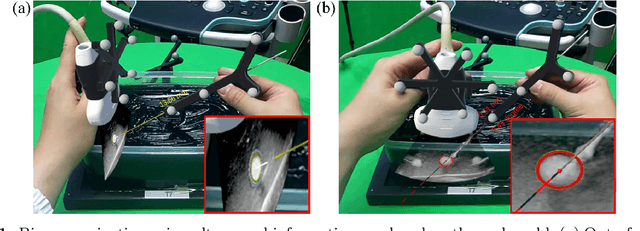
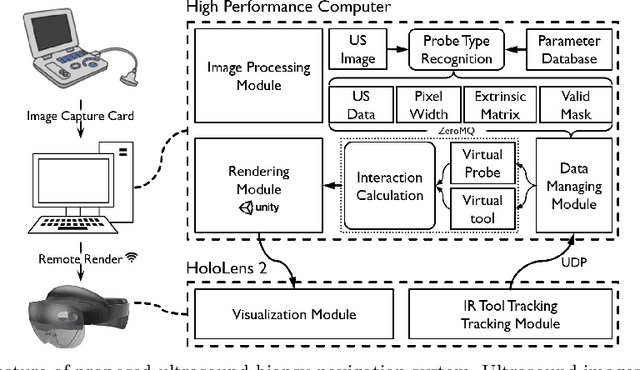
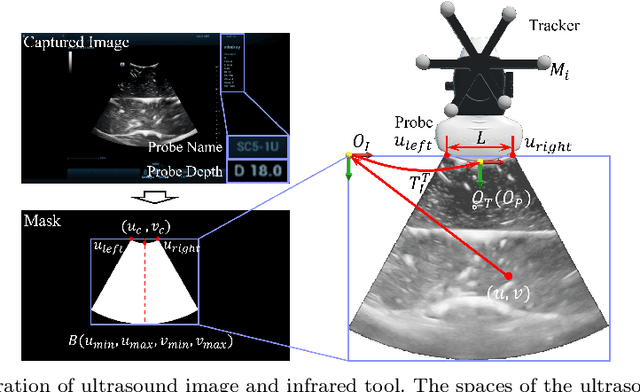
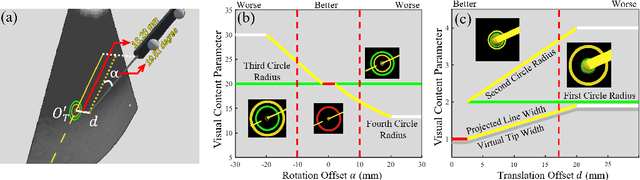
Purpose: Biopsies play a crucial role in determining the classification and staging of tumors. Ultrasound is frequently used in this procedure to provide real-time anatomical information. Using augmented reality (AR), surgeons can visualize ultrasound data and spatial navigation information seamlessly integrated with real tissues. This innovation facilitates faster and more precise biopsy operations. Methods: We developed an AR biopsy navigation system with low display latency and high accuracy. Ultrasound data is initially read by an image capture card and streamed to Unity via net communication. In Unity, navigation information is rendered and transmitted to the HoloLens 2 device using holographic remoting. Retro-reflective tool tracking is implemented on the HoloLens 2, enabling simultaneous tracking of the ultrasound probe and biopsy needle. Distinct navigation information is provided during in-plane and out-of-plane punctuation. To evaluate the effectiveness of our system, we conducted a study involving ten participants, for puncture accuracy and biopsy time, comparing to traditional methods. Results: Our proposed framework enables ultrasound visualization in AR with only $16.22\pm11.45ms$ additional latency. Navigation accuracy reached $1.23\pm 0.68mm$ in the image plane and $0.95\pm 0.70mm$ outside the image plane. Remarkably, the utilization of our system led to $98\%$ and $95\%$ success rate in out-of-plane and in-plane biopsy. Conclusion: To sum up, this paper introduces an AR-based ultrasound biopsy navigation system characterized by high navigation accuracy and minimal latency. The system provides distinct visualization contents during in-plane and out-of-plane operations according to their different characteristics. Use case study in this paper proved that our system can help young surgeons perform biopsy faster and more accurately.