 Add to Chrome
 Add to Firefox
 Add to Edge
LoViF 2026 The First Challenge on Weather Removal in Videos
Apr 14, 2026
This paper presents a review of the LoViF 2026 Challenge on Weather Removal in Videos. The challenge encourages the development of methods for restoring clean videos from inputs degraded by adverse weather conditions such as rain and snow, with an emphasis on achieving visually plausible and temporally consistent results while preserving scene structure and motion dynamics. To support this task, we introduce a new short-form WRV dataset tailored for video weather removal. It consists of 18 videos 1,216 synthesized frames paired with 1,216 real-world ground-truth frames at a resolution of 832 x 480, and is split into training, validation, and test sets with a ratio of 1:1:1. The goal of this challenge is to advance robust and realistic video restoration under real-world weather conditions, with evaluation protocols that jointly consider fidelity and perceptual quality. The challenge attracted 37 participants and received 5 valid final submissions with corresponding fact sheets, contributing to progress in weather removal for videos. The project is publicly available at https://www.codabench.org/competitions/13462/.

Path and Bone-Contour Regularized Unpaired MRI-to-CT Translation
May 06, 2025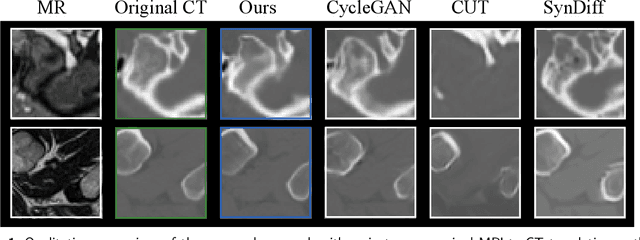
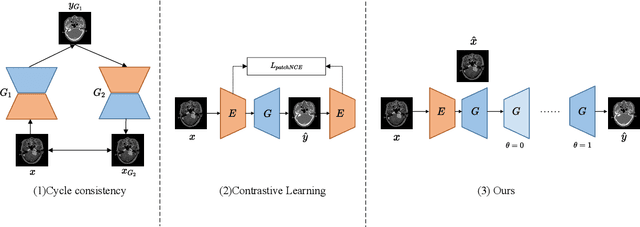
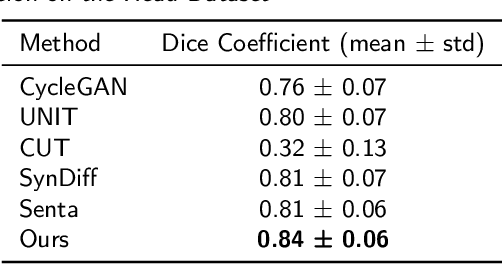
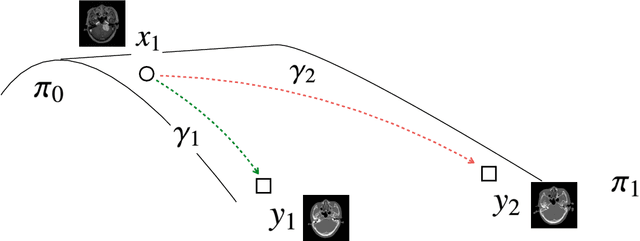
Accurate MRI-to-CT translation promises the integration of complementary imaging information without the need for additional imaging sessions. Given the practical challenges associated with acquiring paired MRI and CT scans, the development of robust methods capable of leveraging unpaired datasets is essential for advancing the MRI-to-CT translation. Current unpaired MRI-to-CT translation methods, which predominantly rely on cycle consistency and contrastive learning frameworks, frequently encounter challenges in accurately translating anatomical features that are highly discernible on CT but less distinguishable on MRI, such as bone structures. This limitation renders these approaches less suitable for applications in radiation therapy, where precise bone representation is essential for accurate treatment planning. To address this challenge, we propose a path- and bone-contour regularized approach for unpaired MRI-to-CT translation. In our method, MRI and CT images are projected to a shared latent space, where the MRI-to-CT mapping is modeled as a continuous flow governed by neural ordinary differential equations. The optimal mapping is obtained by minimizing the transition path length of the flow. To enhance the accuracy of translated bone structures, we introduce a trainable neural network to generate bone contours from MRI and implement mechanisms to directly and indirectly encourage the model to focus on bone contours and their adjacent regions. Evaluations conducted on three datasets demonstrate that our method outperforms existing unpaired MRI-to-CT translation approaches, achieving lower overall error rates. Moreover, in a downstream bone segmentation task, our approach exhibits superior performance in preserving the fidelity of bone structures. Our code is available at: https://github.com/kennysyp/PaBoT.