 Add to Chrome
 Add to Firefox
 Add to Edge
Decouple and Rectify: Semantics-Preserving Structural Enhancement for Open-Vocabulary Remote Sensing Segmentation
Apr 02, 2026
Open-vocabulary semantic segmentation in the remote sensing (RS) field requires both language-aligned recognition and fine-grained spatial delineation. Although CLIP offers robust semantic generalization, its global-aligned visual representations inherently struggle to capture structural details. Recent methods attempt to compensate for this by introducing RS-pretrained DINO features. However, these methods treat CLIP representations as a monolithic semantic space and cannot localize where structural enhancement is required, failing to effectively delineate boundaries while risking the disruption of CLIP's semantic integrity. To address this limitation, we propose DR-Seg, a novel decouple-and-rectify framework in this paper. Our method is motivated by the key observation that CLIP feature channels exhibit distinct functional heterogeneity rather than forming a uniform semantic space. Building on this insight, DR-Seg decouples CLIP features into semantics-dominated and structure-dominated subspaces, enabling targeted structural enhancement by DINO without distorting language-aligned semantics. Subsequently, a prior-driven graph rectification module injects high-fidelity structural priors under DINO guidance to form a refined branch, while an uncertainty-guided adaptive fusion module dynamically integrates this refined branch with the original CLIP branch for final prediction. Comprehensive experiments across eight benchmarks demonstrate that DR-Seg establishes a new state-of-the-art.

MidNet: An Anchor-and-Angle-Free Detector for Oriented Ship Detection in Aerial Images
Nov 22, 2021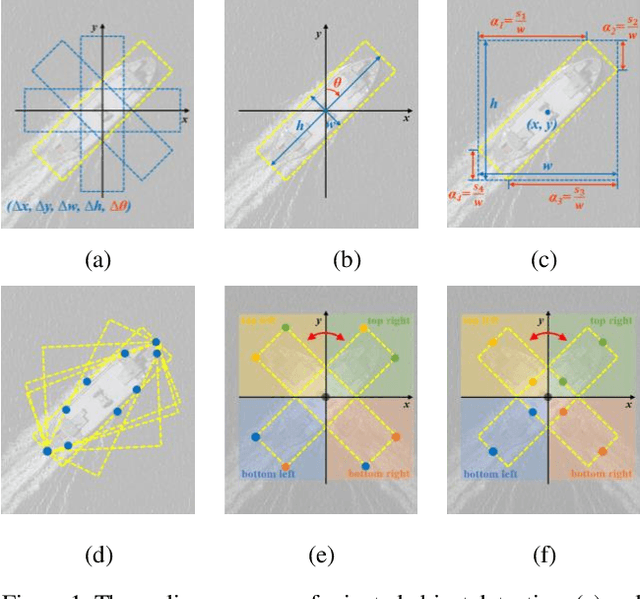
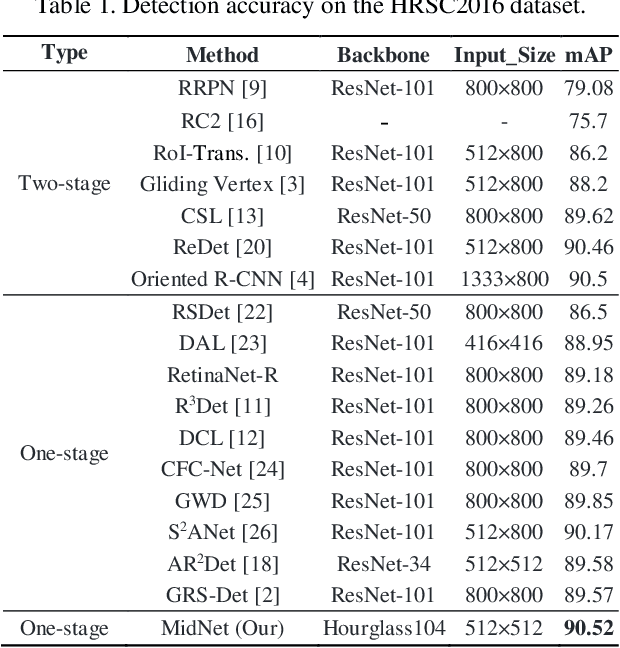
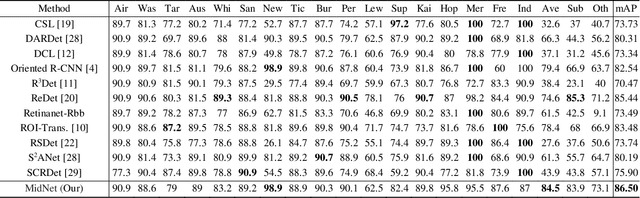
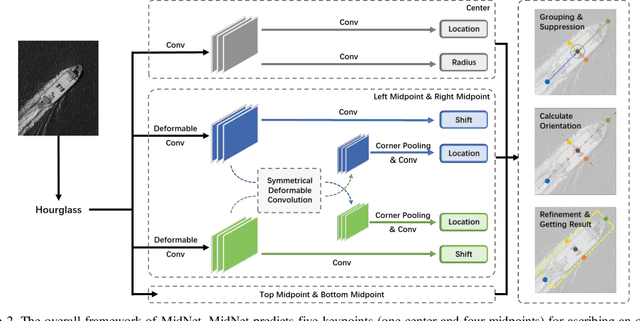
Ship detection in aerial images remains an active yet challenging task due to arbitrary object orientation and complex background from a bird's-eye perspective. Most of the existing methods rely on angular prediction or predefined anchor boxes, making these methods highly sensitive to unstable angular regression and excessive hyper-parameter setting. To address these issues, we replace the angular-based object encoding with an anchor-and-angle-free paradigm, and propose a novel detector deploying a center and four midpoints for encoding each oriented object, namely MidNet. MidNet designs a symmetrical deformable convolution customized for enhancing the midpoints of ships, then the center and midpoints for an identical ship are adaptively matched by predicting corresponding centripetal shift and matching radius. Finally, a concise analytical geometry algorithm is proposed to refine the centers and midpoints step-wisely for building precise oriented bounding boxes. On two public ship detection datasets, HRSC2016 and FGSD2021, MidNet outperforms the state-of-the-art detectors by achieving APs of 90.52% and 86.50%. Additionally, MidNet obtains competitive results in the ship detection of DOTA.