 Add to Chrome
 Add to Firefox
 Add to Edge
A Self-Evolving Agentic Framework for Metasurface Inverse Design
Apr 01, 2026
Metasurface inverse design has become central to realizing complex optical functionality, yet translating target responses into executable, solver-compatible workflows still demands specialized expertise in computational electromagnetics and solver-specific software engineering. Recent large language models (LLMs) offer a complementary route to reducing this workflow-construction burden, but existing language-driven systems remain largely session-bounded and do not preserve reusable workflow knowledge across inverse-design tasks. We present an agentic framework for metasurface inverse design that addresses this limitation through context-level skill evolution. The framework couples a coding agent, evolving skill artifacts, and a deterministic evaluator grounded in physical simulation so that solver-specific strategies can be iteratively refined across tasks without modifying model weights or the underlying physics solver. We evaluate the framework on a benchmark spanning multiple metasurface inverse-design task types, with separate training-aligned and held-out task families. Evolved skills raise in-distribution task success from 38% to 74%, increase criteria pass fraction from 0.510 to 0.870, and reduce average attempts from 4.10 to 2.30. On held-out task families, binary success changes only marginally, but improvements in best margin together with shifts in error composition and agent behavior indicate partial transfer of workflow knowledge. These results suggest that the main value of skill evolution lies in accumulating reusable solver-specific expertise around reliable computational engines, thereby offering a practical path toward more autonomous and accessible metasurface inverse-design workflows.

Deep Convolutional Neural Networks to Predict Mutual Coupling Effects in Metasurfaces
Feb 02, 2021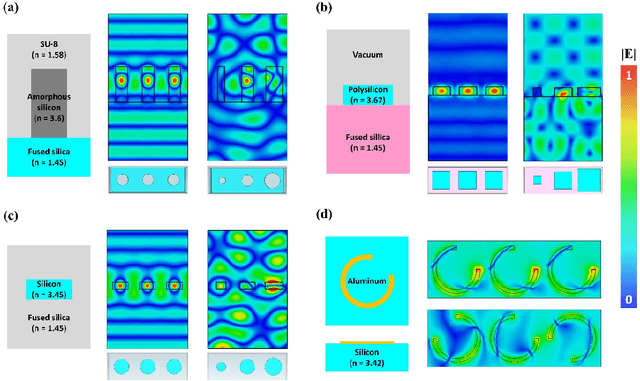
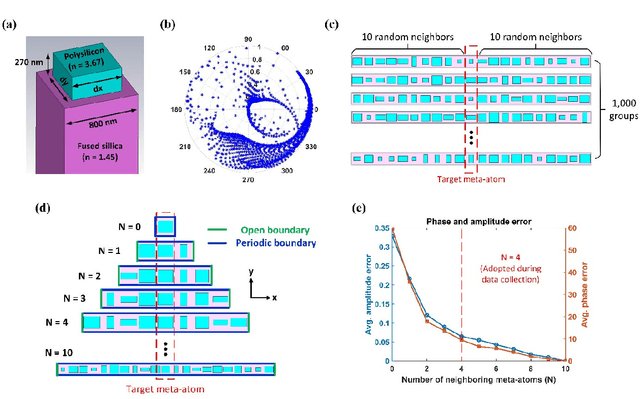
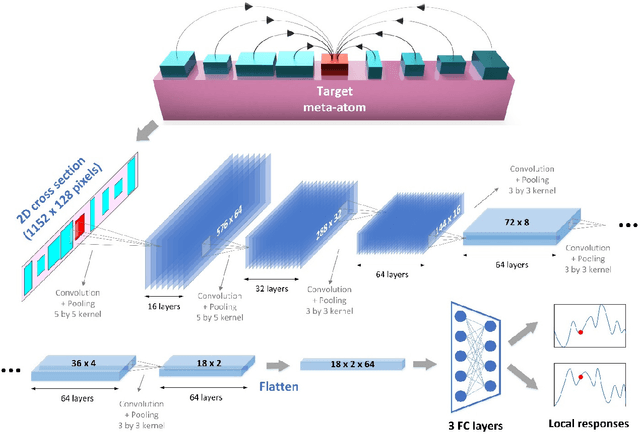
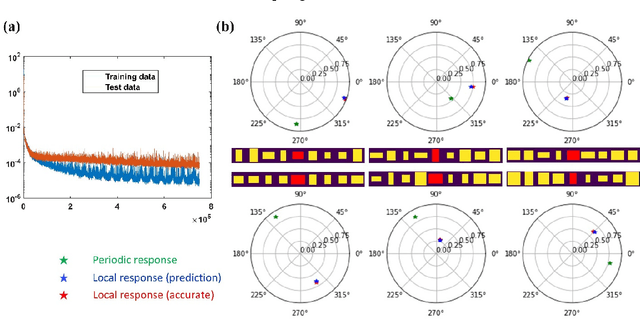
Metasurfaces have provided a novel and promising platform for the realization of compact and large-scale optical devices. The conventional metasurface design approach assumes periodic boundary conditions for each element, which is inaccurate in most cases since the near-field coupling effects between elements will change when surrounded by non-identical structures. In this paper, we propose a deep learning approach to predict the actual electromagnetic (EM) responses of each target meta-atom placed in a large array with near-field coupling effects taken into account. The predicting neural network takes the physical specifications of the target meta-atom and its neighbors as input, and calculates its phase and amplitude in milliseconds. This approach can be applied to explain metasurfaces' performance deterioration caused by mutual coupling and further used to optimize their efficiencies once combined with optimization algorithms. To demonstrate the efficacy of this methodology, we obtain large improvements in efficiency for a beam deflector and a metalens over the conventional design approach. Moreover, we show the correlations between a metasurface's performance and its design errors caused by mutual coupling are not bound to certain specifications (materials, shapes, etc.). As such, we envision that this approach can be readily applied to explore the mutual coupling effects and improve the performance of various metasurface designs.
Minor Privacy Protection Through Real-time Video Processing at the Edge
May 03, 2020

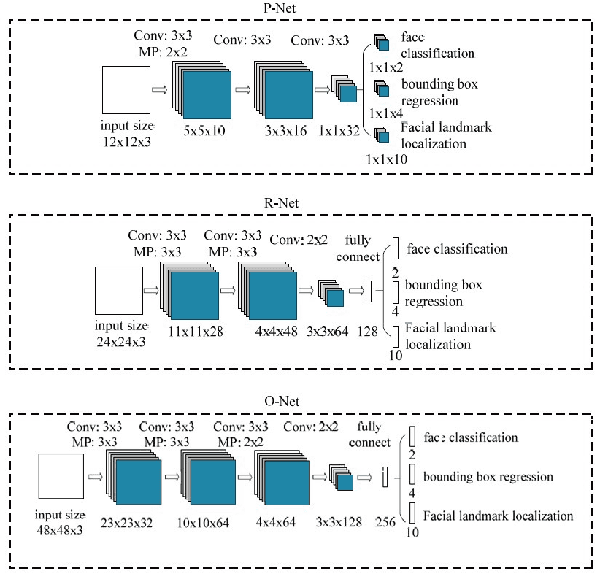

The collection of a lot of personal information about individuals, including the minor members of a family, by closed-circuit television (CCTV) cameras creates a lot of privacy concerns. Particularly, revealing children's identifications or activities may compromise their well-being. In this paper, we investigate lightweight solutions that are affordable to edge surveillance systems, which is made feasible and accurate to identify minors such that appropriate privacy-preserving measures can be applied accordingly. State of the art deep learning architectures are modified and re-purposed in a cascaded fashion to maximize the accuracy of our model. A pipeline extracts faces from the input frames and classifies each one to be of an adult or a child. Over 20,000 labeled sample points are used for classification. We explore the timing and resources needed for such a model to be used in the Edge-Fog architecture at the edge of the network, where we can achieve near real-time performance on the CPU. Quantitative experimental results show the superiority of our proposed model with an accuracy of 92.1% in classification compared to some other face recognition based child detection approaches.