 Add to Chrome
 Add to Firefox
 Add to Edge
ABot-3DWorld 0: A Universal World Model to Explore Any 3D Space
Jul 14, 2026
We present ABot-3DWorld 0, a universal multimodal 3D world model that turns text, image, and video inputs into high-fidelity, explorable 3D worlds. At the heart of our framework is a unified Spatial Generative Primitive (SGP), a compact tuple of a high-quality panorama and a spatial point cloud that delivers an efficient description of any 3D space. Multimodal inputs are first lifted into this primitive; a 3D-consistent panoramic video generator then explores the primitive along a planned trajectory; finally, our panoramic video reconstruction engine converts the generated video into a clean, photorealistic 3D Gaussian Splatting (3DGS) world. This pipeline covers two regimes: rich inputs (multi-view sets, casual video) are lifted into the SGP through a geometry-rigorous recovery that mirrors the observed scene, while a single image or sentence is completed generatively into a creative world. The result is one low-barrier engine for general 3D content creation that further anchors generated worlds to geographic points of interest, enabling map-native spatial exploration at consumer scale. Experiments show that ABot-3DWorld 0 sets the state of the art among open-source methods and demonstrates stronger scene fidelity than Marble under rich multimodal inputs.

Pixel-Wise Symbol Spotting via Progressive Points Location for Parsing CAD Images
Apr 17, 2024
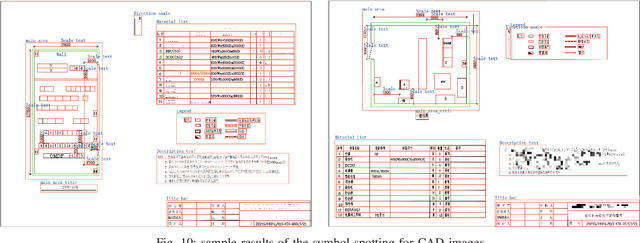
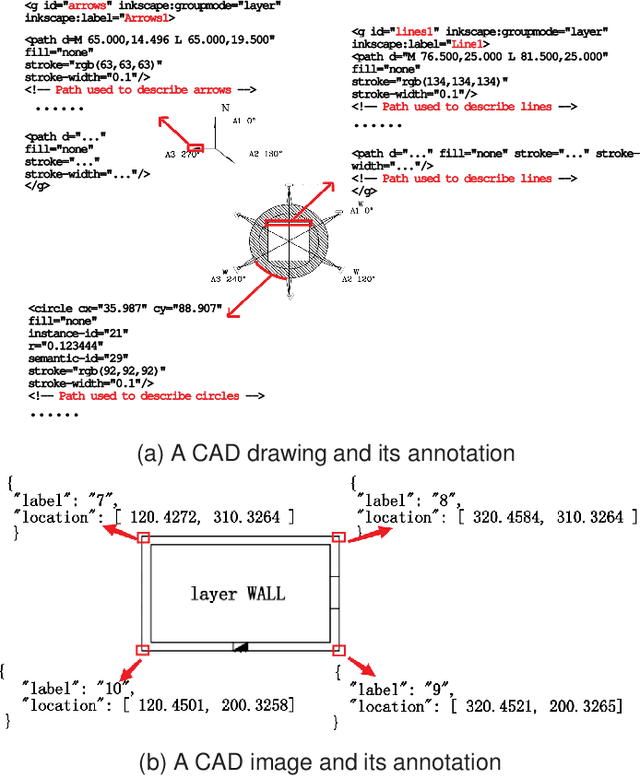

Parsing Computer-Aided Design (CAD) drawings is a fundamental step for CAD revision, semantic-based management, and the generation of 3D prototypes in both the architecture and engineering industries. Labeling symbols from a CAD drawing is a challenging yet notorious task from a practical point of view. In this work, we propose to label and spot symbols from CAD images that are converted from CAD drawings. The advantage of spotting symbols from CAD images lies in the low requirement of labelers and the low-cost annotation. However, pixel-wise spotting symbols from CAD images is challenging work. We propose a pixel-wise point location via Progressive Gaussian Kernels (PGK) to balance between training efficiency and location accuracy. Besides, we introduce a local offset to the heatmap-based point location method. Based on the keypoints detection, we propose a symbol grouping method to redraw the rectangle symbols in CAD images. We have released a dataset containing CAD images of equipment rooms from telecommunication industrial CAD drawings. Extensive experiments on this real-world dataset show that the proposed method has good generalization ability.