 Add to Chrome
 Add to Firefox
 Add to Edge
Structure-Semantic Co-optimized Latent Diffusion Model for Fast Visual Anagram Synthesis
Jun 15, 2026
Visual anagram is an intriguing form of art creation wherein a single image presents different conceptual interpretations under transformations such as flipping or rotation. Recent work has achieved visual anagram synthesis by leveraging pretrained text-to-image (T2I) diffusion models, yet still suffers from several key limitations including computational inefficiency, suboptimal aesthetic quality, and weak semantic fidelity and expressiveness. This work focuses on generating visual anagrams with substantially improved visual quality at minimal computational cost, thereby advancing intelligent creation of illusionary digital art. To increase image resolution while reducing time overhead, we adapt the cutting-edge parallel denoising algorithm from pixel-based T2I model to the adversarially distilled latent-based one, and accordingly propose a structure-semantic co-optimization (S2CO) framework to counteract the consequent visual degradation. As the core of our approach, S2CO framework comprises three key innovations: (\romannumeral1) null-text structure alignment optimization; (\romannumeral2) semantic enhancement optimization; (\romannumeral3) attention-guided noise fusion. Building upon these components, our method dubbed \textbf{S2CO-Anagram} is able to generate higher-resolution anagram images with noticeably superior visual harmony and semantic faithfulness than related SOTA approaches, all while achieving substantially faster inference speed. Code will be publicly available.

PolGS++: Physically-Guided Polarimetric Gaussian Splatting for Fast Reflective Surface Reconstruction
Mar 11, 2026Accurate reconstruction of reflective surfaces remains a fundamental challenge in computer vision, with broad applications in real-time virtual reality and digital content creation. Although 3D Gaussian Splatting (3DGS) enables efficient novel-view rendering with explicit representations, its performance on reflective surfaces still lags behind implicit neural methods, especially in recovering fine geometry and surface normals. To address this gap, we propose PolGS++, a physically-guided polarimetric Gaussian Splatting framework for fast reflective surface reconstruction. Specifically, we integrate a polarized BRDF (pBRDF) model into 3DGS to explicitly decouple diffuse and specular components, providing physically grounded reflectance modeling and stronger geometric cues for reflective surface recovery. Furthermore, we introduce a depth-guided visibility mask acquisition mechanism that enables angle-of-polarization (AoP)-based tangent-space consistency constraints in Gaussian Splatting without costly ray-tracing intersections. This physically guided design improves reconstruction quality and efficiency, requiring only about 10 minutes of training. Extensive experiments on both synthetic and real-world datasets validate the effectiveness of our method.
FBSDiff++: Improved Frequency Band Substitution of Diffusion Features for Efficient and Highly Controllable Text-Driven Image-to-Image Translation
Jan 27, 2026With large-scale text-to-image (T2I) diffusion models achieving significant advancements in open-domain image creation, increasing attention has been focused on their natural extension to the realm of text-driven image-to-image (I2I) translation, where a source image acts as visual guidance to the generated image in addition to the textual guidance provided by the text prompt. We propose FBSDiff, a novel framework adapting off-the-shelf T2I diffusion model into the I2I paradigm from a fresh frequency-domain perspective. Through dynamic frequency band substitution of diffusion features, FBSDiff realizes versatile and highly controllable text-driven I2I in a plug-and-play manner (without need for model training, fine-tuning, or online optimization), allowing appearance-guided, layout-guided, and contour-guided I2I translation by progressively substituting low-frequency band, mid-frequency band, and high-frequency band of latent diffusion features, respectively. In addition, FBSDiff flexibly enables continuous control over I2I correlation intensity simply by tuning the bandwidth of the substituted frequency band. To further promote image translation efficiency, flexibility, and functionality, we propose FBSDiff++ which improves upon FBSDiff mainly in three aspects: (1) accelerate inference speed by a large margin (8.9$\times$ speedup in inference) with refined model architecture; (2) improve the Frequency Band Substitution module to allow for input source images of arbitrary resolution and aspect ratio; (3) extend model functionality to enable localized image manipulation and style-specific content creation with only subtle adjustments to the core method. Extensive qualitative and quantitative experiments verify superiority of FBSDiff++ in I2I translation visual quality, efficiency, versatility, and controllability compared to related advanced approaches.
NeRSP: Neural 3D Reconstruction for Reflective Objects with Sparse Polarized Images
Jun 11, 2024
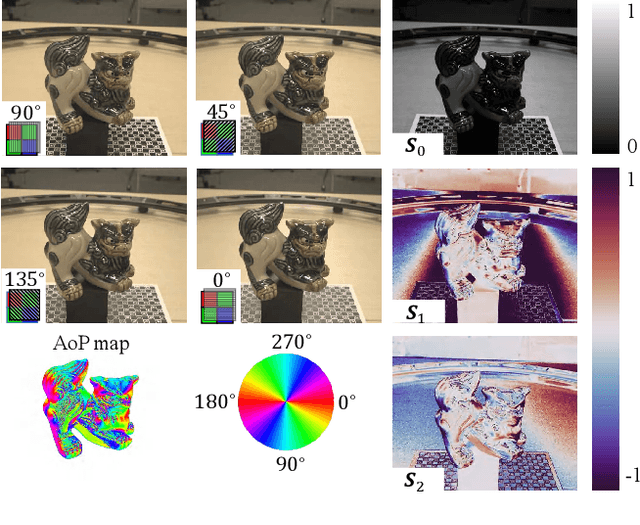

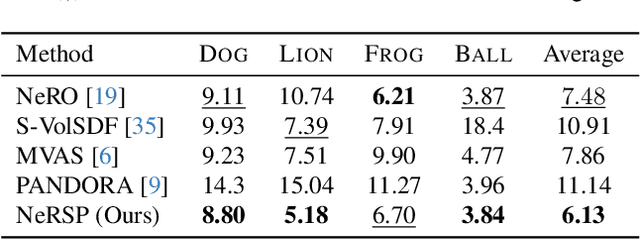
We present NeRSP, a Neural 3D reconstruction technique for Reflective surfaces with Sparse Polarized images. Reflective surface reconstruction is extremely challenging as specular reflections are view-dependent and thus violate the multiview consistency for multiview stereo. On the other hand, sparse image inputs, as a practical capture setting, commonly cause incomplete or distorted results due to the lack of correspondence matching. This paper jointly handles the challenges from sparse inputs and reflective surfaces by leveraging polarized images. We derive photometric and geometric cues from the polarimetric image formation model and multiview azimuth consistency, which jointly optimize the surface geometry modeled via implicit neural representation. Based on the experiments on our synthetic and real datasets, we achieve the state-of-the-art surface reconstruction results with only 6 views as input.