 Add to Chrome
 Add to Firefox
 Add to Edge
MARCO: Click-Intent Decomposition for Calibrated Ads Conversion Prediction
Aug 11, 2026
Not all clicks are equal. Industrial ads ranking decouples conversion probability into click-through rate (CTR) and post-click conversion rate (CVR), yet treats every click as the same event. In reality, users provide a free, self-generated signal of intent through their physical UI interactions. Different click types on the same ad exhibit a 4-fold difference in actual conversion rates. By conflating these signals, the standard CVR model under-predicts high-intent clicks and over-predicts low-intent ones, which is a bias masked by near-perfect aggregate calibration. We propose MARCO (Multi-intent Ads Ranking Composition Optimization), a framework that resolves this bias by decomposing each click by intent. Using the logged click type as a free behavioral label, MARCO trains per-intent CVR heads on homogeneous populations, and at serving time composes their per-intent CVR estimates under a predicted distribution over intents. Theoretically, we prove that decomposition never raises population risk, give the exact headroom under squared loss and non-negativity under the deployed loss, and show through a routing-efficiency dial how much of it reaches serving. Because the population-optimal score is unchanged, any gain is a finite-capacity estimation and calibration effect that we validated both offline and online. For deployment at scale, we further cast multi-impression, multi-click attribution as credit assignment with a bias-variance tradeoff analogous to RL return estimation, showing last-impression, first-click attribution is the low-bias, low-variance, deterministic choice under production constraints, and derive three consistency conditions enforced end-to-end at scale. Deployed at binary intent granularity, MARCO corrects per-intent calibration to approximately 100%, lifts conversions per click by +2.80%, and drives +0.98% cumulative improvement in topline metrics.

A Disentangled Low-Rank RNN Framework for Uncovering Neural Connectivity and Dynamics
Nov 17, 2025
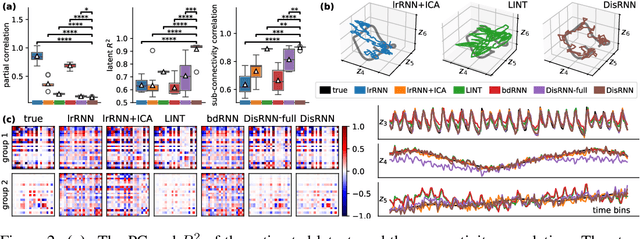
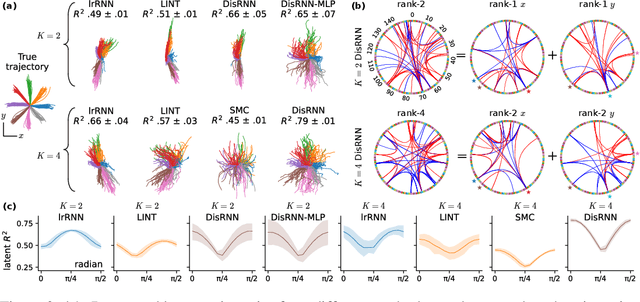
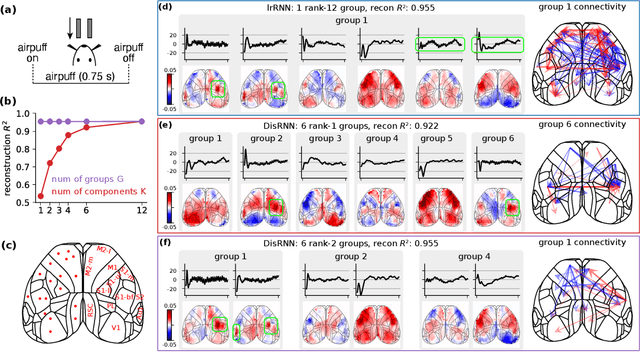
Low-rank recurrent neural networks (lrRNNs) are a class of models that uncover low-dimensional latent dynamics underlying neural population activity. Although their functional connectivity is low-rank, it lacks disentanglement interpretations, making it difficult to assign distinct computational roles to different latent dimensions. To address this, we propose the Disentangled Recurrent Neural Network (DisRNN), a generative lrRNN framework that assumes group-wise independence among latent dynamics while allowing flexible within-group entanglement. These independent latent groups allow latent dynamics to evolve separately, but are internally rich for complex computation. We reformulate the lrRNN under a variational autoencoder (VAE) framework, enabling us to introduce a partial correlation penalty that encourages disentanglement between groups of latent dimensions. Experiments on synthetic, monkey M1, and mouse voltage imaging data show that DisRNN consistently improves the disentanglement and interpretability of learned neural latent trajectories in low-dimensional space and low-rank connectivity over baseline lrRNNs that do not encourage partial disentanglement.
A Revisit of Total Correlation in Disentangled Variational Auto-Encoder with Partial Disentanglement
Feb 04, 2025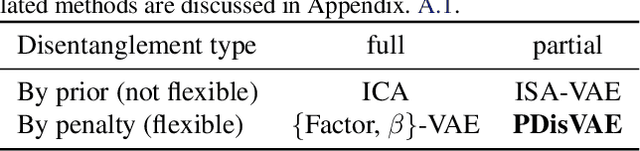
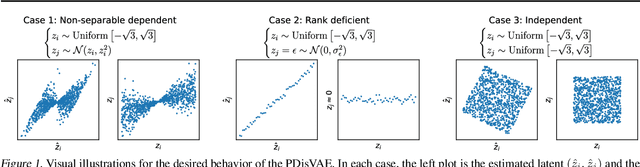
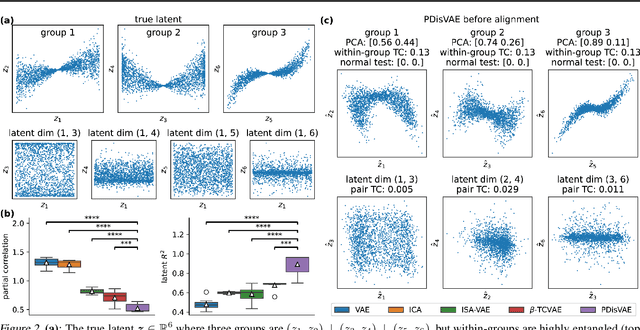
A fully disentangled variational auto-encoder (VAE) aims to identify disentangled latent components from observations. However, enforcing full independence between all latent components may be too strict for certain datasets. In some cases, multiple factors may be entangled together in a non-separable manner, or a single independent semantic meaning could be represented by multiple latent components within a higher-dimensional manifold. To address such scenarios with greater flexibility, we develop the Partially Disentangled VAE (PDisVAE), which generalizes the total correlation (TC) term in fully disentangled VAEs to a partial correlation (PC) term. This framework can handle group-wise independence and can naturally reduce to either the standard VAE or the fully disentangled VAE. Validation through three synthetic experiments demonstrates the correctness and practicality of PDisVAE. When applied to real-world datasets, PDisVAE discovers valuable information that is difficult to find using fully disentangled VAEs, implying its versatility and effectiveness.