 Add to Chrome
 Add to Firefox
 Add to Edge
SHRIMP: Iterative Refinement of Robot Task Plans
Aug 09, 2026
As collaborative robots have entered domains such as manufacturing, agriculture, and healthcare, programming or adapting robot behavior typically requires robotic expertise that most end users lack. Natural language lowers this barrier. Recent advancements in large language models (LLMs) have made it feasible to translate natural language into robot task plans. However, language-based task specification suffers from semantic ambiguity, and generative models lack transparency for how language instructions become robot actions, making it difficult for users to validate the plan before execution. To address these issues, we introduce SHRIMP, a system that allows users to automatically generate a hierarchical robot primitive plan using natural language and iteratively revise their plan through re-prompting and explicit correction. At each revision, SHRIMP allows users to validate their plan in simulation, and once satisfied, execute it on the physical robot. Through a user study involving participants planning tabletop kitchen tasks (n=35), we validate that SHRIMP improves perceived control and enhances robot transparency. System videos and source code are available at https://wisc-hci.github.io/SHRIMP.

Understanding Generative AI in Robot Logic Parametrization
Nov 06, 2024
Leveraging generative AI (for example, Large Language Models) for language understanding within robotics opens up possibilities for LLM-driven robot end-user development (EUD). Despite the numerous design opportunities it provides, little is understood about how this technology can be utilized when constructing robot program logic. In this paper, we outline the background in capturing natural language end-user intent and summarize previous use cases of LLMs within EUD. Taking the context of filmmaking as an example, we explore how a cinematography practitioner's intent to film a certain scene can be articulated using natural language, captured by an LLM, and further parametrized as low-level robot arm movement. We explore the capabilities of an LLM interpreting end-user intent and mapping natural language to predefined, cross-modal data in the process of iterative program development. We conclude by suggesting future opportunities for domain exploration beyond cinematography to support language-driven robotic camera navigation.
Understanding On-the-Fly End-User Robot Programming
Jun 02, 2024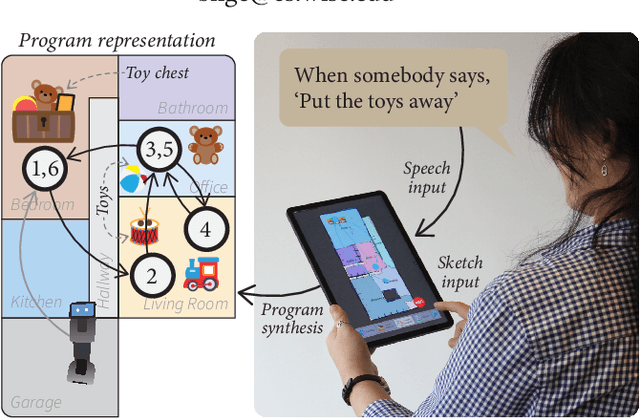


Novel end-user programming (EUP) tools enable on-the-fly (i.e., spontaneous, easy, and rapid) creation of interactions with robotic systems. These tools are expected to empower users in determining system behavior, although very little is understood about how end users perceive, experience, and use these systems. In this paper, we seek to address this gap by investigating end-user experience with on-the-fly robot EUP. We trained 21 end users to use an existing on-the-fly EUP tool, asked them to create robot interactions for four scenarios, and assessed their overall experience. Our findings provide insight into how these systems should be designed to better support end-user experience with on-the-fly EUP, focusing on user interaction with an automatic program synthesizer that resolves imprecise user input, the use of multimodal inputs to express user intent, and the general process of programming a robot.