 Add to Chrome
 Add to Firefox
 Add to Edge
Robo-Blocks: Generative Scaffolding in End-User Design and Programming of Social Robots
May 27, 2026
Programming social robots is challenging for novice robot programmers due to required expertise in planning, interaction design, and programming. While large language models (LLMs) hold significant promise through code generation from natural-language descriptions, they can obscure critical elements of programming and supplant designer intent, eventually resulting in over-reliance instead of developing programming skills. In this paper, we explore how LLM-based social-robot-programming tools can support novice robot programmers through a Research through Design (RtD) process. We designed and prototyped Robo-Blocks, a block-based programming environment that leverages LLMs to offer novice robot programmers generative scaffolding through structured narratives that connect high-level ideas to executable robot behaviors. Through deployment with novices, we discovered emerging user personas and usage patterns for generative scaffolding and showed how this scaffolding shapes end-user design and programming strategies. We present design insights for the effective use of generative scaffolding and its integration into the practice of social-robot programming.

Understanding Generative AI in Robot Logic Parametrization
Nov 06, 2024
Leveraging generative AI (for example, Large Language Models) for language understanding within robotics opens up possibilities for LLM-driven robot end-user development (EUD). Despite the numerous design opportunities it provides, little is understood about how this technology can be utilized when constructing robot program logic. In this paper, we outline the background in capturing natural language end-user intent and summarize previous use cases of LLMs within EUD. Taking the context of filmmaking as an example, we explore how a cinematography practitioner's intent to film a certain scene can be articulated using natural language, captured by an LLM, and further parametrized as low-level robot arm movement. We explore the capabilities of an LLM interpreting end-user intent and mapping natural language to predefined, cross-modal data in the process of iterative program development. We conclude by suggesting future opportunities for domain exploration beyond cinematography to support language-driven robotic camera navigation.
Making Informed Decisions: Supporting Cobot Integration Considering Business and Worker Preferences
Jan 10, 2024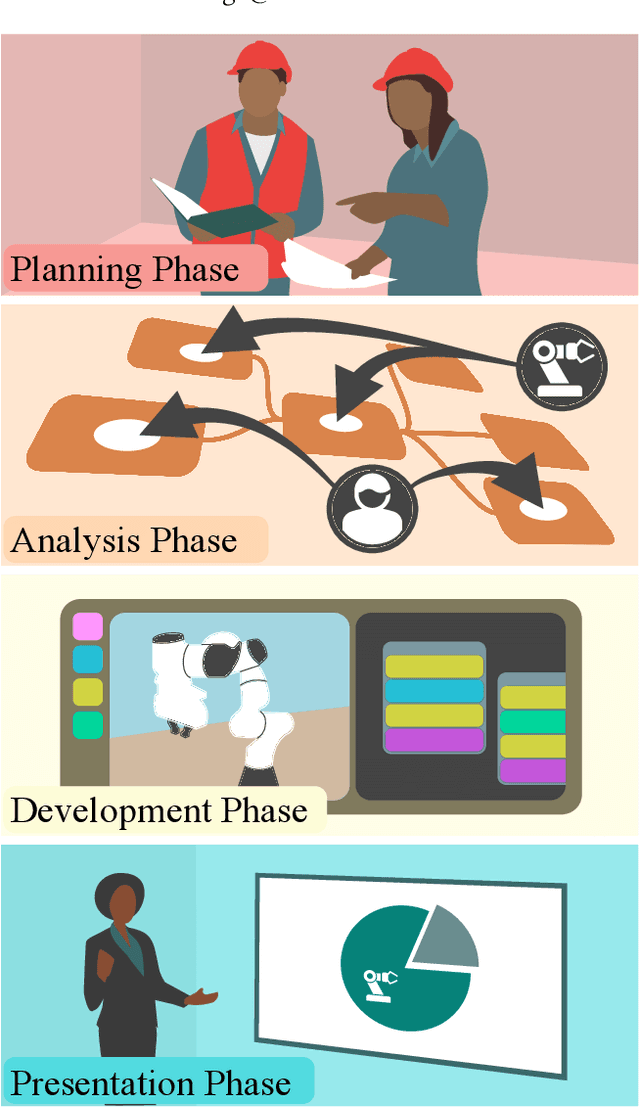
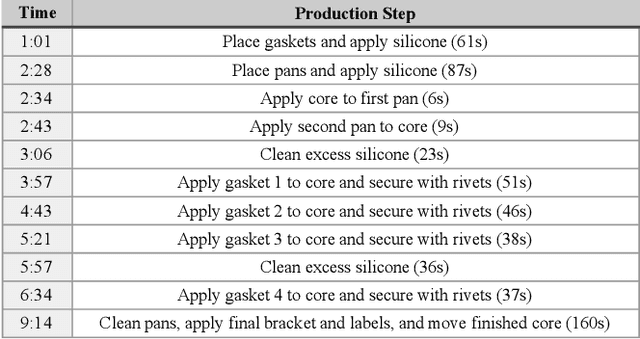
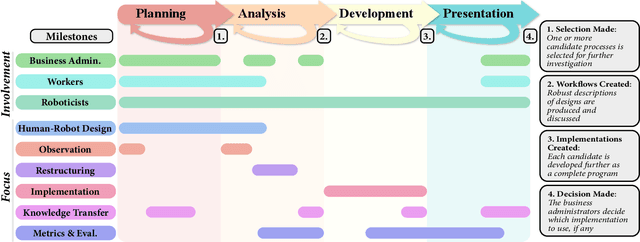
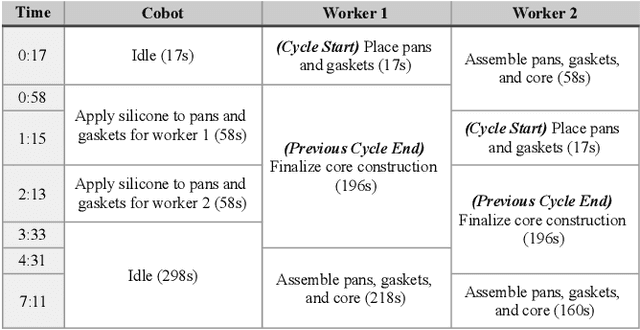
Robots are ubiquitous in small-to-large-scale manufacturers. While collaborative robots (cobots) have significant potential in these settings due to their flexibility and ease of use, proper integration is critical to realize their full potential. Specifically, cobots need to be integrated in ways that utilize their strengths, improve manufacturing performance, and facilitate use in concert with human workers. Effective integration requires careful consideration and the knowledge of roboticists, manufacturing engineers, and business administrators. We propose an approach involving the stages of planning, analysis, development, and presentation, to inform manufacturers about cobot integration within their facilities prior to the integration process. We contextualize our approach in a case study with an SME collaborator and discuss insights learned.