 Add to Chrome
 Add to Firefox
 Add to Edge
SHRIMP: Iterative Refinement of Robot Task Plans
Aug 09, 2026
As collaborative robots have entered domains such as manufacturing, agriculture, and healthcare, programming or adapting robot behavior typically requires robotic expertise that most end users lack. Natural language lowers this barrier. Recent advancements in large language models (LLMs) have made it feasible to translate natural language into robot task plans. However, language-based task specification suffers from semantic ambiguity, and generative models lack transparency for how language instructions become robot actions, making it difficult for users to validate the plan before execution. To address these issues, we introduce SHRIMP, a system that allows users to automatically generate a hierarchical robot primitive plan using natural language and iteratively revise their plan through re-prompting and explicit correction. At each revision, SHRIMP allows users to validate their plan in simulation, and once satisfied, execute it on the physical robot. Through a user study involving participants planning tabletop kitchen tasks (n=35), we validate that SHRIMP improves perceived control and enhances robot transparency. System videos and source code are available at https://wisc-hci.github.io/SHRIMP.

Elements of Robot Morphology: Supporting Designers in Robot Form Exploration
Feb 09, 2026Robot morphology, the form, shape, and structure of robots, is a key design space in human-robot interaction (HRI), shaping how robots function, express themselves, and interact with people. Yet, despite its importance, little is known about how design frameworks can guide systematic form exploration. To address this gap, we introduce Elements of Robot Morphology, a framework that identifies five fundamental elements: perception, articulation, end effectors, locomotion, and structure. Derived from an analysis of existing robots, the framework supports structured exploration of diverse robot forms. To operationalize the framework, we developed Morphology Exploration Blocks (MEB), a set of tangible blocks that enable hands-on, collaborative experimentation with robot morphologies. We evaluate the framework and toolkit through a case study and design workshops, showing how they support analysis, ideation, reflection, and collaborative robot design.
FreeAskWorld: An Interactive and Closed-Loop Simulator for Human-Centric Embodied AI
Nov 17, 2025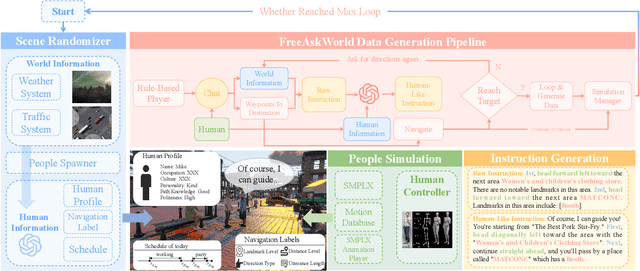
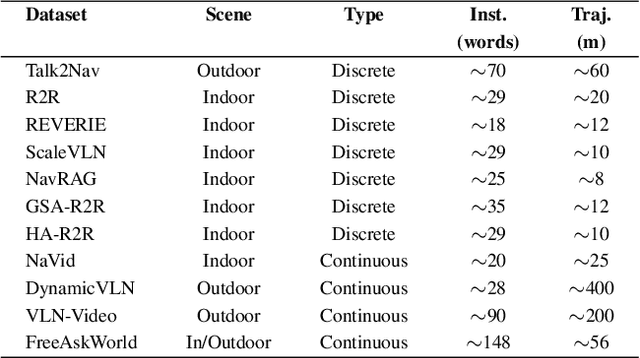
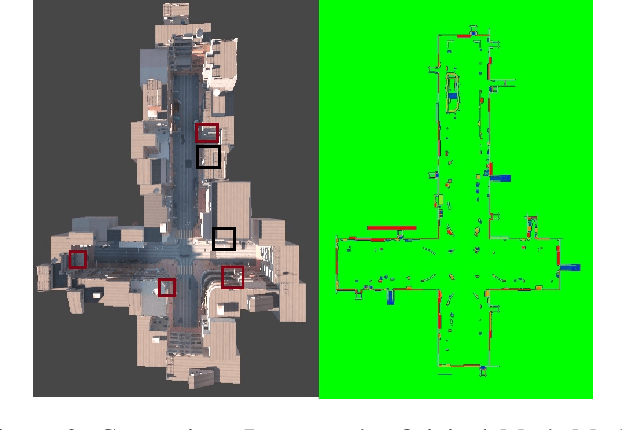
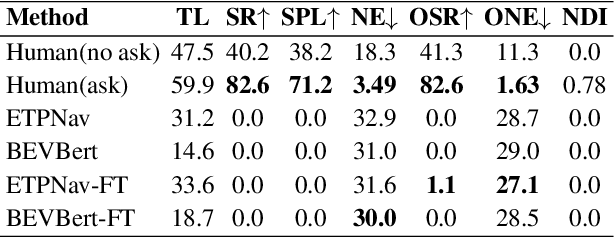
As embodied intelligence emerges as a core frontier in artificial intelligence research, simulation platforms must evolve beyond low-level physical interactions to capture complex, human-centered social behaviors. We introduce FreeAskWorld, an interactive simulation framework that integrates large language models (LLMs) for high-level behavior planning and semantically grounded interaction, informed by theories of intention and social cognition. Our framework supports scalable, realistic human-agent simulations and includes a modular data generation pipeline tailored for diverse embodied tasks.To validate the framework, we extend the classic Vision-and-Language Navigation (VLN) task into a interaction enriched Direction Inquiry setting, wherein agents can actively seek and interpret navigational guidance. We present and publicly release FreeAskWorld, a large-scale benchmark dataset comprising reconstructed environments, six diverse task types, 16 core object categories, 63,429 annotated sample frames, and more than 17 hours of interaction data to support training and evaluation of embodied AI systems. We benchmark VLN models, and human participants under both open-loop and closed-loop settings. Experimental results demonstrate that models fine-tuned on FreeAskWorld outperform their original counterparts, achieving enhanced semantic understanding and interaction competency. These findings underscore the efficacy of socially grounded simulation frameworks in advancing embodied AI systems toward sophisticated high-level planning and more naturalistic human-agent interaction. Importantly, our work underscores that interaction itself serves as an additional information modality.
* 9 pages, 4 figures