 Add to Chrome
 Add to Firefox
 Add to Edge
Data Journalist Agent: Transforming Data into Verifiable Multimodal Stories
Jun 09, 2026
Data tells stories that shape society; the data journalist's job is to turn raw information into stories non-experts can trust. A high-quality news feature takes a newsroom team weeks: hunting for context, running statistics, choosing an angle, and designing visuals. Recent agents handle individual steps well: data-science agents close the analysis loop, while design agents synthesize beautiful websites. But can an agent serve as a data journalist end to end? We introduce Data Journalist Agent (Data2Story), a multi-agent framework that orchestrates specialized roles into a single virtual newsroom. Data2Story contributes two innovations. (i) Claims are evidence-grounded: an Inspector links every number, angle, and asset back to data, code, or an external reference. (ii) Articles are multimodally generative: rather than defaulting to plain text and static charts, Data2Story reasons about what readers will want to see, then deploys multimodal tools, such as interactive maps for geography and audio for music. We evaluate Data2Story on 18 articles, each paired with the originally published expert piece, along four axes: (a) human-agent angle coverage; (b) rubric evaluation with 53 participants across five dimensions; (c) computer-use agents as judges, a cost-saving proxy for how readers navigate interactive articles; and (d) verifiability, where a coding verifier re-executes statements against the data and checks claims against references. Data2Story produces competitive, evidence-traceable multimedia stories, with particular strength in transparency and auditability. Human articles retain an edge in editorial angle, creative design, and presentation. We position Data2Story as a collaborator for journalists, enabling more evidence-based, transparent, and verifiable reporting. Code and demos are available at https://data2story.github.io.

Learning from Human Driving: A Human-in-the-Loop Online Behavior Cloning Framework for Autonomous Driving
Jun 06, 2026With the evolution of large foundation models (LFMs), data-driven autonomous driving has made significant strides. However, existing paradigms still face severe challenges in complex interaction and long-tail scenarios due to distribution shift and causal confusion. These limitations often result in a lack of human-level decision-making flexibility and safety in extreme conditions. To overcome this limitation, this paper proposes a Human-in-the-Loop Online Behavior Cloning frame work (HiL-OBC) for autonomous driving, which aims to deeply integrate the cross-modal perceptual capabilities of LFMs with the high-level driving intelligence of human experts. Specifically, HiL-OBC deployment is executed through three critical phases: policy initialization with human intervention, latent behavioral modeling with Bayesian policy adaptation, and online deploy ment and updates. Furthermore, we design a Multi-modal Online Behavior Cloning (MOBC) model, which optimizes the base driving policy online through a lightweight network architecture, a takeover trigger mechanism, and a multi-variant loss function, thereby enhancing the system's decision-making robustness in complex environments. We evaluated the HiL-OBC on the LangAuto-Human CARLA benchmark. Experimental results demonstrate that the driving policies optimized via the human-in-the-loop mechanism achieve substantial performance gains: the DS of StructNav, LFG, and LMDrive increased by 47.25%, 31.59%, and 32.12%, respectively, with a simultaneous of various experimental settings and key components highlights the advantages of human-in-the-loop learning in improving decision-making robustness and overall driving performance.
Multi-Graph Convolution Network for Pose Forecasting
Apr 11, 2023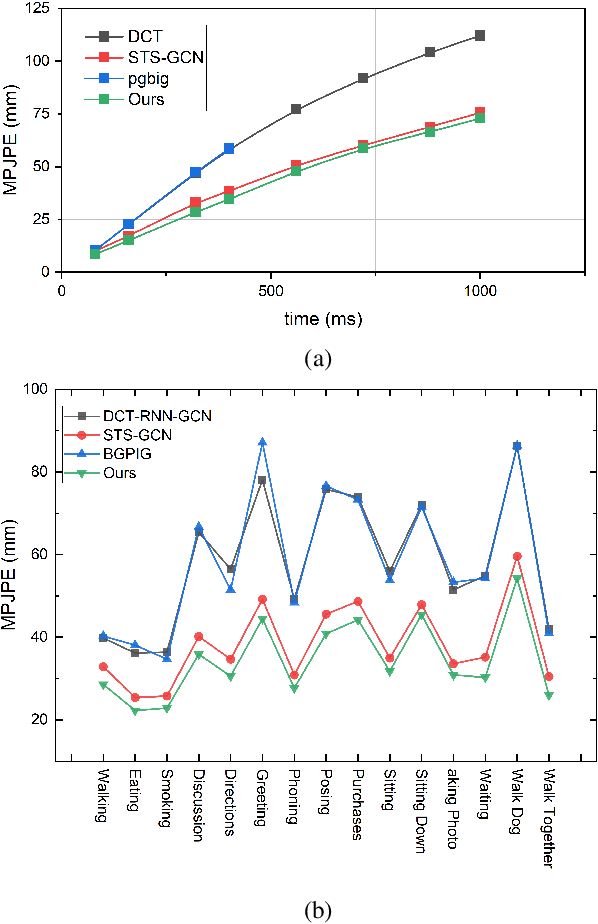
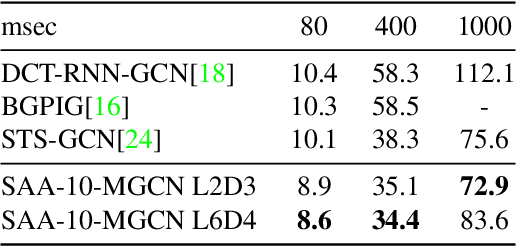
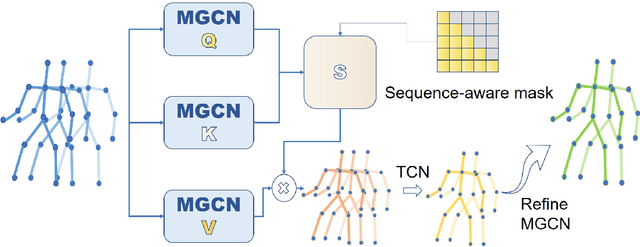
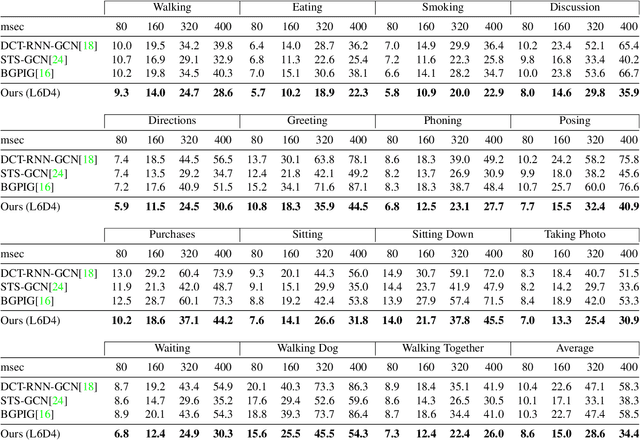
Recently, there has been a growing interest in predicting human motion, which involves forecasting future body poses based on observed pose sequences. This task is complex due to modeling spatial and temporal relationships. The most commonly used models for this task are autoregressive models, such as recurrent neural networks (RNNs) or variants, and Transformer Networks. However, RNNs have several drawbacks, such as vanishing or exploding gradients. Other researchers have attempted to solve the communication problem in the spatial dimension by integrating Graph Convolutional Networks (GCN) and Long Short-Term Memory (LSTM) models. These works deal with temporal and spatial information separately, which limits the effectiveness. To fix this problem, we propose a novel approach called the multi-graph convolution network (MGCN) for 3D human pose forecasting. This model simultaneously captures spatial and temporal information by introducing an augmented graph for pose sequences. Multiple frames give multiple parts, joined together in a single graph instance. Furthermore, we also explore the influence of natural structure and sequence-aware attention to our model. In our experimental evaluation of the large-scale benchmark datasets, Human3.6M, AMSS and 3DPW, MGCN outperforms the state-of-the-art in pose prediction.