 Add to Chrome
 Add to Firefox
 Add to Edge
PEARL: Unbiased Percentile Estimation via Contrastive Learning for Industrial-Scale Livestream Recommendation
May 20, 2026
Recommender systems trained on user interaction data are susceptible to behavioral intensity imbalance--a systematic distortion arising from heterogeneous engagement patterns across users. This imbalance skews feedback signals such that observed interactions no longer faithfully reflect true preferences, causing models to disproportionately amplify signals from highly active users while underrepresenting others, which ultimately degrades recommendation quality and robustness at scale. To address this issue, we propose a nonparametric contrastive percentile approximation framework, PEARL, that models relative preference signals instead of absolute engagement magnitudes. Building upon relative advantage debiasing, PEARL leverages real contrastive interaction samples to approximate percentile relationships directly, without relying on auxiliary distribution estimation models. We provide theoretical justification demonstrating that such pairwise comparisons yield unbiased estimates of percentile-based preference signals. For broader applicability, we introduce a prediction-based bootstrapping mechanism for percentile smoothing to handle sparse and discrete feedback, alongside a generalized value-weighted formulation and a co-training strategy to enhance both modeling flexibility and representation learning. Extensive offline experiments demonstrate that PEARL effectively mitigates behavioral bias and consistently improves recommendation performance across multiple ranking targets. Deployed in a production livestream platform with a combined user base of billions, online A/B testing confirms substantial real-world gains: +2.10% Watch Duration, +0.80% Consumption Amount, +1.49% Interaction Rate, and -6.91% Report Rate.

LensNet: An End-to-End Learning Framework for Empirical Point Spread Function Modeling and Lensless Imaging Reconstruction
May 03, 2025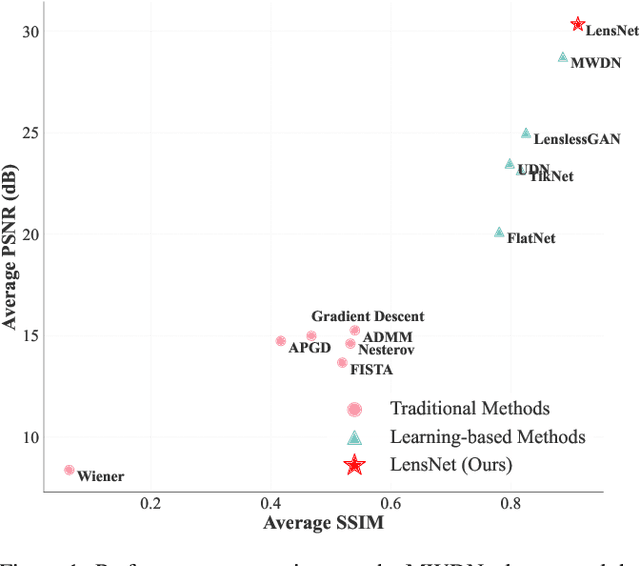
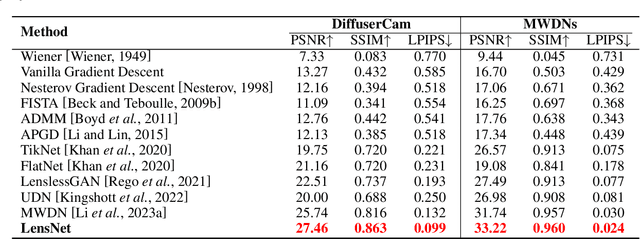

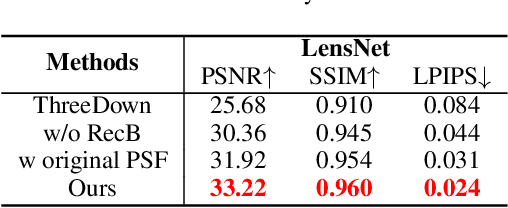
Lensless imaging stands out as a promising alternative to conventional lens-based systems, particularly in scenarios demanding ultracompact form factors and cost-effective architectures. However, such systems are fundamentally governed by the Point Spread Function (PSF), which dictates how a point source contributes to the final captured signal. Traditional lensless techniques often require explicit calibrations and extensive pre-processing, relying on static or approximate PSF models. These rigid strategies can result in limited adaptability to real-world challenges, including noise, system imperfections, and dynamic scene variations, thus impeding high-fidelity reconstruction. In this paper, we propose LensNet, an end-to-end deep learning framework that integrates spatial-domain and frequency-domain representations in a unified pipeline. Central to our approach is a learnable Coded Mask Simulator (CMS) that enables dynamic, data-driven estimation of the PSF during training, effectively mitigating the shortcomings of fixed or sparsely calibrated kernels. By embedding a Wiener filtering component, LensNet refines global structure and restores fine-scale details, thus alleviating the dependency on multiple handcrafted pre-processing steps. Extensive experiments demonstrate LensNet's robust performance and superior reconstruction quality compared to state-of-the-art methods, particularly in preserving high-frequency details and attenuating noise. The proposed framework establishes a novel convergence between physics-based modeling and data-driven learning, paving the way for more accurate, flexible, and practical lensless imaging solutions for applications ranging from miniature sensors to medical diagnostics. The link of code is https://github.com/baijiesong/Lensnet.
Retinexmamba: Retinex-based Mamba for Low-light Image Enhancement
May 06, 2024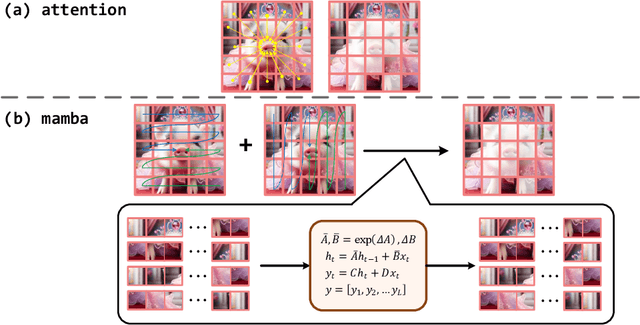
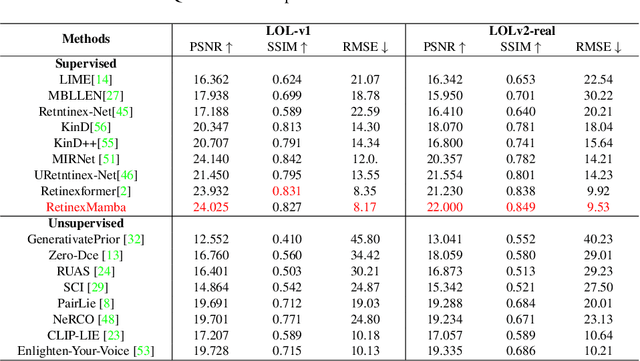
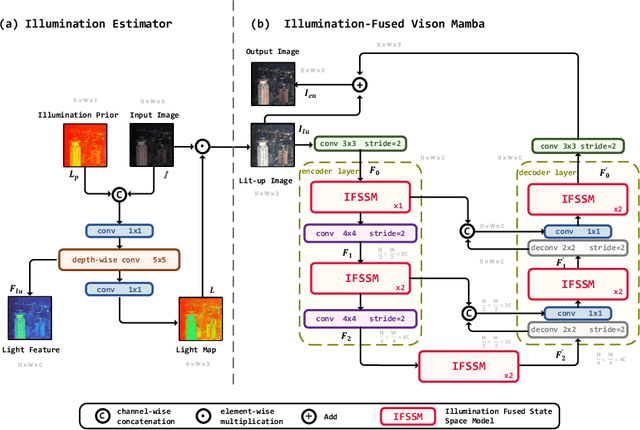
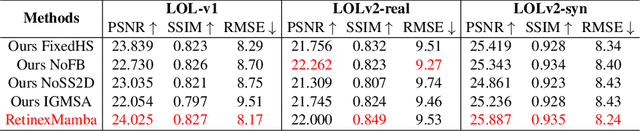
In the field of low-light image enhancement, both traditional Retinex methods and advanced deep learning techniques such as Retinexformer have shown distinct advantages and limitations. Traditional Retinex methods, designed to mimic the human eye's perception of brightness and color, decompose images into illumination and reflection components but struggle with noise management and detail preservation under low light conditions. Retinexformer enhances illumination estimation through traditional self-attention mechanisms, but faces challenges with insufficient interpretability and suboptimal enhancement effects. To overcome these limitations, this paper introduces the RetinexMamba architecture. RetinexMamba not only captures the physical intuitiveness of traditional Retinex methods but also integrates the deep learning framework of Retinexformer, leveraging the computational efficiency of State Space Models (SSMs) to enhance processing speed. This architecture features innovative illumination estimators and damage restorer mechanisms that maintain image quality during enhancement. Moreover, RetinexMamba replaces the IG-MSA (Illumination-Guided Multi-Head Attention) in Retinexformer with a Fused-Attention mechanism, improving the model's interpretability. Experimental evaluations on the LOL dataset show that RetinexMamba outperforms existing deep learning approaches based on Retinex theory in both quantitative and qualitative metrics, confirming its effectiveness and superiority in enhancing low-light images.