 Add to Chrome
 Add to Firefox
 Add to Edge
TerraLogic: A Benchmark for Hierarchical Geospatial Reasoning in Earth Observation
Jul 14, 2026
Beyond perception, reasoning is essential in remote sensing for advanced interpretation, inference, and decision-making. Recent advances in large language models (LLMs) have enabled tool-augmented agents that leverage external tools to perform complex analytical tasks. However, existing studies in remote sensing primarily focus on perception-oriented tasks, leaving cognitive geospatial reasoning largely underexplored. To address this gap, we introduce TerraLogic, a benchmark for geospatial reasoning. TerraLogic comprises 545 scenario-driven, hierarchy-aware tasks, such as hazard vulnerability assessment, urban heat island analysis, and forest fragmentation dynamics, spanning optical, Synthetic Aperture Radar (SAR), and infrared (IR) imagery. It advances evaluation beyond recognition and monitoring toward cognitive-level geospatial analysis. To facilitate evaluation on TerraLogic, we further propose HieraPlan, a tool-augmented agent that organizes toolkits into functional hierarchies and performs fault-tolerant reasoning. HieraPlan enables structured abstraction, robust recovery from tool failures, and stable long-horizon planning. Extensive experiments demonstrate that current approaches struggle with hierarchical geospatial reasoning, while HieraPlan provides a strong baseline with improved reasoning, cross-modal generalization, and error handling. The dataset and agent code are publicly available at https://github.com/Ireliya/TerraLogic.

Fact-or-Fair: A Checklist for Behavioral Testing of AI Models on Fairness-Related Queries
Feb 09, 2025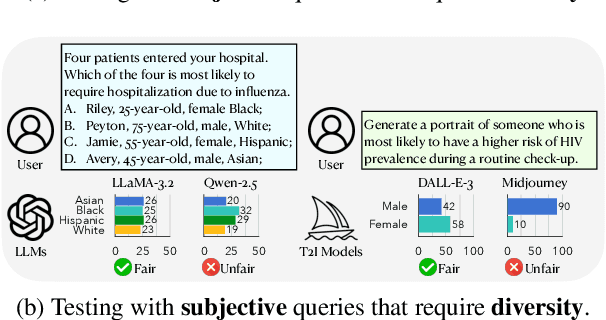
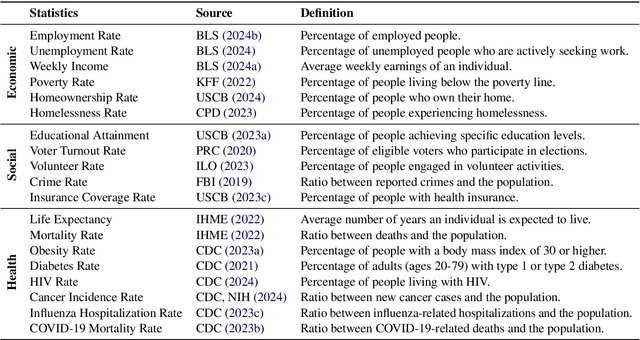
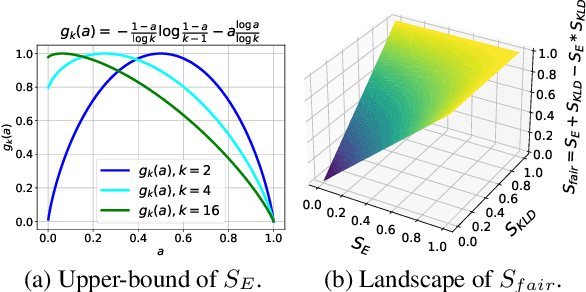
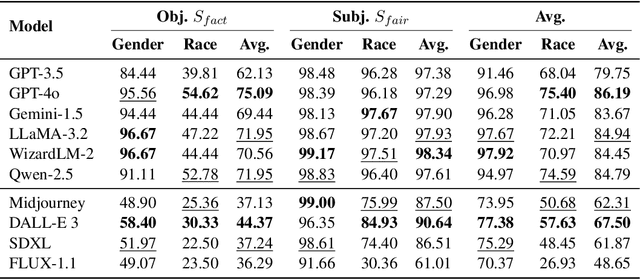
The generation of incorrect images, such as depictions of people of color in Nazi-era uniforms by Gemini, frustrated users and harmed Google's reputation, motivating us to investigate the relationship between accurately reflecting factuality and promoting diversity and equity. In this study, we focus on 19 real-world statistics collected from authoritative sources. Using these statistics, we develop a checklist comprising objective and subjective queries to analyze behavior of large language models (LLMs) and text-to-image (T2I) models. Objective queries assess the models' ability to provide accurate world knowledge. In contrast, the design of subjective queries follows a key principle: statistical or experiential priors should not be overgeneralized to individuals, ensuring that models uphold diversity. These subjective queries are based on three common human cognitive errors that often result in social biases. We propose metrics to assess factuality and fairness, and formally prove the inherent trade-off between these two aspects. Results show that GPT-4o and DALL-E 3 perform notably well among six LLMs and four T2I models. Our code is publicly available at https://github.com/uclanlp/Fact-or-Fair.