 Add to Chrome
 Add to Firefox
 Add to Edge
Break the Inaccessible Boundary: Distilling Post-Conversion Content for User Retention Modeling
Apr 28, 2026
User retention is a key metric to measure long-term engagement in modern platforms. In real-time bidding (RTB) advertising system for user re-engagement, the retention model is required to predict future revisit probability at bidding time, before the user converts and consumes any content. Although post-conversion content, termed Onboarding Content, provides highly informative signals for retention prediction, directly using it in training causes severe feature leakage and creates a gap between training and serving. To address this issue, we propose OCARM, a two-stage distillation-aligned framework for Onboarding Content Augmented Retention Modeling, enabling the model to implicitly capture future content using only observable features during inference. In the first stage, we deliberately expose onboarding content to train a hierarchical encoder that produces teacher representations. In the second stage, a user encoder is aligned with the frozen teacher through distillation, allowing the model to approximate the inaccessible onboarding signals without leakage. Extensive offline experiments and online A/B tests demonstrate that our framework achieves consistent improvements in a real-world growth scenario.

UniMixer: A Unified Architecture for Scaling Laws in Recommendation Systems
Apr 02, 2026In recent years, the scaling laws of recommendation models have attracted increasing attention, which govern the relationship between performance and parameters/FLOPs of recommenders. Currently, there are three mainstream architectures for achieving scaling in recommendation models, namely attention-based, TokenMixer-based, and factorization-machine-based methods, which exhibit fundamental differences in both design philosophy and architectural structure. In this paper, we propose a unified scaling architecture for recommendation systems, namely \textbf{UniMixer}, to improve scaling efficiency and establish a unified theoretical framework that unifies the mainstream scaling blocks. By transforming the rule-based TokenMixer to an equivalent parameterized structure, we construct a generalized parameterized feature mixing module that allows the token mixing patterns to be optimized and learned during model training. Meanwhile, the generalized parameterized token mixing removes the constraint in TokenMixer that requires the number of heads to be equal to the number of tokens. Furthermore, we establish a unified scaling module design framework for recommender systems, which bridges the connections among attention-based, TokenMixer-based, and factorization-machine-based methods. To further boost scaling ROI, a lightweight UniMixing module is designed, \textbf{UniMixing-Lite}, which further compresses the model parameters and computational cost while significantly improve the model performance. The scaling curves are shown in the following figure. Extensive offline and online experiments are conducted to verify the superior scaling abilities of \textbf{UniMixer}.
FedMHO: Heterogeneous One-Shot Federated Learning Towards Resource-Constrained Edge Devices
Feb 12, 2025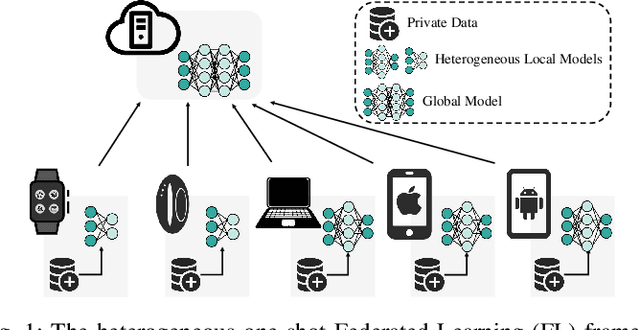
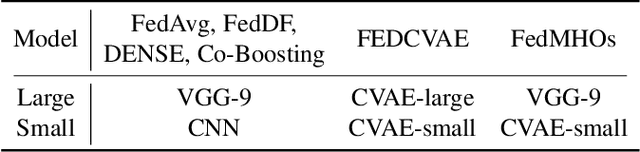
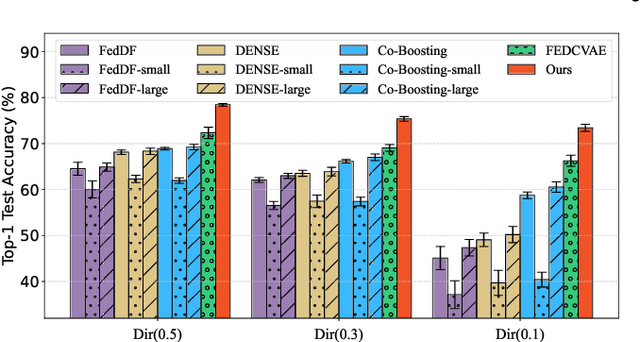
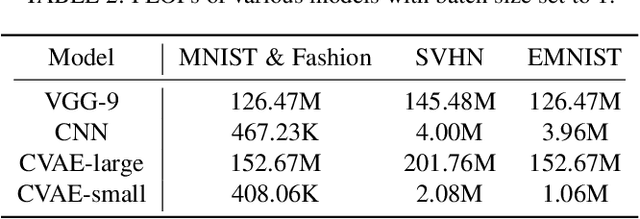
Federated Learning (FL) is increasingly adopted in edge computing scenarios, where a large number of heterogeneous clients operate under constrained or sufficient resources. The iterative training process in conventional FL introduces significant computation and communication overhead, which is unfriendly for resource-constrained edge devices. One-shot FL has emerged as a promising approach to mitigate communication overhead, and model-heterogeneous FL solves the problem of diverse computing resources across clients. However, existing methods face challenges in effectively managing model-heterogeneous one-shot FL, often leading to unsatisfactory global model performance or reliance on auxiliary datasets. To address these challenges, we propose a novel FL framework named FedMHO, which leverages deep classification models on resource-sufficient clients and lightweight generative models on resource-constrained devices. On the server side, FedMHO involves a two-stage process that includes data generation and knowledge fusion. Furthermore, we introduce FedMHO-MD and FedMHO-SD to mitigate the knowledge-forgetting problem during the knowledge fusion stage, and an unsupervised data optimization solution to improve the quality of synthetic samples. Comprehensive experiments demonstrate the effectiveness of our methods, as they outperform state-of-the-art baselines in various experimental setups.