 Add to Chrome
 Add to Firefox
 Add to Edge
HeartAgent: An Autonomous Agent System for Explainable Differential Diagnosis in Cardiology
Mar 11, 2026
Heart diseases remain a leading cause of morbidity and mortality worldwide, necessitating accurate and trustworthy differential diagnosis. However, existing artificial intelligence-based diagnostic methods are often limited by insufficient cardiology knowledge, inadequate support for complex reasoning, and poor interpretability. Here we present HeartAgent, a cardiology-specific agent system designed to support a reliable and explainable differential diagnosis. HeartAgent integrates customized tools and curated data resources and orchestrates multiple specialized sub-agents to perform complex reasoning while generating transparent reasoning trajectories and verifiable supporting references. Evaluated on the MIMIC dataset and a private electronic health records cohort, HeartAgent achieved over 36% and 20% improvements over established comparative methods, in top-3 diagnostic accuracy, respectively. Additionally, clinicians assisted by HeartAgent demonstrated gains of 26.9% in diagnostic accuracy and 22.7% in explanatory quality compared with unaided experts. These results demonstrate that HeartAgent provides reliable, explainable, and clinically actionable decision support for cardiovascular care.

Automating Expert-Level Medical Reasoning Evaluation of Large Language Models
Jul 10, 2025As large language models (LLMs) become increasingly integrated into clinical decision-making, ensuring transparent and trustworthy reasoning is essential. However, existing evaluation strategies of LLMs' medical reasoning capability either suffer from unsatisfactory assessment or poor scalability, and a rigorous benchmark remains lacking. To address this, we introduce MedThink-Bench, a benchmark designed for rigorous, explainable, and scalable assessment of LLMs' medical reasoning. MedThink-Bench comprises 500 challenging questions across ten medical domains, each annotated with expert-crafted step-by-step rationales. Building on this, we propose LLM-w-Ref, a novel evaluation framework that leverages fine-grained rationales and LLM-as-a-Judge mechanisms to assess intermediate reasoning with expert-level fidelity while maintaining scalability. Experiments show that LLM-w-Ref exhibits a strong positive correlation with expert judgments. Benchmarking twelve state-of-the-art LLMs, we find that smaller models (e.g., MedGemma-27B) can surpass larger proprietary counterparts (e.g., OpenAI-o3). Overall, MedThink-Bench offers a foundational tool for evaluating LLMs' medical reasoning, advancing their safe and responsible deployment in clinical practice.
Uncertainty-Aware Large Language Models for Explainable Disease Diagnosis
May 06, 2025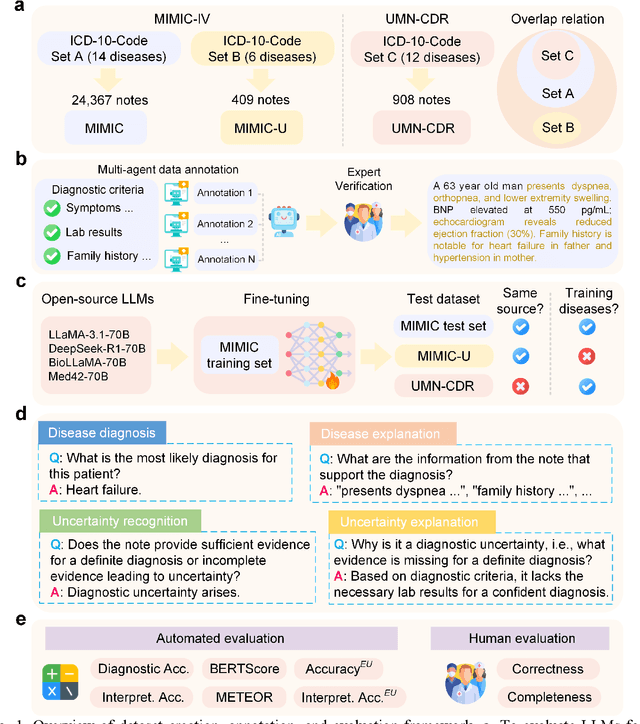
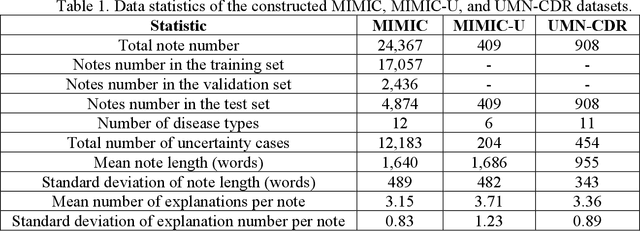
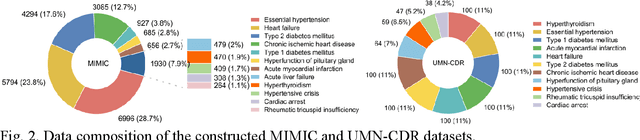
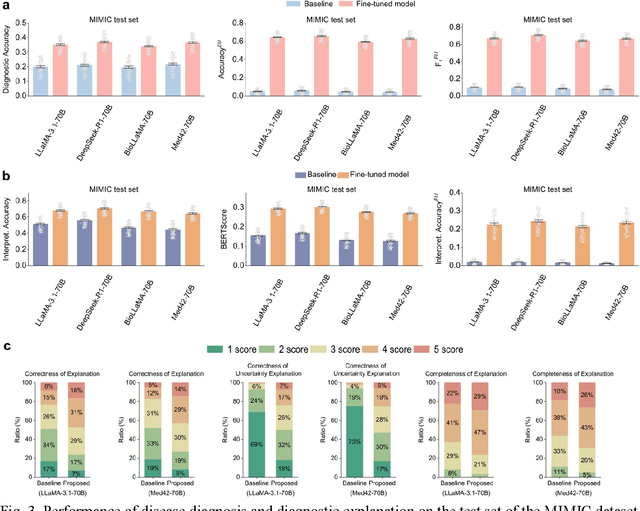
Explainable disease diagnosis, which leverages patient information (e.g., signs and symptoms) and computational models to generate probable diagnoses and reasonings, offers clear clinical values. However, when clinical notes encompass insufficient evidence for a definite diagnosis, such as the absence of definitive symptoms, diagnostic uncertainty usually arises, increasing the risk of misdiagnosis and adverse outcomes. Although explicitly identifying and explaining diagnostic uncertainties is essential for trustworthy diagnostic systems, it remains under-explored. To fill this gap, we introduce ConfiDx, an uncertainty-aware large language model (LLM) created by fine-tuning open-source LLMs with diagnostic criteria. We formalized the task and assembled richly annotated datasets that capture varying degrees of diagnostic ambiguity. Evaluating ConfiDx on real-world datasets demonstrated that it excelled in identifying diagnostic uncertainties, achieving superior diagnostic performance, and generating trustworthy explanations for diagnoses and uncertainties. To our knowledge, this is the first study to jointly address diagnostic uncertainty recognition and explanation, substantially enhancing the reliability of automatic diagnostic systems.