 Add to Chrome
 Add to Firefox
 Add to Edge
Domain Knowledge Graph Construction Via A Simple Checker
Oct 08, 2023
With the availability of large language models, there is a growing interest for semiconductor chip design companies to leverage the technologies. For those companies, deployment of a new methodology must include two important considerations: confidentiality and scalability. In this context, this work tackles the problem of knowledge graph construction from hardware-design domain texts. We propose an oracle-checker scheme to leverage the power of GPT3.5 and demonstrate that the essence of the problem is in distillation of domain expert's background knowledge. Using RISC-V unprivileged ISA specification as an example, we explain key ideas and discuss practicality of our proposed oracle-checker approach.

Crossbar-aware neural network pruning
Jul 25, 2018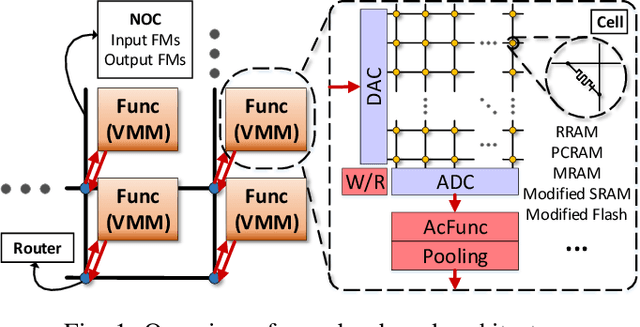
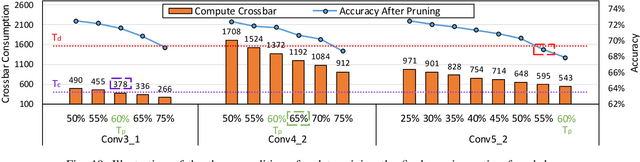
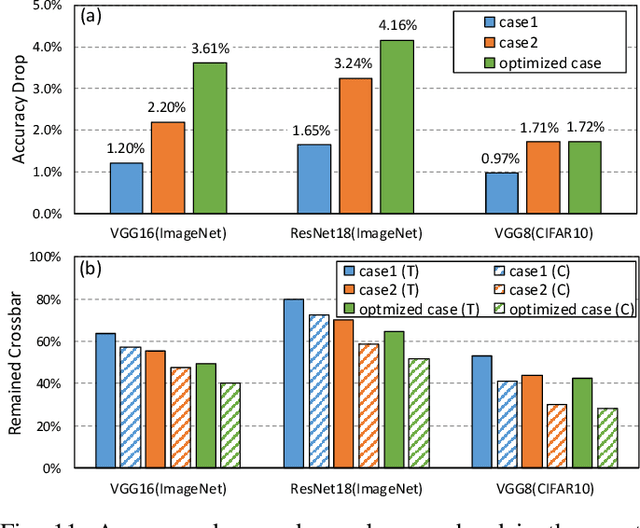
Crossbar architecture based devices have been widely adopted in neural network accelerators by taking advantage of the high efficiency on vector-matrix multiplication (VMM) operations. However, in the case of convolutional neural networks (CNNs), the efficiency is compromised dramatically due to the large amounts of data reuse. Although some mapping methods have been designed to achieve a balance between the execution throughput and resource overhead, the resource consumption cost is still huge while maintaining the throughput. Network pruning is a promising and widely studied leverage to shrink the model size. Whereas, previous work didn`t consider the crossbar architecture and the corresponding mapping method, which cannot be directly utilized by crossbar-based neural network accelerators. Tightly combining the crossbar structure and its mapping, this paper proposes a crossbar-aware pruning framework based on a formulated L0-norm constrained optimization problem. Specifically, we design an L0-norm constrained gradient descent (LGD) with relaxant probabilistic projection (RPP) to solve this problem. Two grains of sparsity are successfully achieved: i) intuitive crossbar-grain sparsity and ii) column-grain sparsity with output recombination, based on which we further propose an input feature maps (FMs) reorder method to improve the model accuracy. We evaluate our crossbar-aware pruning framework on median-scale CIFAR10 dataset and large-scale ImageNet dataset with VGG and ResNet models. Our method is able to reduce the crossbar overhead by 44%-72% with little accuracy degradation. This work greatly saves the resource and the related energy cost, which provides a new co-design solution for mapping CNNs onto various crossbar devices with significantly higher efficiency.