 Add to Chrome
 Add to Firefox
 Add to Edge
Global Commander and Local Operative: A Dual-Agent Framework for Scene Navigation
Feb 21, 2026
Vision-and-Language Scene navigation is a fundamental capability for embodied human-AI collaboration, requiring agents to follow natural language instructions to execute coherent action sequences in complex environments. Existing approaches either rely on multiple agents, incurring high coordination and resource costs, or adopt a single-agent paradigm, which overloads the agent with both global planning and local perception, often leading to degraded reasoning and instruction drift in long-horizon settings. To address these issues, we introduce DACo, a planning-grounding decoupled architecture that disentangles global deliberation from local grounding. Concretely, it employs a Global Commander for high-level strategic planning and a Local Operative for egocentric observing and fine-grained execution. By disentangling global reasoning from local action, DACo alleviates cognitive overload and improves long-horizon stability. The framework further integrates dynamic subgoal planning and adaptive replanning to enable structured and resilient navigation. Extensive evaluations on R2R, REVERIE, and R4R demonstrate that DACo achieves 4.9%, 6.5%, 5.4% absolute improvements over the best-performing baselines in zero-shot settings, and generalizes effectively across both closed-source (e.g., GPT-4o) and open-source (e.g., Qwen-VL Series) backbones. DACo provides a principled and extensible paradigm for robust long-horizon navigation. Project page: https://github.com/ChocoWu/DACo

MapTracker: Tracking with Strided Memory Fusion for Consistent Vector HD Mapping
Mar 23, 2024


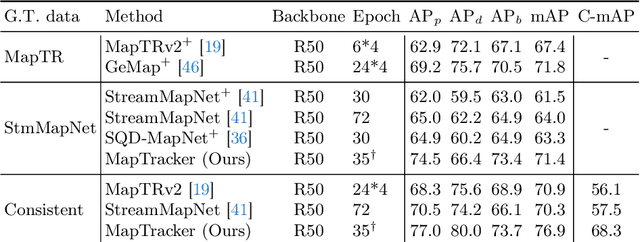
This paper presents a vector HD-mapping algorithm that formulates the mapping as a tracking task and uses a history of memory latents to ensure consistent reconstructions over time. Our method, MapTracker, accumulates a sensor stream into memory buffers of two latent representations: 1) Raster latents in the bird's-eye-view (BEV) space and 2) Vector latents over the road elements (i.e., pedestrian-crossings, lane-dividers, and road-boundaries). The approach borrows the query propagation paradigm from the tracking literature that explicitly associates tracked road elements from the previous frame to the current, while fusing a subset of memory latents selected with distance strides to further enhance temporal consistency. A vector latent is decoded to reconstruct the geometry of a road element. The paper further makes benchmark contributions by 1) Improving processing code for existing datasets to produce consistent ground truth with temporal alignments and 2) Augmenting existing mAP metrics with consistency checks. MapTracker significantly outperforms existing methods on both nuScenes and Agroverse2 datasets by over 8% and 19% on the conventional and the new consistency-aware metrics, respectively. The code will be available on our project page: https://map-tracker.github.io.
CASA: Category-agnostic Skeletal Animal Reconstruction
Nov 04, 2022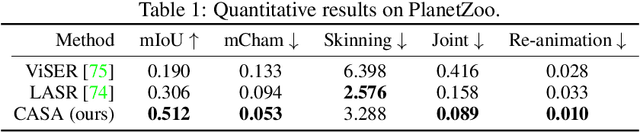
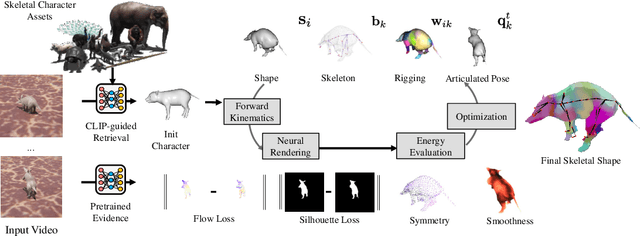

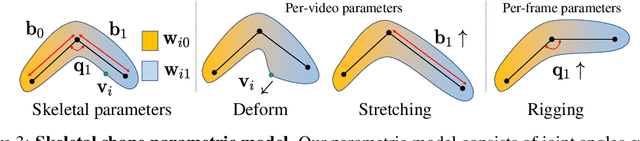
Recovering the skeletal shape of an animal from a monocular video is a longstanding challenge. Prevailing animal reconstruction methods often adopt a control-point driven animation model and optimize bone transforms individually without considering skeletal topology, yielding unsatisfactory shape and articulation. In contrast, humans can easily infer the articulation structure of an unknown animal by associating it with a seen articulated character in their memory. Inspired by this fact, we present CASA, a novel Category-Agnostic Skeletal Animal reconstruction method consisting of two major components: a video-to-shape retrieval process and a neural inverse graphics framework. During inference, CASA first retrieves an articulated shape from a 3D character assets bank so that the input video scores highly with the rendered image, according to a pretrained language-vision model. CASA then integrates the retrieved character into an inverse graphics framework and jointly infers the shape deformation, skeleton structure, and skinning weights through optimization. Experiments validate the efficacy of CASA regarding shape reconstruction and articulation. We further demonstrate that the resulting skeletal-animated characters can be used for re-animation.