 Add to Chrome
 Add to Firefox
 Add to Edge
EmoAgent-R1: Towards Multimodal Emotion Understanding with Reinforcement Learning-based Dynamic Agent Specialization
Jul 25, 2026
Multimodal large language models (MLLMs) have achieved impressive performance in multimodal emotion recognition (MER) tasks and lifted MER to a new level that is complex emotion understanding with advanced video understanding abilities and natural language description. However, existing MLLM-based methods often use a fixed prompt to perceive the emotions, ignoring the dynamicity and complexity of the emotion source in the multimodal inputs. To address these issues, we propose a novel Reinforcement Learning-based Dynamic Agent Specialization framework (\textbf{EmoAgent-R1}) to optimize the emotion recognition, reasoning, and generalization abilities of an MLLM with dynamic agent specialization based on reinforcement learning. Specifically, we first adopt a cold start strategy to endow an MLLM with preliminary emotion recognition, reasoning, and agent routing ability by training with synthetic answer-conditioned chain-of-thought data and agent routing data. Then, we further train the MLLM with reinforcement learning to perceive emotions in a two-step agentic workflow with agent selection and agent specialization. To effectively train EmoAgent-R1, we propose a novel Progressive Group-Relative Policy Optimization (P-GRPO) to combine group-based relative advantages with a PMI-inspired progressive token-level modulation to transform sparse rewards into fine-grained learning signals, mitigating the coarse-grained uniform credit assignment issue in GRPO. Extensive experiments on MER benchmarks demonstrate the superiority of our EmoAgent-R1 in stronger emotion reasoning performance and improved optimization stability.

FlowPalm: Optical Flow Driven Non-Rigid Deformation for Geometrically Diverse Palmprint Generation
Apr 11, 2026Recently, synthetic palmprints have been increasingly used as substitutes for real data to train recognition models. To be effective, such synthetic data must reflect the diversity of real palmprints, including both style variation and geometric variation. However, existing palmprint generation methods mainly focus on style translation, while geometric variation is either ignored or approximated by simple handcrafted augmentations. In this work, we propose FlowPalm, an optical-flow-driven palmprint generation framework capable of simulating the complex non-rigid deformations observed in real palms. Specifically, FlowPalm estimates optical flows between real palmprint pairs to capture the statistical patterns of geometric deformations. Building on these priors, we design a progressive sampling process that gradually introduces the geometric deformations during diffusion while maintaining identity consistency. Extensive experiments on six benchmark datasets demonstrate that FlowPalm significantly outperforms state-of-the-art palmprint generation approaches in downstream recognition tasks. Project page: https://yuchenzou.github.io/FlowPalm/
Coarse-to-Fine Monocular Re-Localization in OpenStreetMap via Semantic Alignment
Mar 02, 2026Monocular re-localization plays a crucial role in enabling intelligent agents to achieve human-like perception. However, traditional methods rely on dense maps, which face scalability limitations and privacy risks. OpenStreetMap (OSM), as a lightweight map that protects privacy, offers semantic and geometric information with global scalability. Nonetheless, there are still challenges in using OSM for localization: the inherent cross-modal discrepancies between natural images and OSM, as well as the high computational cost of global map-based localization. In this paper, we propose a hierarchical search framework with semantic alignment for localization in OSM. First, the semantic awareness capability of DINO-ViT is utilised to deconstruct visual elements to establish semantic relationships with OSM. Second, a coarse-to-fine search paradigm is designed to replace global dense matching, enabling efficient progressive refinement. Extensive experiments demonstrate that our method significantly improves both localization accuracy and speed. When trained on a single dataset, the 3° orientation recall of our method even outperforms the 5° recall of state-of-the-art methods.
Towards Unified Modeling in Federated Multi-Task Learning via Subspace Decoupling
May 30, 2025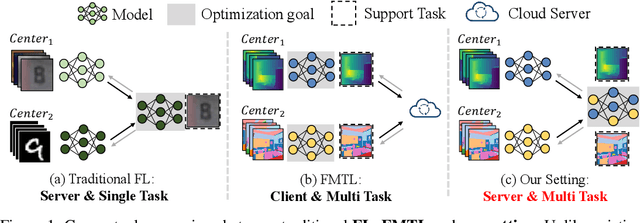
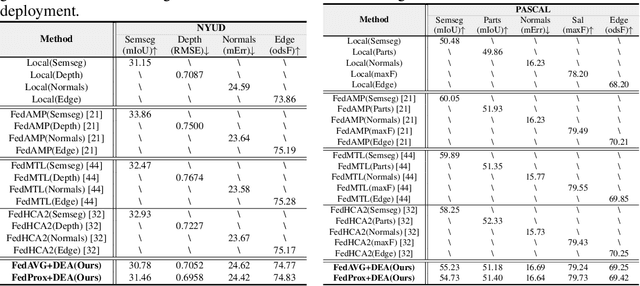
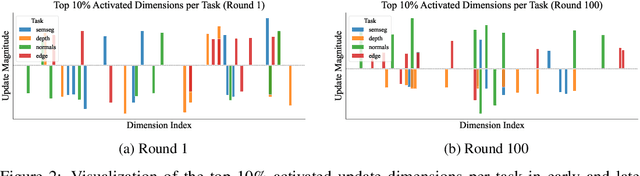
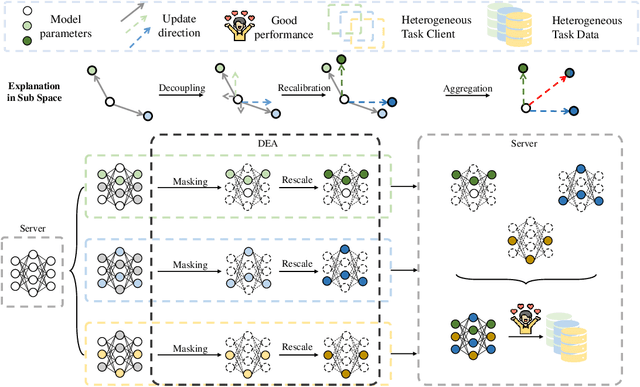
Federated Multi-Task Learning (FMTL) enables multiple clients performing heterogeneous tasks without exchanging their local data, offering broad potential for privacy preserving multi-task collaboration. However, most existing methods focus on building personalized models for each client and unable to support the aggregation of multiple heterogeneous tasks into a unified model. As a result, in real-world scenarios where task objectives, label spaces, and optimization paths vary significantly, conventional FMTL methods struggle to achieve effective joint training. To address this challenge, we propose FedDEA (Federated Decoupled Aggregation), an update-structure-aware aggregation method specifically designed for multi-task model integration. Our method dynamically identifies task-relevant dimensions based on the response strength of local updates and enhances their optimization effectiveness through rescaling. This mechanism effectively suppresses cross-task interference and enables task-level decoupled aggregation within a unified global model. FedDEA does not rely on task labels or architectural modifications, making it broadly applicable and deployment-friendly. Experimental results demonstrate that it can be easily integrated into various mainstream federated optimization algorithms and consistently delivers significant overall performance improvements on widely used NYUD-V2 and PASCAL-Context. These results validate the robustness and generalization capabilities of FedDEA under highly heterogeneous task settings.
Venturing into Uncharted Waters: The Navigation Compass from Transformer to Mamba
Jun 24, 2024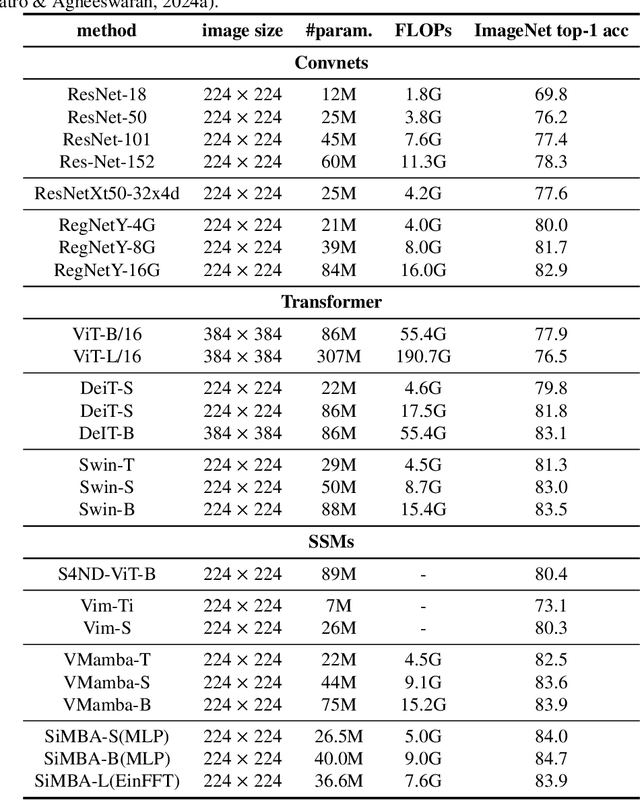
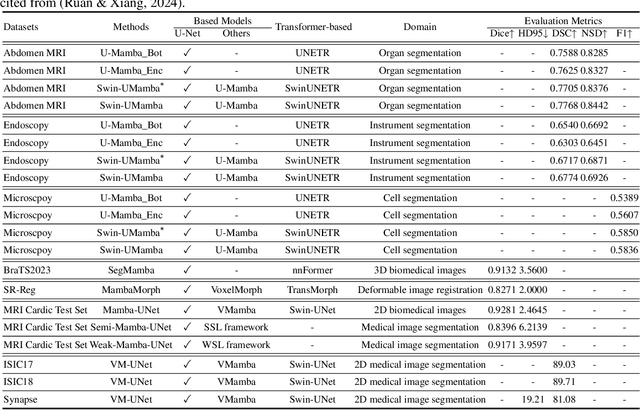
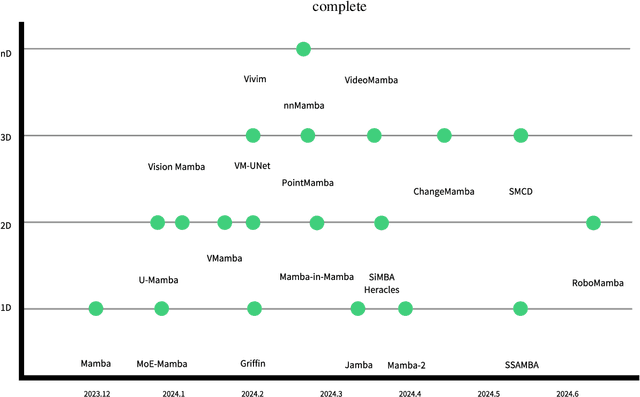
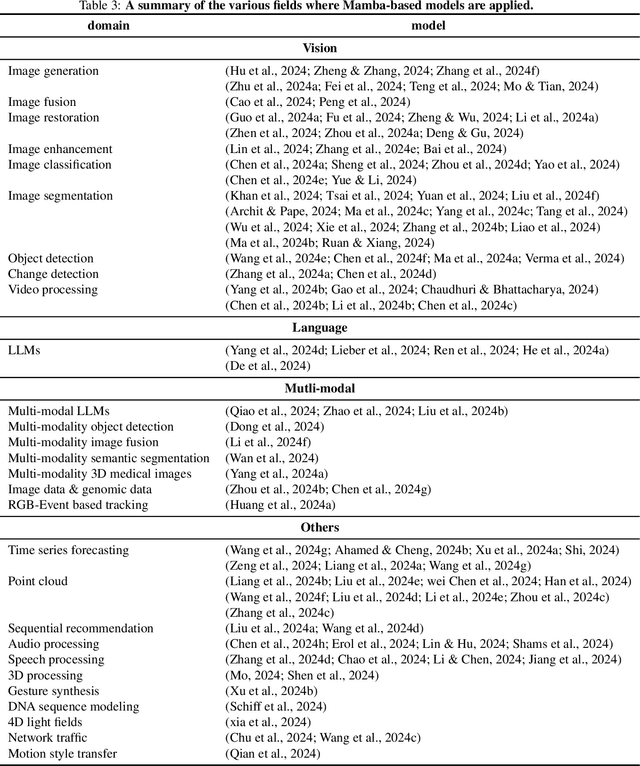
Transformer, a deep neural network architecture, has long dominated the field of natural language processing and beyond. Nevertheless, the recent introduction of Mamba challenges its supremacy, sparks considerable interest among researchers, and gives rise to a series of Mamba-based models that have exhibited notable potential. This survey paper orchestrates a comprehensive discussion, diving into essential research dimensions, covering: (i) the functioning of the Mamba mechanism and its foundation on the principles of structured state space models; (ii) the proposed improvements and the integration of Mamba with various networks, exploring its potential as a substitute for Transformers; (iii) the combination of Transformers and Mamba to compensate for each other's shortcomings. We have also made efforts to interpret Mamba and Transformer in the framework of kernel functions, allowing for a comparison of their mathematical nature within a unified context. Our paper encompasses the vast majority of improvements related to Mamba to date.