 Add to Chrome
 Add to Firefox
 Add to Edge
Let Samples Speak: Mitigating Spurious Correlation by Exploiting the Clusterness of Samples
Dec 28, 2025
Deep learning models are known to often learn features that spuriously correlate with the class label during training but are irrelevant to the prediction task. Existing methods typically address this issue by annotating potential spurious attributes, or filtering spurious features based on some empirical assumptions (e.g., simplicity of bias). However, these methods may yield unsatisfactory performance due to the intricate and elusive nature of spurious correlations in real-world data. In this paper, we propose a data-oriented approach to mitigate the spurious correlation in deep learning models. We observe that samples that are influenced by spurious features tend to exhibit a dispersed distribution in the learned feature space. This allows us to identify the presence of spurious features. Subsequently, we obtain a bias-invariant representation by neutralizing the spurious features based on a simple grouping strategy. Then, we learn a feature transformation to eliminate the spurious features by aligning with this bias-invariant representation. Finally, we update the classifier by incorporating the learned feature transformation and obtain an unbiased model. By integrating the aforementioned identifying, neutralizing, eliminating and updating procedures, we build an effective pipeline for mitigating spurious correlation. Experiments on image and NLP debiasing benchmarks show an improvement in worst group accuracy of more than 20% compared to standard empirical risk minimization (ERM). Codes and checkpoints are available at https://github.com/davelee-uestc/nsf_debiasing .

A new embedding quality assessment method for manifold learning
Aug 08, 2011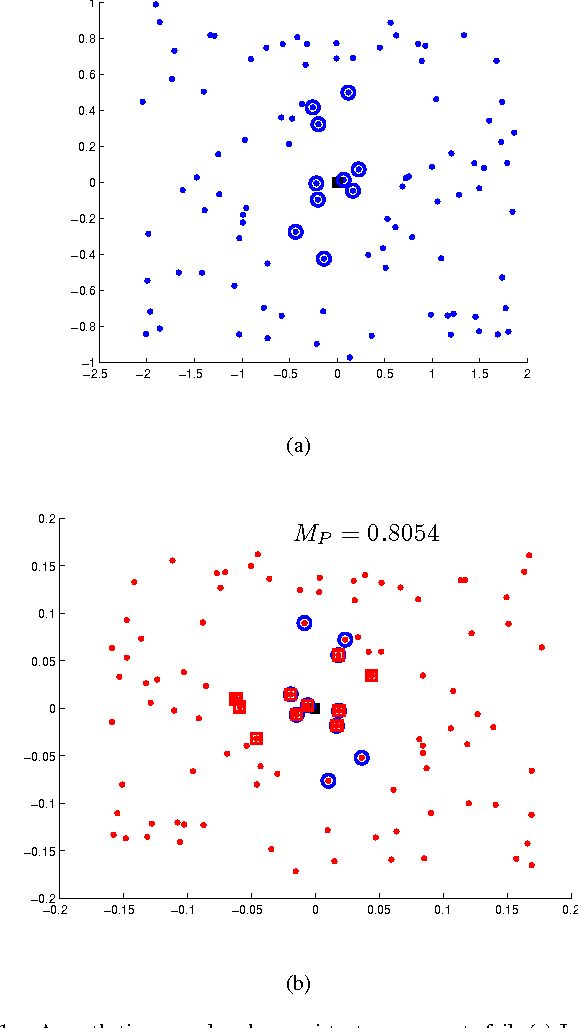
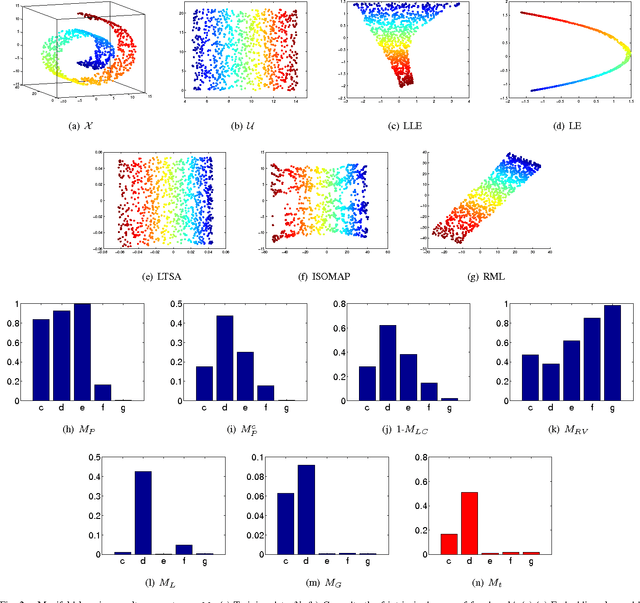
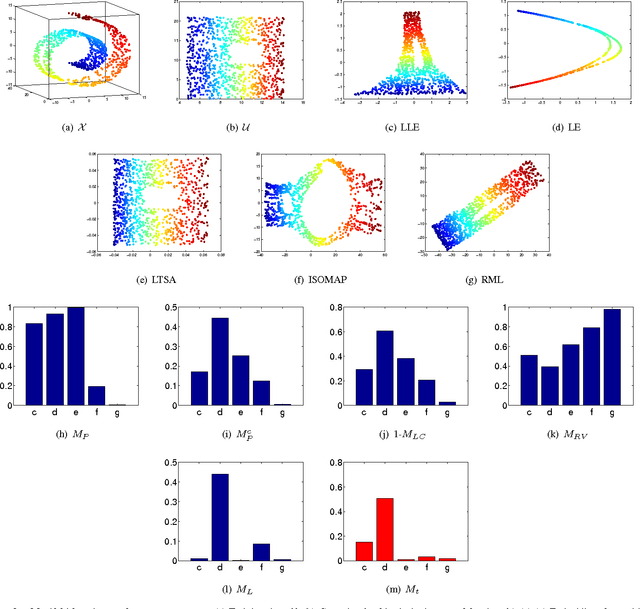

Manifold learning is a hot research topic in the field of computer science. A crucial issue with current manifold learning methods is that they lack a natural quantitative measure to assess the quality of learned embeddings, which greatly limits their applications to real-world problems. In this paper, a new embedding quality assessment method for manifold learning, named as Normalization Independent Embedding Quality Assessment (NIEQA), is proposed. Compared with current assessment methods which are limited to isometric embeddings, the NIEQA method has a much larger application range due to two features. First, it is based on a new measure which can effectively evaluate how well local neighborhood geometry is preserved under normalization, hence it can be applied to both isometric and normalized embeddings. Second, it can provide both local and global evaluations to output an overall assessment. Therefore, NIEQA can serve as a natural tool in model selection and evaluation tasks for manifold learning. Experimental results on benchmark data sets validate the effectiveness of the proposed method.