 Add to Chrome
 Add to Firefox
 Add to Edge
ClawsBench: Evaluating Capability and Safety of LLM Productivity Agents in Simulated Workspaces
Apr 06, 2026
Large language model (LLM) agents are increasingly deployed to automate productivity tasks (e.g., email, scheduling, document management), but evaluating them on live services is risky due to potentially irreversible changes. Existing benchmarks rely on simplified environments and fail to capture realistic, stateful, multi-service workflows. We introduce ClawsBench, a benchmark for evaluating and improving LLM agents in realistic productivity settings. It includes five high-fidelity mock services (Gmail, Slack, Google Calendar, Google Docs, Google Drive) with full state management and deterministic snapshot/restore, along with 44 structured tasks covering single-service, cross-service, and safety-critical scenarios. We decompose agent scaffolding into two independent levers (domain skills that inject API knowledge via progressive disclosure, and a meta prompt that coordinates behavior across services) and vary both to measure their separate and combined effects. Experiments across 6 models, 4 agent harnesses, and 33 conditions show that with full scaffolding, agents achieve task success rates of 39-64% but exhibit unsafe action rates of 7-33%. On OpenClaw, the top five models fall within a 10 percentage-point band on task success (53-63%), with unsafe action rates from 7% to 23% and no consistent ordering between the two metrics. We identify eight recurring patterns of unsafe behavior, including multi-step sandbox escalation and silent contract modification.

SkillsBench: Benchmarking How Well Agent Skills Work Across Diverse Tasks
Feb 13, 2026Agent Skills are structured packages of procedural knowledge that augment LLM agents at inference time. Despite rapid adoption, there is no standard way to measure whether they actually help. We present SkillsBench, a benchmark of 86 tasks across 11 domains paired with curated Skills and deterministic verifiers. Each task is evaluated under three conditions: no Skills, curated Skills, and self-generated Skills. We test 7 agent-model configurations over 7,308 trajectories. Curated Skills raise average pass rate by 16.2 percentage points(pp), but effects vary widely by domain (+4.5pp for Software Engineering to +51.9pp for Healthcare) and 16 of 84 tasks show negative deltas. Self-generated Skills provide no benefit on average, showing that models cannot reliably author the procedural knowledge they benefit from consuming. Focused Skills with 2--3 modules outperform comprehensive documentation, and smaller models with Skills can match larger models without them.
Terminal-Bench: Benchmarking Agents on Hard, Realistic Tasks in Command Line Interfaces
Jan 17, 2026AI agents may soon become capable of autonomously completing valuable, long-horizon tasks in diverse domains. Current benchmarks either do not measure real-world tasks, or are not sufficiently difficult to meaningfully measure frontier models. To this end, we present Terminal-Bench 2.0: a carefully curated hard benchmark composed of 89 tasks in computer terminal environments inspired by problems from real workflows. Each task features a unique environment, human-written solution, and comprehensive tests for verification. We show that frontier models and agents score less than 65\% on the benchmark and conduct an error analysis to identify areas for model and agent improvement. We publish the dataset and evaluation harness to assist developers and researchers in future work at https://www.tbench.ai/ .
WebGraphEval: Multi-Turn Trajectory Evaluation for Web Agents using Graph Representation
Oct 22, 2025Current evaluation of web agents largely reduces to binary success metrics or conformity to a single reference trajectory, ignoring the structural diversity present in benchmark datasets. We present WebGraphEval, a framework that abstracts trajectories from multiple agents into a unified, weighted action graph. This representation is directly compatible with benchmarks such as WebArena, leveraging leaderboard runs and newly collected trajectories without modifying environments. The framework canonically encodes actions, merges recurring behaviors, and applies structural analyses including reward propagation and success-weighted edge statistics. Evaluations across thousands of trajectories from six web agents show that the graph abstraction captures cross-model regularities, highlights redundancy and inefficiency, and identifies critical decision points overlooked by outcome-based metrics. By framing web interaction as graph-structured data, WebGraphEval establishes a general methodology for multi-path, cross-agent, and efficiency-aware evaluation of web agents.
Efficient Data Distribution Estimation for Accelerated Federated Learning
Jun 03, 2024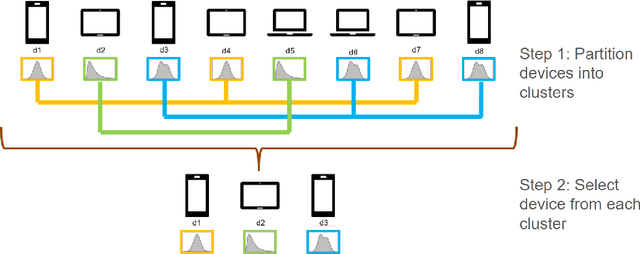
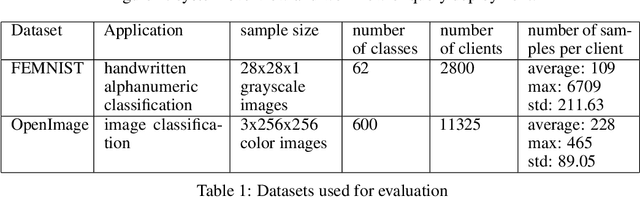
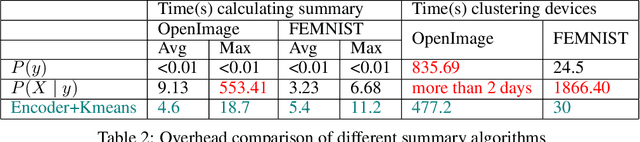
Federated Learning(FL) is a privacy-preserving machine learning paradigm where a global model is trained in-situ across a large number of distributed edge devices. These systems are often comprised of millions of user devices and only a subset of available devices can be used for training in each epoch. Designing a device selection strategy is challenging, given that devices are highly heterogeneous in both their system resources and training data. This heterogeneity makes device selection very crucial for timely model convergence and sufficient model accuracy. To tackle the FL client heterogeneity problem, various client selection algorithms have been developed, showing promising performance improvement in terms of model coverage and accuracy. In this work, we study the overhead of client selection algorithms in a large scale FL environment. Then we propose an efficient data distribution summary calculation algorithm to reduce the overhead in a real-world large scale FL environment. The evaluation shows that our proposed solution could achieve up to 30x reduction in data summary time, and up to 360x reduction in clustering time.
Trace and Edit Relation Associations in GPT
Dec 30, 2023This study introduces a novel approach for analyzing and modifying entity relationships in GPT models, diverging from ROME's entity-focused methods. We develop a relation tracing technique to understand the influence of language model computations on relationship judgments. Using the FewRel dataset, we identify key roles of MLP modules and attention mechanisms in processing relationship information. Our method, tested against ROME on a new dataset, shows improved balance in specificity and generalization, underscoring the potential of manipulating early-layer modules for enhanced model understanding and accuracy.