 Add to Chrome
 Add to Firefox
 Add to Edge
GraphVerse: A Comprehensive Visual Graph Reasoning Benchmark for Multimodal Large Language Models
Aug 07, 2026
Recent Multimodal Large Language Models (MLLMs) have achieved remarkable progress across diverse vision-language tasks, creating an urgent need for more challenging benchmarks. Yet existing evaluations still provide limited insight into whether these models can truly reason over structured visual information. Visual Graph Reasoning (VGR) offers a compelling testbed for this challenge, requiring models to integrate perception, structural understanding, and multi-step reasoning over graph-based visual inputs. However, prior VGR benchmarks often reduce the task to visual perception followed by text-based reasoning, restrict evaluation to single-image settings, rely on answer-only metrics, and underrepresent realistic graph-centric scenarios. To bridge the gap, we introduce GraphVerse, a unified benchmark that jointly evaluates perception, visual reasoning, and text-based graph reasoning in MLLMs under both single-image and paired-image settings. At its core is a suite of Graph-centric Image Editing (GIE) strategies that modify graph images while preserving their semantics, turning them into active tests of visual reasoning. We further propose VGR-Score, a process-sensitive metric that evaluates reasoning quality beyond final-answer accuracy. Extensive experiments reveal several key limitations of current MLLMs in VGR, while also validating the effectiveness of GIE strategies and the transferability of GraphVerse to broader multimodal reasoning capabilities. The code is available at https://github.com/sunyuanfu/GraphVerse.

IAG: Induction-Augmented Generation Framework for Answering Reasoning Questions
Nov 30, 2023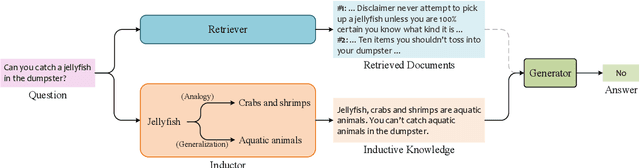
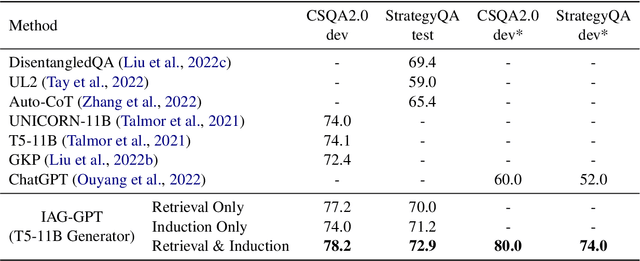
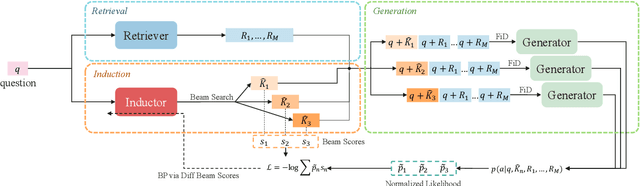
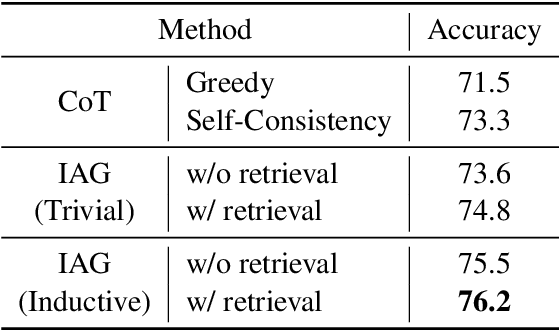
Retrieval-Augmented Generation (RAG), by incorporating external knowledge with parametric memory of language models, has become the state-of-the-art architecture for open-domain QA tasks. However, common knowledge bases are inherently constrained by limited coverage and noisy information, making retrieval-based approaches inadequate to answer implicit reasoning questions. In this paper, we propose an Induction-Augmented Generation (IAG) framework that utilizes inductive knowledge along with the retrieved documents for implicit reasoning. We leverage large language models (LLMs) for deriving such knowledge via a novel prompting method based on inductive reasoning patterns. On top of this, we implement two versions of IAG named IAG-GPT and IAG-Student, respectively. IAG-GPT directly utilizes the knowledge generated by GPT-3 for answer prediction, while IAG-Student gets rid of dependencies on GPT service at inference time by incorporating a student inductor model. The inductor is firstly trained via knowledge distillation and further optimized by back-propagating the generator feedback via differentiable beam scores. Experimental results show that IAG outperforms RAG baselines as well as ChatGPT on two Open-Domain QA tasks. Notably, our best models have won the first place in the official leaderboards of CSQA2.0 (since Nov 1, 2022) and StrategyQA (since Jan 8, 2023).