 Add to Chrome
 Add to Firefox
 Add to Edge
Context-Informed Ship Trajectory Prediction via Conditional Attention
Jul 29, 2026
Long-term ship trajectory prediction is a fundamental capability for maritime safety and autonomous navigation. While recent Transformer-based architectures have improved forecasting horizons, they predominantly rely on historical kinematic states, treating vessel motion as an isolated system. In reality, maritime navigation is profoundly modulated by extrinsic factors like weather and constrained by static vessel characteristics. Existing multimodal approaches fundamentally model the joint distribution over states and contexts, treating environmental variables as peer features rather than encoding the directional physical dependence of vessel dynamics on environmental conditions. In this work, we propose the Conditional Informer, a novel encoder-decoder architecture that formulates trajectory prediction as a conditional generation task. We employ a dedicated Conditional Attention mechanism where the vessel state explicitly queries environmental contexts through cross-attention, encoding the physical prior that weather modulates - but is not generated by - vessel dynamics. Furthermore, to address the intermittency of real-world data, we introduce a Modality Masking training strategy to prevent catastrophic degradation during sensor fallback. Extensive experiments on AIS and ERA5 data demonstrate that our approach outperforms kinematic and concatenation-based baselines by 15.4% in prediction accuracy when context is available. Crucially, Modality Masking prevents shortcut learning, reducing fallback error by nearly an order of magnitude compared to unconstrained models.

Catastrophic Compositional Generation: Why Vanilla Diffusion Models Fail to Extrapolate
Jun 22, 2026The task of compositional generation involves using a conditional generative model, trained only on a subset of the possible conditions, to produce samples from compositionally-defined target distributions such as a geometric combination of the source distributions. In this work, we argue that this task is often infeasible for vanilla conditional diffusion models: we conjecture that no inference-time technique can efficiently produce samples from the target distribution in certain well-motivated settings. This idea is supported by theory-guided generalization arguments and carefully-designed experiments on both synthetic and realistic data. In particular, while recent methods such as Feynman-Kac correction reduce inference-time approximation error, our results show that score estimation error has a more catastrophic effect on performance when the target distribution is out-of-distribution with respect to the sources, highlighting the need for a different approach to this task.
Towards an AI co-scientist
Feb 26, 2025Scientific discovery relies on scientists generating novel hypotheses that undergo rigorous experimental validation. To augment this process, we introduce an AI co-scientist, a multi-agent system built on Gemini 2.0. The AI co-scientist is intended to help uncover new, original knowledge and to formulate demonstrably novel research hypotheses and proposals, building upon prior evidence and aligned to scientist-provided research objectives and guidance. The system's design incorporates a generate, debate, and evolve approach to hypothesis generation, inspired by the scientific method and accelerated by scaling test-time compute. Key contributions include: (1) a multi-agent architecture with an asynchronous task execution framework for flexible compute scaling; (2) a tournament evolution process for self-improving hypotheses generation. Automated evaluations show continued benefits of test-time compute, improving hypothesis quality. While general purpose, we focus development and validation in three biomedical areas: drug repurposing, novel target discovery, and explaining mechanisms of bacterial evolution and anti-microbial resistance. For drug repurposing, the system proposes candidates with promising validation findings, including candidates for acute myeloid leukemia that show tumor inhibition in vitro at clinically applicable concentrations. For novel target discovery, the AI co-scientist proposed new epigenetic targets for liver fibrosis, validated by anti-fibrotic activity and liver cell regeneration in human hepatic organoids. Finally, the AI co-scientist recapitulated unpublished experimental results via a parallel in silico discovery of a novel gene transfer mechanism in bacterial evolution. These results, detailed in separate, co-timed reports, demonstrate the potential to augment biomedical and scientific discovery and usher an era of AI empowered scientists.
Human-Robot Shared Control for Surgical Robot Based on Context-Aware Sim-to-Real Adaptation
Apr 23, 2022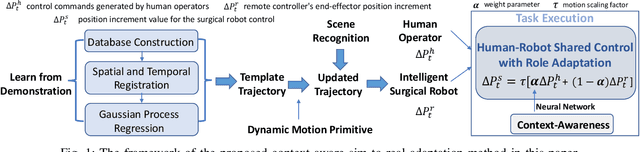
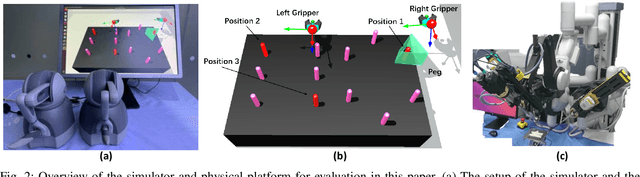
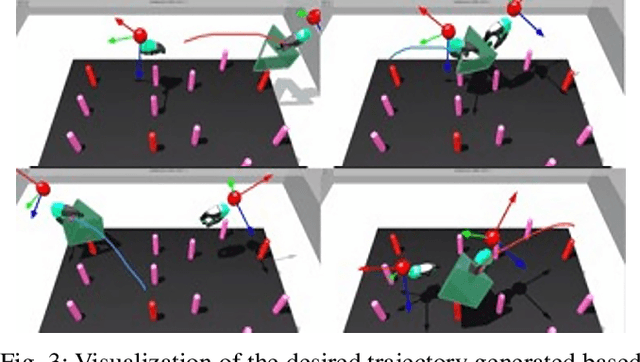
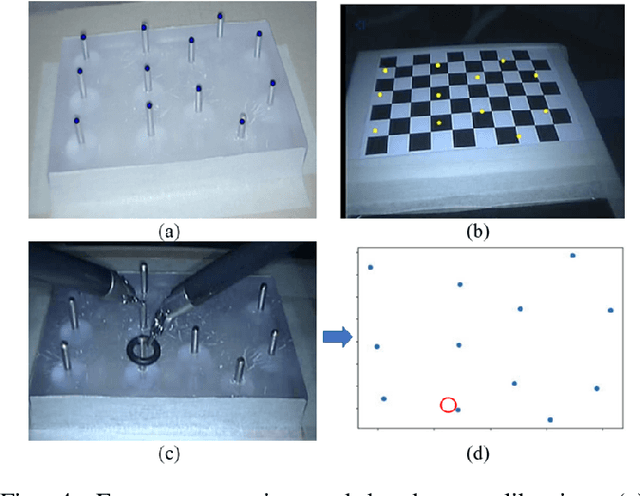
Human-robot shared control, which integrates the advantages of both humans and robots, is an effective approach to facilitate efficient surgical operation. Learning from demonstration (LfD) techniques can be used to automate some of the surgical subtasks for the construction of the shared control mechanism. However, a sufficient amount of data is required for the robot to learn the manoeuvres. Using a surgical simulator to collect data is a less resource-demanding approach. With sim-to-real adaptation, the manoeuvres learned from a simulator can be transferred to a physical robot. To this end, we propose a sim-to-real adaptation method to construct a human-robot shared control framework for robotic surgery. In this paper, a desired trajectory is generated from a simulator using LfD method, while dynamic motion primitives (DMP) is used to transfer the desired trajectory from the simulator to the physical robotic platform. Moreover, a role adaptation mechanism is developed such that the robot can adjust its role according to the surgical operation contexts predicted by a neural network model. The effectiveness of the proposed framework is validated on the da Vinci Research Kit (dVRK). Results of the user studies indicated that with the adaptive human-robot shared control framework, the path length of the remote controller, the total clutching number and the task completion time can be reduced significantly. The proposed method outperformed the traditional manual control via teleoperation.