 Add to Chrome
 Add to Firefox
 Add to Edge
RLDX-1 Technical Report
May 05, 2026
While Vision-Language-Action models (VLAs) have shown remarkable progress toward human-like generalist robotic policies through the versatile intelligence (i.e. broad scene understanding and language-conditioned generalization) inherited from pre-trained Vision-Language Models, they still struggle with complex real-world tasks requiring broader functional capabilities (e.g. motion awareness, memory-aware decision making, and physical sensing). To address this, we introduce RLDX-1, a general-purpose robotic policy for dexterous manipulation built on the Multi-Stream Action Transformer (MSAT), an architecture that unifies these capabilities by integrating heterogeneous modalities through modality-specific streams with cross-modal joint self-attention. RLDX-1 further combines this architecture with system-level design choices, including synthesizing training data for rare manipulation scenarios, learning procedures specialized for human-like manipulation, and inference optimizations for real-time deployment. Through empirical evaluation, we show that RLDX-1 consistently outperforms recent frontier VLAs (e.g. $π_{0.5}$ and GR00T N1.6) across both simulation benchmarks and real-world tasks that require broad functional capabilities beyond general versatility. In particular, RLDX-1 shows superiority in ALLEX humanoid tasks by achieving success rates of 86.8% while $π_{0.5}$ and GR00T N1.6 achieve around 40%, highlighting the ability of RLDX-1 to control a high-DoF humanoid robot under diverse functional demands. Together, these results position RLDX-1 as a promising step toward reliable VLAs for complex, contact-rich, and dynamic real-world dexterous manipulation.

Spectral and Polarization Vision: Spectro-polarimetric Real-world Dataset
Nov 30, 2023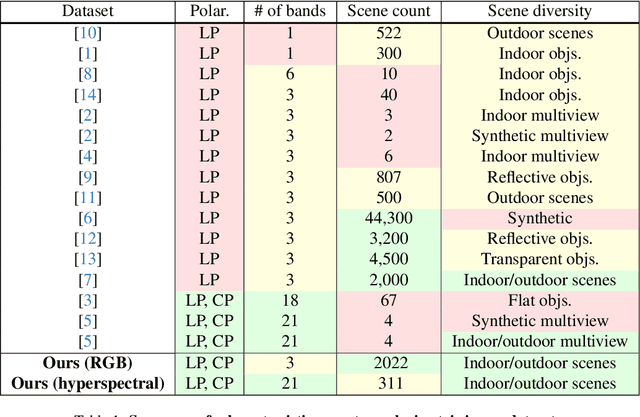
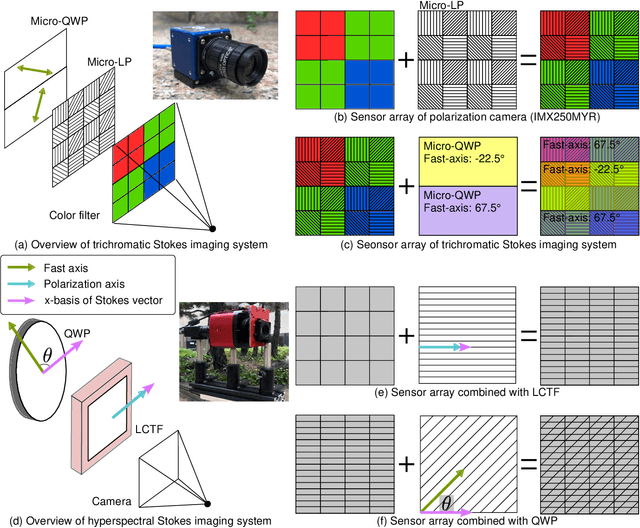
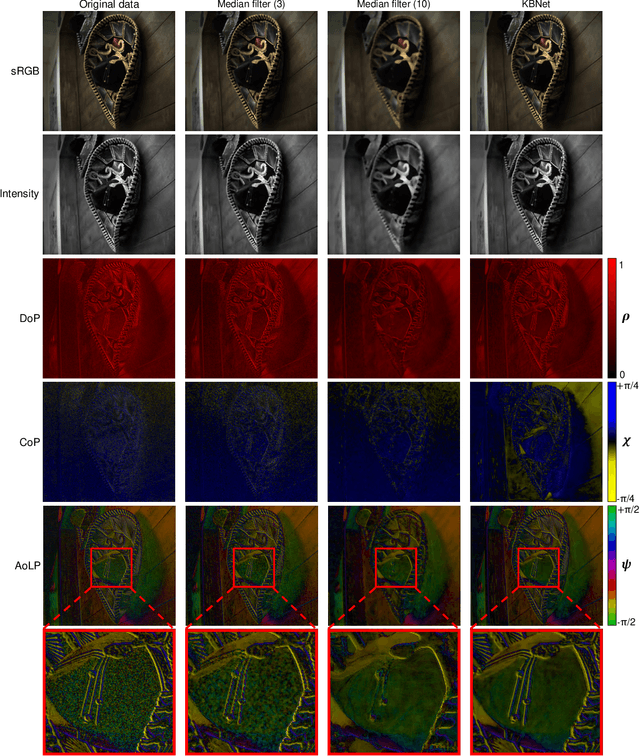
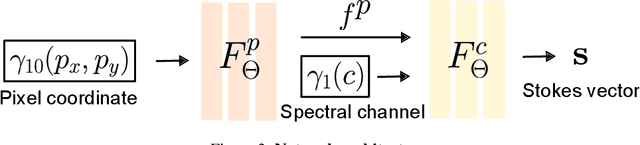
Image datasets are essential not only in validating existing methods in computer vision but also in developing new methods. Most existing image datasets focus on trichromatic intensity images to mimic human vision. However, polarization and spectrum, the wave properties of light that animals in harsh environments and with limited brain capacity often rely on, remain underrepresented in existing datasets. Although spectro-polarimetric datasets exist, these datasets have insufficient object diversity, limited illumination conditions, linear-only polarization data, and inadequate image count. Here, we introduce two spectro-polarimetric datasets: trichromatic Stokes images and hyperspectral Stokes images. These novel datasets encompass both linear and circular polarization; they introduce multiple spectral channels; and they feature a broad selection of real-world scenes. With our dataset in hand, we analyze the spectro-polarimetric image statistics, develop efficient representations of such high-dimensional data, and evaluate spectral dependency of shape-from-polarization methods. As such, the proposed dataset promises a foundation for data-driven spectro-polarimetric imaging and vision research. Dataset and code will be publicly available.
Neural Spectro-polarimetric Fields
Jun 21, 2023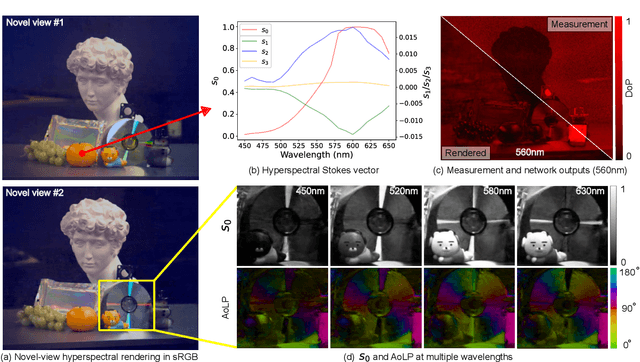
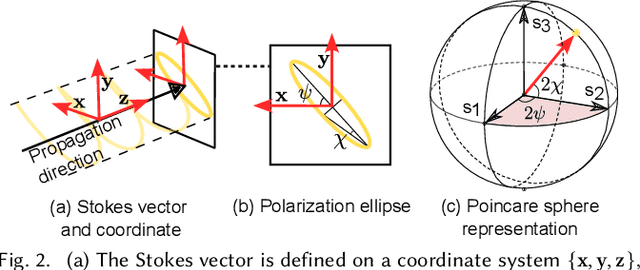
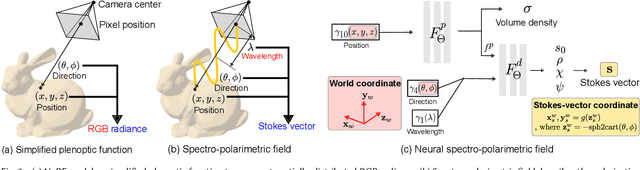
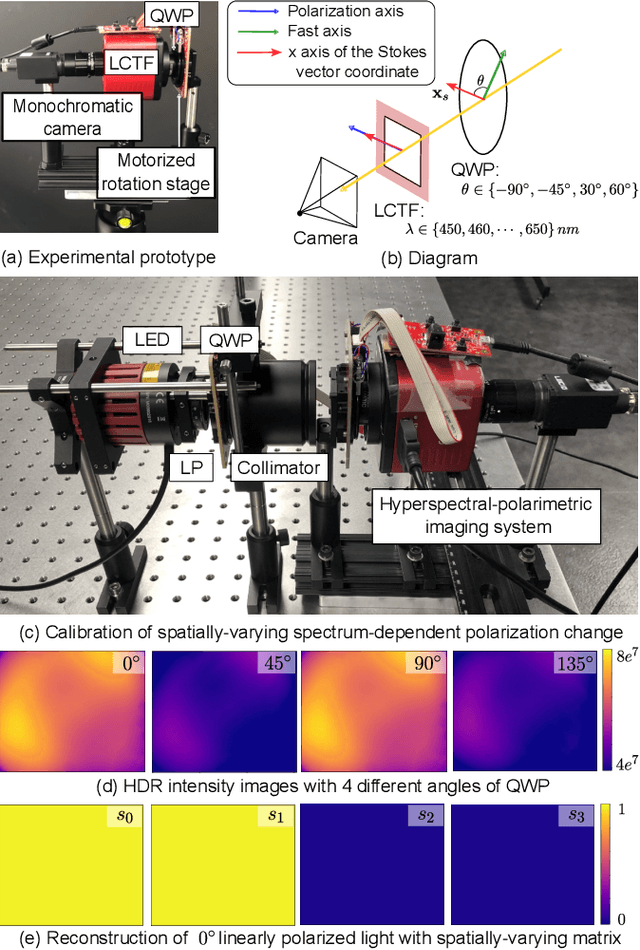
Modeling the spatial radiance distribution of light rays in a scene has been extensively explored for applications, including view synthesis. Spectrum and polarization, the wave properties of light, are often neglected due to their integration into three RGB spectral bands and their non-perceptibility to human vision. Despite this, these properties encompass substantial material and geometric information about a scene. In this work, we propose to model spectro-polarimetric fields, the spatial Stokes-vector distribution of any light ray at an arbitrary wavelength. We present Neural Spectro-polarimetric Fields (NeSpoF), a neural representation that models the physically-valid Stokes vector at given continuous variables of position, direction, and wavelength. NeSpoF manages inherently noisy raw measurements, showcases memory efficiency, and preserves physically vital signals, factors that are crucial for representing the high-dimensional signal of a spectro-polarimetric field. To validate NeSpoF, we introduce the first multi-view hyperspectral-polarimetric image dataset, comprised of both synthetic and real-world scenes. These were captured using our compact hyperspectral-polarimetric imaging system, which has been calibrated for robustness against system imperfections. We demonstrate the capabilities of NeSpoF on diverse scenes.