 Add to Chrome
 Add to Firefox
 Add to Edge
ThorArena: Benchmarking Humanoid Physical Interaction with Human Motion-Force Demonstrations
Jul 07, 2026
Humanoid robots are increasingly expected to perform contact-rich tasks that require not only accurate whole-body motion but also robust physical interaction with surrounding objects and humans. Although recent advances in humanoid motion imitation and whole-body control have achieved remarkable tracking performance, existing datasets and benchmarks primarily focus on kinematic motion while largely overlooking synchronized interaction forces. As a result, current evaluations fail to capture how external interaction forces affect tracking accuracy, stability, and control robustness. In this paper, we present ThorArena, a benchmark for evaluating force-aware humanoid interaction based on human demonstrations with synchronized motion and force measurements. We collect a real-world interaction dataset that simultaneously captures whole-body human motion and forces exerted by both hands across six representative physical interaction tasks. Based on these demonstrations, we propose force-aware evaluation metrics that jointly assess whole-body tracking accuracy, robustness under different force levels, control effort, and episode survival through the Force-Aware Tracking Score (FATS) and complementary diagnostic metrics. We further establish a unified benchmark protocol that replays recorded interaction forces in simulation and provides a standardized evaluation interface for different humanoid control policies. Experiments on representative whole-body control policies demonstrate that force-aware evaluation reveals substantial performance differences that remain largely hidden under conventional no-force evaluation. ThorArena provides a practical and reproducible framework for studying force-aware humanoid interaction and offers a new benchmark for evaluating contact-rich humanoid behaviors.

HumanoidUMI: Bridging Robot-Free Demonstrations and Humanoid Whole-Body Manipulation
Jun 25, 2026High-quality demonstration data are essential for humanoid robot skill learning, especially for whole-body behaviors that require coordinated perception, locomotion, and manipulation. Existing data-collection methods largely rely on robot teleoperation, which is constrained by hardware accessibility, operator expertise, and limited efficiency. Inspired by the Universal Manipulation Interface (UMI), we propose HumanoidUMI, a portable and robot-free framework for humanoid whole-body data collection. HumanoidUMI uses lightweight VR devices and UMI-inspired grippers to collect sparse human keypoint trajectories, wrist-view observations, and gripper actions. These demonstrations train a high-level policy to predict future keypoints, which are retargeted to robot-native whole-body references and executed by a whole-body controller. Experiments in five real-world scenarios demonstrate the effectiveness of the proposed framework and validate the collected demonstrations for transferable humanoid whole-body skill learning.
BifrostUMI: Bridging Robot-Free Demonstrations and Humanoid Whole-Body Manipulation
May 05, 2026High-quality data collection is a fundamental cornerstone for training humanoid whole-body visuomotor policies. Current data acquisition paradigms predominantly rely on robot teleoperation, which is often hindered by limited hardware accessibility and low operational efficiency. Inspired by the Universal Manipulation Interface (UMI), we propose BifrostUMI, a portable, efficient, and robot-free data collection framework tailored for humanoid robots. BifrostUMI leverages lightweight VR devices to capture human demonstrations as sparse keypoint trajectories while simultaneously recording wrist-mounted visual data. These multimodal data are subsequently utilized to train a high-level policy network that predicts future keypoint trajectories conditioned on the captured visual features. Through a robust keypoint retargeting pipeline, keypoint trajectories are precisely mapped onto the robot's morphology and executed via a whole-body controller. This approach enables the seamless transfer of diverse and agile behaviors from natural human demonstrations to humanoid embodiments. We demonstrate the efficacy and versatility of the proposed framework across two distinct experimental scenarios.
OmniUMI: Towards Physically Grounded Robot Learning via Human-Aligned Multimodal Interaction
Apr 12, 2026UMI-style interfaces enable scalable robot learning, but existing systems remain largely visuomotor, relying primarily on RGB observations and trajectory while providing only limited access to physical interaction signals. This becomes a fundamental limitation in contact-rich manipulation, where success depends on contact dynamics such as tactile interaction, internal grasping force, and external interaction wrench that are difficult to infer from vision alone. We present OmniUMI, a unified framework for physically grounded robot learning via human-aligned multimodal interaction. OmniUMI synchronously captures RGB, depth, trajectory, tactile sensing, internal grasping force, and external interaction wrench within a compact handheld system, while maintaining collection--deployment consistency through a shared embodiment design. To support human-aligned demonstration, OmniUMI provides dual-force feedback through bilateral gripper feedback and natural perception of external interaction wrench in the handheld embodiment. Built on this interface, we extend diffusion policy with visual, tactile, and force-related observations, and deploy the learned policy through impedance-based execution for unified regulation of motion and contact behavior. Experiments demonstrate reliable sensing and strong downstream performance on force-sensitive pick-and-place, interactive surface erasing, and tactile-informed selective release. Overall, OmniUMI combines physically grounded multimodal data acquisition with human-aligned interaction, providing a scalable foundation for learning contact-rich manipulation.
Thor: Towards Human-Level Whole-Body Reactions for Intense Contact-Rich Environments
Oct 30, 2025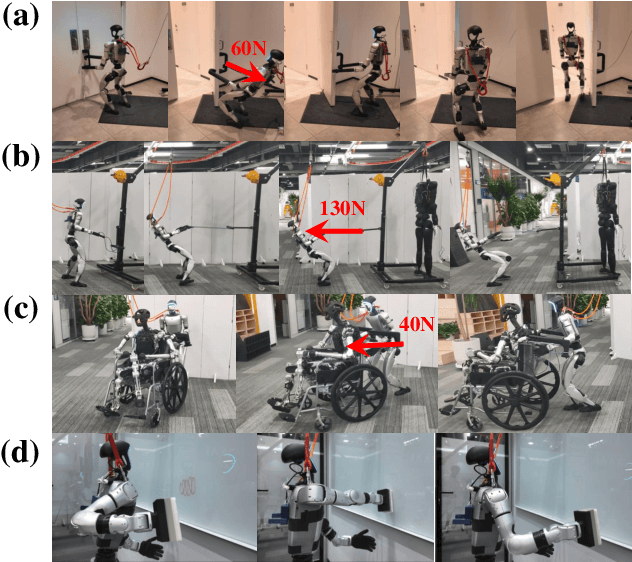
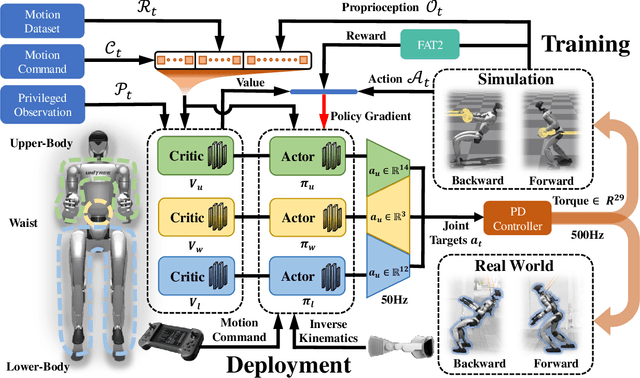
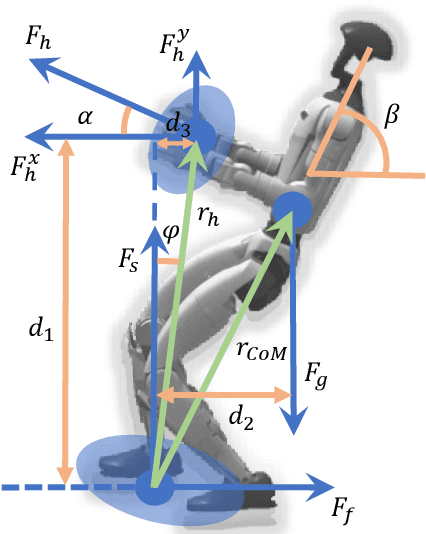
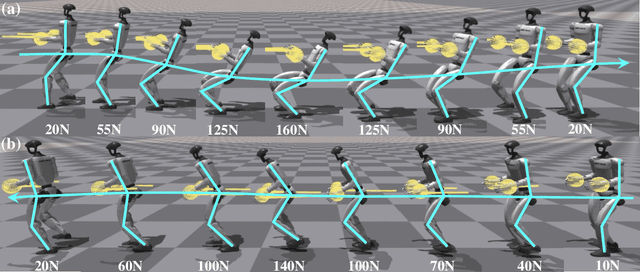
Humanoids hold great potential for service, industrial, and rescue applications, in which robots must sustain whole-body stability while performing intense, contact-rich interactions with the environment. However, enabling humanoids to generate human-like, adaptive responses under such conditions remains a major challenge. To address this, we propose Thor, a humanoid framework for human-level whole-body reactions in contact-rich environments. Based on the robot's force analysis, we design a force-adaptive torso-tilt (FAT2) reward function to encourage humanoids to exhibit human-like responses during force-interaction tasks. To mitigate the high-dimensional challenges of humanoid control, Thor introduces a reinforcement learning architecture that decouples the upper body, waist, and lower body. Each component shares global observations of the whole body and jointly updates its parameters. Finally, we deploy Thor on the Unitree G1, and it substantially outperforms baselines in force-interaction tasks. Specifically, the robot achieves a peak pulling force of 167.7 N (approximately 48% of the G1's body weight) when moving backward and 145.5 N when moving forward, representing improvements of 68.9% and 74.7%, respectively, compared with the best-performing baseline. Moreover, Thor is capable of pulling a loaded rack (130 N) and opening a fire door with one hand (60 N). These results highlight Thor's effectiveness in enhancing humanoid force-interaction capabilities.