 Add to Chrome
 Add to Firefox
 Add to Edge
ThorArena: Benchmarking Humanoid Physical Interaction with Human Motion-Force Demonstrations
Jul 07, 2026
Humanoid robots are increasingly expected to perform contact-rich tasks that require not only accurate whole-body motion but also robust physical interaction with surrounding objects and humans. Although recent advances in humanoid motion imitation and whole-body control have achieved remarkable tracking performance, existing datasets and benchmarks primarily focus on kinematic motion while largely overlooking synchronized interaction forces. As a result, current evaluations fail to capture how external interaction forces affect tracking accuracy, stability, and control robustness. In this paper, we present ThorArena, a benchmark for evaluating force-aware humanoid interaction based on human demonstrations with synchronized motion and force measurements. We collect a real-world interaction dataset that simultaneously captures whole-body human motion and forces exerted by both hands across six representative physical interaction tasks. Based on these demonstrations, we propose force-aware evaluation metrics that jointly assess whole-body tracking accuracy, robustness under different force levels, control effort, and episode survival through the Force-Aware Tracking Score (FATS) and complementary diagnostic metrics. We further establish a unified benchmark protocol that replays recorded interaction forces in simulation and provides a standardized evaluation interface for different humanoid control policies. Experiments on representative whole-body control policies demonstrate that force-aware evaluation reveals substantial performance differences that remain largely hidden under conventional no-force evaluation. ThorArena provides a practical and reproducible framework for studying force-aware humanoid interaction and offers a new benchmark for evaluating contact-rich humanoid behaviors.

Thor: Towards Human-Level Whole-Body Reactions for Intense Contact-Rich Environments
Oct 30, 2025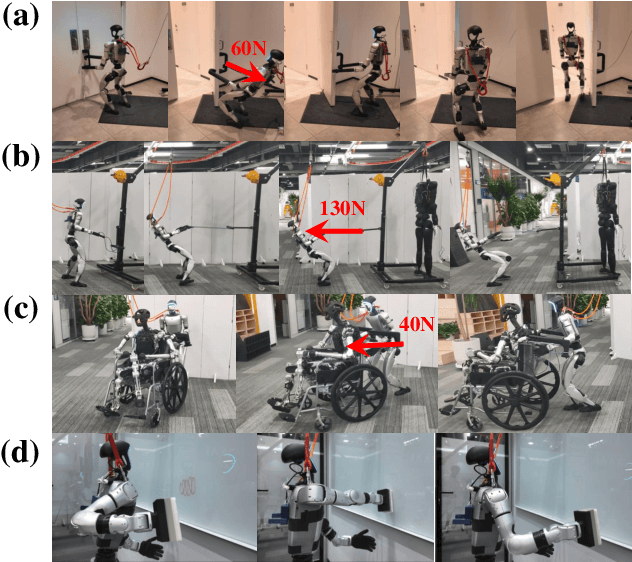
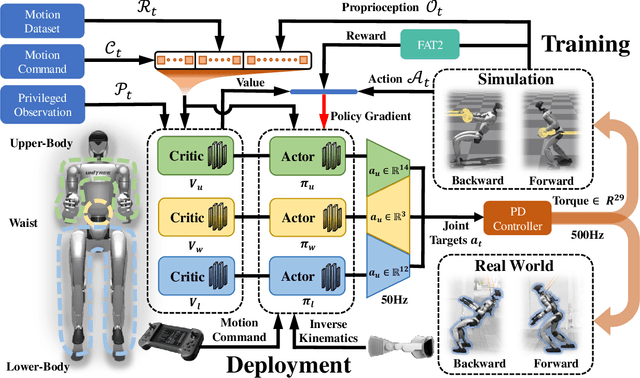
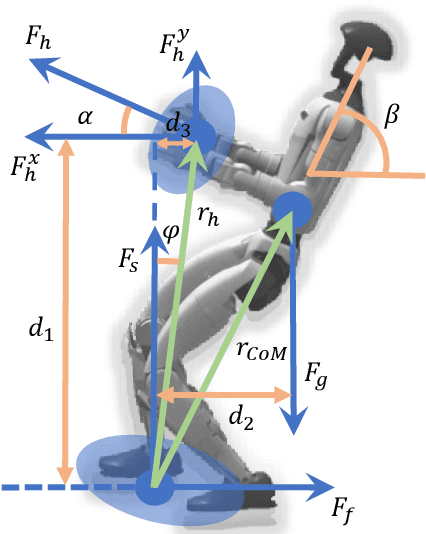
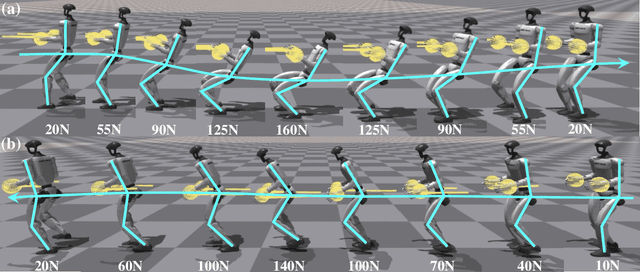
Humanoids hold great potential for service, industrial, and rescue applications, in which robots must sustain whole-body stability while performing intense, contact-rich interactions with the environment. However, enabling humanoids to generate human-like, adaptive responses under such conditions remains a major challenge. To address this, we propose Thor, a humanoid framework for human-level whole-body reactions in contact-rich environments. Based on the robot's force analysis, we design a force-adaptive torso-tilt (FAT2) reward function to encourage humanoids to exhibit human-like responses during force-interaction tasks. To mitigate the high-dimensional challenges of humanoid control, Thor introduces a reinforcement learning architecture that decouples the upper body, waist, and lower body. Each component shares global observations of the whole body and jointly updates its parameters. Finally, we deploy Thor on the Unitree G1, and it substantially outperforms baselines in force-interaction tasks. Specifically, the robot achieves a peak pulling force of 167.7 N (approximately 48% of the G1's body weight) when moving backward and 145.5 N when moving forward, representing improvements of 68.9% and 74.7%, respectively, compared with the best-performing baseline. Moreover, Thor is capable of pulling a loaded rack (130 N) and opening a fire door with one hand (60 N). These results highlight Thor's effectiveness in enhancing humanoid force-interaction capabilities.